

Thanks to y’all, I’m in New York City for the annual “climate week” that overlaps with the UN General Assembly meeting. For many years, diplomats, entrepreneurs, advocates, and the occasional scientist have gathered for a series of seminars, panels, backroom talks, and —well, lotsa words. It’s of course somewhat anachronistic to be gathering in the country busily trying to warm the planet, but that’s happened before; what’s new this time is a sense that there’s now another existential crisis horning in on the doomsday action.
As Alastair Marsh reports,
Aniket Shah, the Jefferies executive who heads the bank’s strategy on sustainability and the energy transition, says he’s asking the global finance industry not to let AI overshadow talks about reducing planet-warming pollution. His comments, which feed into an already polarized debate, come just ahead of New York climate week, where more than 100,000 people are expected to gather over the coming days.
“Climate change is about 50 billion tons of greenhouse gases going to zero, and so we actually have to have a right framing of what is driving that,” said Shah. “Data center demand growth is actually not in the top five.”
Others are making the same point. Here’s Al Gore:
The energy use and emissions of AI data centers are dwarfed by numerous other activities, he notes. “Just to pick one example, the emissions from uncovered landfills around the world are a large multiple of the emissions from all of the AI data centers put together.”
In a report published last week, Gore’s Generation Investment Management noted that in most countries data centers are “not the most important” drivers of energy demand. The biggest contributor is a rise in air conditioning use, with electric cars and heat pumps — both important planks of the green energy transition — also identified as major guzzlers of electricity.
Fair enough, and Gore’s point is well taken: in the long run, air conditioning on an ever-heating planet is doubtless a harder task to power.
But I think no one need worry that there’s a grave danger of the AI fears supplanting climate worry. For one thing, data centers are driving one of the best discussions of air pollution in a long time, beginning of course with Elon Musk’s southern monstrosities, which have been sited next to poor neighborhoods and which are apparently filling their air with noxious chemicals. As Disha Raychaudhuri and Valerie Volcovici reported earlier this summer,
Elon Musk’s artificial intelligence company xAI has installed 59 natural gas turbines for its Colossus 2 data center project in Tennessee without securing federal clean air permits, according to communications between regulators and xAI representatives.
Potential emissions from the turbines are far beyond the threshold that would require a federal permit, and would be released near predominantly Black communities already estimated to be suffering disproportionately high rates of lung disease, according to a Reuters analysis based on government data and information in the correspondence with regulators.
The findings, which have not been previously reported, reflect how exploding electricity demand from AI data centers is driving companies to build off-grid power plants at a pace outstripping environmental oversight, with potentially big risks to public health.
It’s a very good thing for climate campaigners whenever we’re talking air pollution because…solar panels don’t make any.
And each passing day brings new accounts of just how much energy these centers are threatening to use. Against the global backdrop it may not be enormous, but look at, say, Oregon. According to a new story from the state’s public broadcaster, data centers are using a quarter of the state’s electricity. Forget lights and electric toothbrushes and watching the Ducks beat Portland State 84-0 and water heaters—a quarter of the power spent running the hallucination machine.
A new report released Thursday from ECOnorthwest and the University of Virginia, funded by the Portland-based nonprofit Lemelson Foundation, quantifies basic yet hard-to-find data. That includes how many data centers the state currently has (111), what’s in the pipeline (32), their employment impact (2,630 direct workers), and their energy use (about 23% of retail electricity sales statewide in 2025).
“Oregon already has a substantial data center market, with 111 operational facilities representing approximately 22.1 million square feet of gross building space,” report authors wrote in key findings exclusively shared with OPB ahead of the release. “An additional 32 facilities are identified as planned or under construction, representing approximately 6.9 million square feet of potential future development.”
And don’t forget last month’s study showing that the use of AI to help oil companies find more crude would produce even more emissions than the data centers. As Arcelia Martin reported at the time
The “enabled emissions” that come when oil and gas drillers use artificial intelligence to find and exploit new energy reserves are far more damaging to the climate than the emissions that come from the data centers that power AI platforms, a new study by two former Microsoft employees concludes.
As Emily Atkin pointed out at the time
Specifically, they found that Big Oil’s use of AI to produce more oil and gas could create 3.3 to 13.3 times more climate pollution than powering AI’s data centers.
On the low end, these tools could enable additional yearly carbon emissions equal to Mexico’s, according to the research. On the high end, they could enable yearly climate pollution equal to Russia’s—the world’s fourth-largest emitting country.
(There will, by the way, be a small demonstration outside Amazon headquarters tomorrow morning at 11:20, corner of 39th and Fifth—see you there!)
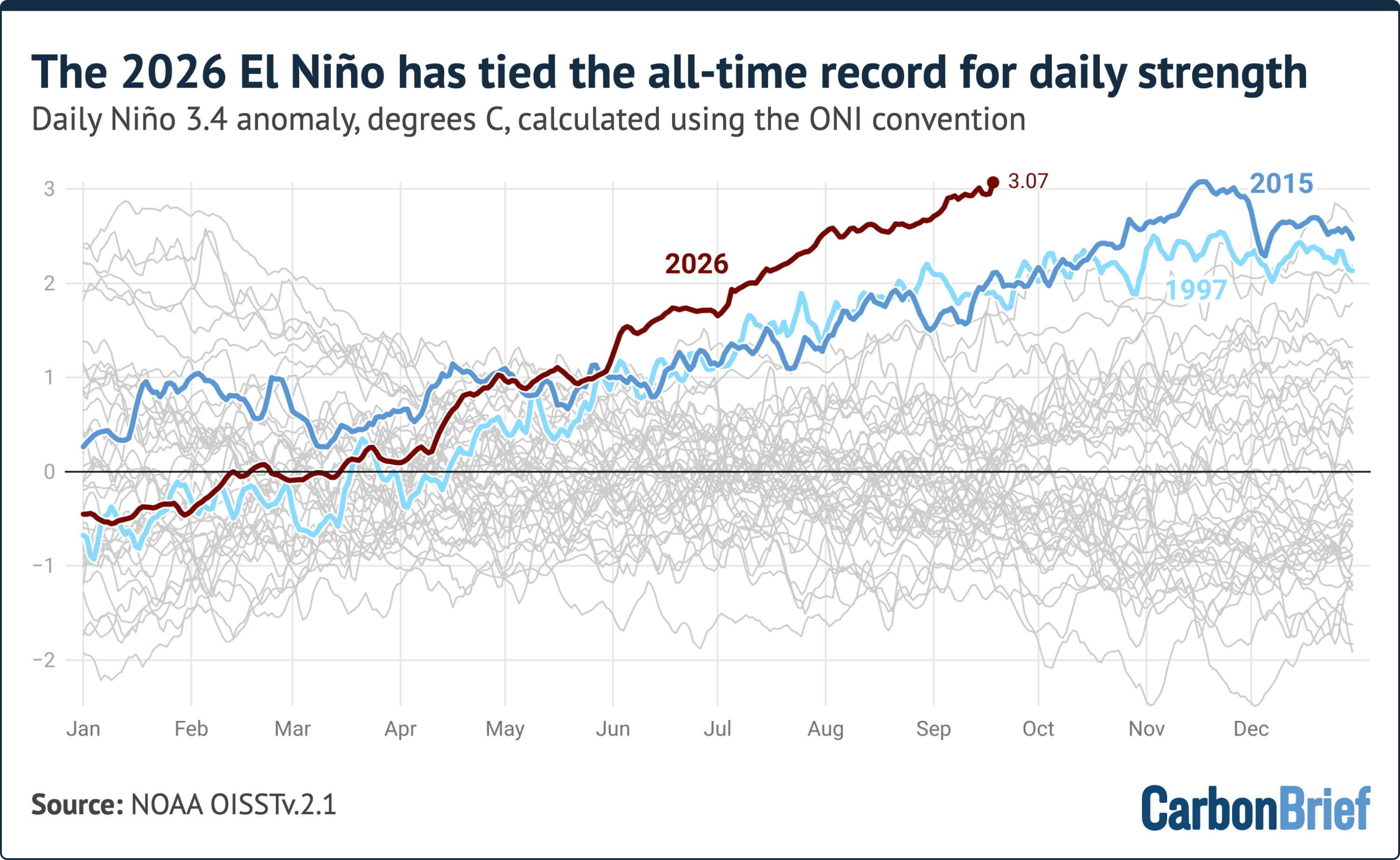
But the real reason I wouldn’t worry about the climate crisis disappearing from our consciousness is, Mother Nature gets to weigh in. And she seems to be saying: Sam Altman may be a scary dude, but don’t sleep on me. The chart at the top of today’s edition comes from Zeke Hausfather’s Carbon Brief blog, and what it depicts is that the El Niño still growing in the Pacific is now reaching absolute record size.
Sea surface temperatures in the tropical Pacific now equal the previous daily record set in 2015 and will likely keep rising in the days ahead.
In fact, some other scientists using a slightly different data set, say we actually broke the record over the weekend. In any event, the temperature is all but certain to keep going up; we’re still a couple of months out from the usual peak. Hausfather again:
Taken together, the models project a peak monthly anomaly later this year of around 4.1C, with 80% of the 674 individual model runs falling between 3.4C and 4.6C.
Every single model run peaks above the 2015-16 record. The projected margin over that record, some 1.3C, is larger than the entire gap between the strongest and fifth-strongest El Niño of the past 150 years.
Meanwhile, a new study from a few days ago seems to show much stronger feedback loops from things like permafrost thaw and wildfire smoke. As the home journal of one of the authors explained
Warming-induced emissions—greenhouse gas emissions from natural sources driven by rising temperatures—could amplify global warming by approximately 20–30% and add an estimated 0.2–0.4°C of warming this century on top of anthropogenic warming under different scenarios. These major additional drivers of warming are largely unaccounted for in current climate projections and policies.
If all this sounds bad to you, well, it is. The only comfort I can take from it is the fact that we are going to get a stiff slap in the coming months, and I think it combines well with the slap we’re getting from the existential fears about out-of-control AI. (Read Ezra Klein’s very powerful op-ed from the weekend, which is especially important since he’s been cautiously bullish about this technology in the past).
It is very very hard to get human beings to truly consider bad news—but once we start it might become a bit of a habit. If we can contemplate human extinction from AI, we can contemplate mass extinction from the climate crisis.
And maybe we can even decide to do something about them. In my now too-long experience, our species doesn’t seem to react much sooner than it absolutely has to. But we seem to be within spitting distance of that point.
Anyway, I think I’ve given 11 talks/interviews/seminars today (lotsa words, like I said). I’m beat. But I’ll be back on Wednesday or Thursday with some more words yet about building the movement to make this happen.
In other climate and energy news
+I’m starting to hear more stories like this one from Julia Tilton. A conservative Idaho county that had banned renewable development is having second thoughts:
Bannock County, nestled in a valley a few hours north of Salt Lake City and 100 miles west of Wyoming’s Teton Range, is a prime location for new power plants. It’s home to the Populus substation, a critical juncture for getting electrons onto the grid and into Idaho, Utah, Wyoming, and the Pacific Northwest. Building new power plants near a substation is cheaper, and those savings can help bring down costs for utility customers.
But the biggest opportunity for county residents, as Hough sees it, is not utility-bill savings: It’s economic development. In recent years, Bannock County’s population has grown far more slowly than Idaho’s. The county’s rural communities, meanwhile, are watching essential services disappear, and drought worsened by climate change is making it difficult for family farms to stay afloat.
Hough believes renewables would bring money into the community. Bannock County’s neighbors offer local proof: In 2024, projects in nearby Power and Bingham counties generated $909,000 and $639,000 in tax revenue, respectively. Hough wants to send a message — to the renewables industry and others — that Bannock County is “open for business,” too.
“Rural America is in a transition state,” Hough said from his office in Pocatello, the county seat, in July. “How do we make or help rural America … transition to this new way of life, so that they can thrive and prosper?”
+From Wen Stephenson, an account of how Nepal is trying to reckon with its flooding disaster. This is an important piece, I fear, because (among other things) it shows residents honestly facing the facts: they totally deserve serious aid from the rich world for a crisis they didn’t cause, and they’re not going to get much if any of those just desserts. He quotes the veteran climate reporter Sonia Awale:
“That process is very slow,” Awale replied. “We simply don’t have time to wait for that money. And, honestly, it is not money enough. Even if it does come through, are the people who actually need it going to get that money?”
In other words, Awale was telling me, Nepal must assume that, as a country on the front lines of climate catastrophe, it is on its own. “Each country will need to prepare in their own way,” she said. There are things that Nepal won’t be able to do without assistance—large infrastructure projects to protect highways, for example, or regional early-warning systems for catastrophic floods. But what can be done, especially at the local level, must be done, she added. “I’ve seen local communities do their own thing, something as simple as rainwater harvesting or planting sugarcane—which is a cash crop—on the banks of the river as a natural buffer [against floods]. Those local solutions become so important—and local government’s role becomes so important, working directly with people.”
+In the UK, the new Labour prime minister gave an excellent talk about community ownership of renewable energy.
With nearly £30m of funding for People’s Power projects, communities across every nation of the UK will soon have the chance to build and control their own clean energy supply.
This investment means villages, towns and cities can harness the natural resources around them with solar panels on libraries, publicly owned windfarms, hydro schemes in their rivers, or whatever else works for them. The purpose is to put money back in people’s pockets while giving them a direct role in tackling the climate crisis.
Every council and community group awarded funding will have at least part-ownership in its renewable energy projects. That means, in the years ahead, more and more communities in Britain will do more than simply host solar panels and wind turbines. They will own a stake in them and retain a share of the wealth they create.
However, a cynic might note that thirty million pounds is not really very much money divided amongst the 70 million people in the UK, and also that the British establishment seems to be coalescing around the very bad idea of approving new drilling in the North Sea. The head of the centrist Liberal Democrats Ed Davey gave his blessing:
“I personally have always felt made sense because we're going to need a lot of gas in the transition.”
As is often the case, the veteran thinker George Monbiot had the most persuasive (and scathing) take on this development. I worry about this less because of the relatively small amounts of hydrocarbons still left beneath British waves than because it sends the wrong signal to… Democratic politicos in the U.S. who will have to make far more consequential decisions should they ever regain power. One hopes the pusillanimity of the Labour government will prove a political as well as a scientific mistake, and perhaps point to a different course. Meanwhile, a new study indicates that in the UK rooftop solar on commercial buildings could generate twenty times as much power as the hyper-expensive new nuclear reactor under construction. Oh, and Megan Specia and Adrew Testa have a grim account of what life was like in a UK hospital during the summer’s endless heat:
By late morning one day last month, the air inside Queen’s Medical Center in Nottingham, England, was thick and uncomfortable. Sweat glistened on the faces of staff members hurrying around the sprawling hospital. Patients tossed in their beds.
“It’s just getting to be way too hot; I am saying my prayers waiting for it to stop,” said Celia Burgess, 78, who was in a geriatric unit with two portable fans blowing in her direction. “I mean, they are trying, but it’s not much good. It’s these old hospitals.”
+From the highly reliable Michael Grunwald, some good reporting on what he calls “the latest corporate climate ruse”:
Proposed revisions to the leading global standard for measuring and managing planet-warming emissions would make cutting down trees look good for the climate, as strange as it sounds. The changes to the widely used Greenhouse Gas Protocol would create a warped reality in which companies could claim credit for cutting emissions when they harvest trees for paper, burn trees for energy or convert trees into other wood products. And the more wood they use, the more emissions they could claim to reduce.
There’s a simple explanation for these perverse results: The process to rewrite the rules has been dominated by wood products companies that would benefit, including the forestry giant Weyerhaeuser, the furniture giant IKEA and other foreign and domestic conglomerates. One of the few independent experts overseeing the process resigned in June to protest the excessive industry influence. Then last month the top land-use expert at the World Resources Institute, the environmental think tank whose management of the protocol has helped give it worldwide credibility, quit his job after his repeated warnings about greenwashing were ignored…
The industry-favored approach would also credit companies with emissions reductions for any ongoing tree growth on their land — and since all the excess carbon in our atmosphere is making trees grow faster, those companies would receive an ironic climate bonus for the effects of climate change.
In practice, this would produce wacky outcomes. Tree-cutting companies could cancel out their emissions under the protocol by simply buying or even leasing additional woodlands. Food companies could market hamburgers as “carbon-negative” if the ranchers had forests nearby, even though beef is by far the leading driver of deforestation. Burning wood for electricity would also pencil out as carbon-negative under the proposal, even though hundreds of scientists have warned that burning wood is even worse for the climate than burning coal.
+What’s this! The remarkable reporting duo of Emily Sanders and Rebecca Leber are combining to produce a new web journal, Point Source News, devoted to “tracing fossil fuel disinformation.” And they’re training some of their investigative fire on an important upcoming event
One event we’re looking ahead to is the October 5 Supreme Court arguments in Suncor Energy Inc. v. County Commissioners of Boulder County. Oil companies ExxonMobil and Suncor will argue that the justices should stop a lawsuit brought by the city and county of Boulder, Colorado, which would make the companies help pay for local climate costs because of their decades-long deceptive practices about the dangers of burning fossil fuels, from moving toward trial. The outcome could have major implications for dozens of similar lawsuits around the country.
One of the first stories we’re publishing this week gives a lay of the land of how industry maneuvering is trying to change the landscape of legal accountability for the fossil fuel industry. You can also catch us in person and over Zoom the next few weeks. Emily is moderating a press briefing with Covering Climate Now on covering the Boulder case on September 23. Rebecca will be joining Rebecca John and Fieldnotes’ Julie Kane for a briefing on natural gas deception on September 16. Both of us will be in-person at New York’s Climate Week, and we are looking for events that should be on our radars. You can take a look at our new website here.
+The Trump administration’s trademark, of course, is doing so much bad stuff that most of it gets lost. But one should at least note that they’ve decided to completely upend the Endangered Species Act, which is the closest America has ever come to officially recognizing that we share the planet with some other creatures and maybe it would be nice not to wipe them out. That wokeness is ending soon, as Catrin Einhorn reports:
Under a new interpretation of the law’s language outlined in the memo, the accidental killing or injury of an animal would no longer be considered illegal; only actions specifically intending to target an animal would.
The change would be transformative because, in the United States, the killing of endangered animals almost always happens incidentally, in the course of economic activity. Until now, industries and individuals could be held accountable for those foreseeable deaths and, as a result, they have been incentivized to avoid them.
“This is really an assault on the act like we’ve never seen before,” said Andrew Mergen, a law professor at Harvard University who previously worked for the Justice Department, where he spent two decades supervising Endangered Species Act litigation in the courts of appeals.
“What the administration is proposing to do is take all of the force out of what we have all understood the act to mean: Don’t kill endangered species,” Professor Mergen said. “What they seem to be saying in this document is, it doesn’t matter if you killed an endangered species if you didn’t mean to.”
Professor Mergen said that the move amounted to an extraordinary shift in law more broadly, because it has long been recognized that people can be held accountable for actions they did not intend if they should have known better, for example, when it comes to killing people.
+From former White House staffer Heather Clark and Hannah Safford, a new whitepaper on how building more housing could help more than the housing shortage:
America’s affordability problem, for instance, is bigger than home prices and rents. How we build affects household costs like insurance and utilities. In Alabama, fortified roofs and stronger building codes are helping bolster the insurance market for new and existing homes alike, while making homes far safer. In Vermont – a state where manufactured homes typically burn expensive fuel oil or propane for heating, new superefficient manufactured homes can cut annual energy bills by about $2,700 per year compared to existing stock. Across the country, building more efficiently can provide relief for the 80 million people struggling to pay their energy bills, while protecting people from the escalating threat of extreme heat.
Where we build influences affordability as well. Pew finds that homes built in established neighborhoods rather than on greenfields save taxpayers an average of $21,000 per home in roads, water, sewer, and utility infrastructure and up to 50% in ongoing maintenance. More new homes near jobs and services also save an average of $700 per person per year in fuel and vehicle costs through shorter commutes and fewer miles driven.
Much undeveloped land is also in areas, such as floodplains or the wildland-urban interface, that are becoming increasingly risky. Disasters – hurricanes, floods, fires – destroy the equivalent of one month’s worth of new home construction in the United States every year. What’s the point of building new homes if those homes are just going to get flattened? Even homes left standing are facing rising insurance costs that simply don’t pencil for most people.
It’s not enough to just build. We must build for benefits. While the systems are complex, the agenda is simple: We need more of the right homes in the right locations, at the lowest costs.
+Jeff St. John offers a comprehensive and even-handed report on Gavin Newsom’s climate credentials as the California governor eyes a presidential bid.
Under Newsom’s leadership, California has built gigawatts of new clean energy to keep up with its mandate to achieve 100% renewable and carbon-free power by 2045. The state has added millions of electric vehicles to its roads, and committed to end the sale of gasoline-fueled cars by 2035. And it has instituted policies aimed at protecting the environment and communities from industrial and fossil fuel pollution.
But Newsom has also taken heat for backsliding on his environmental justice promises, particularly during his second term. Many critics blame this shift on his unwillingness to take on major oil, gas, and utility interests, even as household energy costs — and corporate profits — have soared.
“I’m a hard grader — I’d give him a B,” said Dan Kammen, a noted climate scientist and longtime professor at the University of California, Berkeley
Dan Gearino offers the best part of the California story—a fascinating account of how swiftly the state is kicking the natural gas habit. Spoiler: it centers on batteries
And from Texas, Liam Denning provides a chronicle of the Lone Star State’s fast move towards solar
Curiously, new peaks in power demand aren’t translating into peak power prices. When demand last peaked, in August 2023, that month’s day-ahead peak prices for the Texas grid operator’s south zone averaged about $360 per megawatt-hour. This July, which recorded the latest peak, saw an average price of less than $30. The reason, according to CreditSights utilities analyst Andy DeVries, the surge in solar power twinned with a surge in batteries…
Solar power, like all renewables, has effectively zero marginal cost: Once it’s built, it runs when the sun shines. The more solar power that is running, the further right the supply curve shifts, curbing demand for traditional power plants and suppressing prices. Whereas this previously teed up a sudden surge in prices at sunset as panels went dark, the arrival of batteries at scale, allowing surplus solar power generated in the afternoon to be deployed later, has extended price suppression into the evening. Texas added more battery capacity in the 12 months through July than any other state, accounting for roughly a third of total US additions, according to data compiled by the Energy Information Administration.
+Do not miss Emily Atkin’s account of visiting real estate open houses in the Miami area to see what they’re telling prospective homebuyers about rising sea levels
The most surreal example came at a bayfront high-rise in Sunset Harbour, the same flood-prone neighborhood where Miller’s first agent had assured her the flooding was “fixed.” By this point, I had started telling realtors I was shopping for my parents instead of myself. So when the agent told me the condo’s windows had no hurricane protection—no shutters, no impact glass—I imagined putting my parents in it. Expressing concern did not require much acting.
“What would they do if there were a storm?” I asked.
“It hasn’t been an issue, and I don’t anticipate it to be an issue,” the realtor said. He noted the last time a high-category storm hit Miami was Hurricane Andrew in 1992, a few years before the building went up.
“But that doesn’t mean it couldn’t happen again, right?” I ask.
“I’m a glass half full kind of guy,” he replied. “Hasn’t happened yet, so you’ll be ok.”
“Yeah,” I said. “Totally.”
+From the redoubtable Aaron Regunberg, an offering for the High Holy Days. Reflecting on Abraham’s plan to sacrifice Isaac:
He had no right. No more than the fossil fuel industry executives who predicted civilizational collapse and, rather than warning the public, lied—and continue to lie—in order to stall climate action. No more than the MAGA politicians who insist it’s all a hoax, or the corporatist Democrats who acknowledge climate change while taking fossil fuel money and direction. No more than the millionaires and billionaires in their private jets, the advertising and law firm partners raking in cash to defend Big Oil, the corporate-backed think tanks and pundits promoting climate hushing and championing increased oil and gas production as a “pragmatic” approach. All of these hedonists are pursuing their own selfish rewards while offering up our children—my sons, outside in the cemetery, and yours, but also, in the case of all but perhaps the wealthiest oligarchs with the most exorbitant bunkers, their own children and grandchildren, too.
+Always read everything that the European think tank Ember puts out, including a big new report on the way that the “electric revolution” in both energy and information are coinciding. It is more sanguine about AI than some (including the corporate insiders insisting it may well exterminate us all) but they make an important point:
One shared tech stack makes two revolutions turn the same flywheel. Five components – chips, batteries, power electronics, motors and sensors – sit inside the machines of both revolutions, so each purchase of one makes the others cheaper. The smartphone made the battery cheap enough for the car; the car made it cheap enough for the grid. Since 1990, their combined cost has fallen by 99%.
+Seth Borenstein reports on new data showing that we’ve lost…12 trillion tons of ice from Greenland and the Antarctic in the last half-century. Which, as he points out, “is enough frozen water to stack ice 5 feet (1.5 meters) deep across the continental United States.”
+From Reflective, an NGO devoted to considering the possibilities for geoengineering, a proposed timeline for making some decisions about whether or not to pursue the effort to counteract co2 pollution by pouring, say, sulfur into the air.
The roadmap borrows the logic of clinical trials: learn everything you can at one scale before moving to a larger one. Phase 0 is foundational work such as modeling, laboratory studies, and impact analysis. Phases 1 and 2 are stratospheric research at scales too small to affect surface climate. Phase 3, if reached, is monitored cooling…
With research running in parallel and funded in the right order, an informed decision about whether to begin monitored cooling is reachable in 10–22 years for $370M–$1.36B. Funding and coordination will determine how much research runs in parallel and whether activities can be compressed, but will never bypass gates.
My reflection, as it were, on this topic is that the conversation will get easier if we also use the early part of that timeline (roughly the remaining years of this decade) to break the political power of the fossil fuel industry, so that we don’t need to imagine this as a moral hazard for extending carbon emissions indefinitely. It’s one reason this next stretch of years, through 2030, is so key.
+The invaluable Heatmap website has been doing some polling, and it shows the limitations of the “clean energy is cheap” argument. Jeva Lange explains:
More than two-thirds (78%) of voters who are “doubtful” or “dismissive” of climate change — a population segment described by the Yale Program on Climate Communications and that we have labeled as “skeptics” — told us they believe that advocates for wind and solar energy exaggerate how cheap the sources have become (a mere 17% disagreed).
Even for those in the middle who are “persuadable” on climate change (as opposed to the “persuadeds,” who describe themselves as “alarmed” about it), an affordability argument doesn’t land cleanly — 62% believed the claims are exaggerated compared to 24%. In fact, a majority of all voters — 55% — told us that wind and solar are only cost-competitive with oil and gas because of subsidies, even as 75% acknowledge that oil and gas companies get government help lowering costs, too.
+From Cathy Schen, a quite lovely memoir of her father, an oil man, with the implicit reminder that fossil fuel was an important source of jobs, and of a sense of mission, for much of the 20th century
My father had begun each workday walking the plant site. He wore a hard hat and safety goggles. He pulled on rubber overshoes and rolled up his suit’s pant legs. He oversaw construction, talked over engineering problems, inspected safety precautions, and reviewed blue ink designs. He performed cost analyses from a trailer, a Pall Mall cigarette smoldering in the ashtray. When Exxon offered him a job at its New York City headquarters, he turned it down. “There’s no way I am going to shuffle papers doing a desk job,” he told me.
But even in this story Exxon comes off pretty badly, disposing of staffers about as blithely as it has disposed of the climate
+Valerie Amor provides a fascinating exploration of whether architects like her are professionally obligated to electrify new buildings. Very much worth a listen!
+I could use some good news. More than two decades ago I went to Newfoundland to report a story for Outside—the world’s largest cod fishery had literally collapsed, the fish hoovered up by ever more efficient trawlers. Canada had to stop all fishing for the iconic species, and the province’s lovely “outports” or small fishing villages were depopulating. I spent a day out with a boat full of men catching snow crab—it simply wasn’t the same. “We count crab” instead of catching them, one said, meaning very little skill was required.
But in recent weeks Canadian authorities reported that cod stocks were “healthy” again, and began to cautiously raise the amount that could be fished. One trusts they will ward off the disastrous rush that nearly wiped out the fishery. To me it is a reminder that when humans step back, nature retains some ability to recover, at least for now.

Why has TX been able to achieve this level of solar power use & AZ is nowhere close? I put solar cells on my roof 4 years ago, saving me tons but not all on extremely high summer electricity bills, even though Salt River Project, a supposedly public electricity company, has made installing solar very difficult. Why are our public utilities not going all in on a resource we have more of than any other state??? Clue: Republican dominated legislature. Although TX also has that. 🙄
Thanks for another informative article! I realize that this article is about the carbon footprint of data centers relative to other sources.
But what sometimes seems lost in this discussion is that, beyond requiring a ton of energy, data centers also suck up enormous amounts of water in their so-called close-loop systems. Water and climate are married at the hip. And way out West, things are drying up.