


I got a slightly queasy feeling the other day when someone sent me a news article saying Sheldon Whitehouse had investments in companies that were connected to data centers, and insisted this was the reason he had introduced a permitting reform bill. This is NOT TRUE. He introduced permitting reform legislation last month because he wants to do something useful to slow down climate change, which he cares about a whole lot. He is the Senator from the Ocean State of Rhode Island, and his wife is a leading marine biologist, not to mention board member of an important environmental organization. Here’s what he told an interviewer not long ago
The oceans have really saved our sorry a**es as human beings. Ninety percent of the excess heat that the fossil fuel industry has caused with its pollution has actually been absorbed by the oceans. We'd be like sixty degrees Fahrenheit hotter, six zero degrees Fahrenheit hotter if all of that extra heat energy had stayed in the atmosphere instead of been absorbed into the ocean. The ocean has also absorbed about a third of the CO₂ in a chemical reaction, and unfortunately, that chemical reaction makes the ocean more acidic, which kills coral polyps, it kills pteropods. It does a lot of damage to the natural ocean ecosystem. And then, of course, when you warm the ocean that much, um, you raise sea levels, you raise storm risk, you get back to that home insurance crisis. The coastal property values crash that the mortgage giant Freddie Mac predicted from this. So the ocean is a really, really, really big part of that. If there's one word I'd want your, uh, listeners to look up, it's zettajoules, Z-E-T-T-A-J-O-U-L-E-S. If you Google that, you'll learn a lot about how much the ocean is doing for us. But at some point, we begin to wear out our welcome with the oceans, and it-its limits are found about being able to save us from ourselves.
He is, I am almost certain, the only member of the U.S. Senate who is up to date on pteropods.
He’s also scheduled, should the Democrats win the Senate, to take over as the very important chair of the chamber’s Judiciary Committee, where he’ll have (among other tasks) the job of protecting us from the justices Trump will keep trying to inflict on us. So it makes sense that before he leaves his post as ranking member on the Environment and Public Works Committee (soon to be in the able hands of either Oregon’s Jeff Merkley or Ed “Green New Deal” Markey) he’d want to take a crack at the task of crafting a grand bargain that would make it easier to build out the clean energy and electric transmission projects the country badly needs. He and his staff carried out that mission, and they too are Good People—Dan Dudis, the Democratic staff director for the EPW committee, has been doing important work for years. He used, for instance, to run the Chamber Watch project for Public Citizen, monitoring the nefarious work of the U.S. Chamber of Commerce which launders many of corporate America’s worst ideas through the gauzy lens of Main Street small business.
Anyway, working in perhaps necessary secrecy, Whitehouse and New Mexico Senator Martin Heinrich and their staff hammered out a complicated piece of legislation, which they all agreed would be the first order of business after the election, meaning the lame duck Congress will take it up on Nov. 9. Their GOP colleagues—Senators from Utah and West Virginia—had apparently shared the draft with their Big Oil lobbyist friends, because within (literally) five minutes of it being announced they were tweeting out their congratulations. It’s called the Bipartisan American Affordability and Jobs Act (BAAJA), presumably not because it emerged just as the actual Baja peninsula was under assault from an unprecedented series of cyclones. In essence, the legislation makes it easier to permit almost anything energy-related—clean, dirty.
Bad People like it—the Wall Street Journal almost immediately opined that “these reforms would help all industries, but fossil fuels stand to benefit most.” But plenty of Good People like it too, on the grounds that it’s the best bargain possible—in particular, its provisions to speed up the buildout of transmission lines seem sensible and useful. If I were going to single out one impassioned plea for its passage, it would be this from my friend Sam Matey-Coste, both because its written with his usual heart-on-the-sleeve brio, and because it comes from a younger person than most in this debate, which is important. He cites Ezra Klein and Derek Thompson’s essential book Abundance, which is about the need to end the sclerotic system of permitting and regulation that stifles so much Good Stuff in our country, from housing to transportation to energy, and holds out this bill as a paradigmatic example.
Since I basically agree with this argument, it’s going to take some explaining why I have grave reservations about this bill, grave enough that (spoiler alert bonus, since it will save you many paragraphs of reading if you just stop now in dismay) were I voting I wouldn’t support it. (On the very unwise premise that anyone made me a Senator). But those explanations begin with this:
When we’re talking about liberating the housing market, we’re talking about making it easier to build something that’s pretty much an unqualified good. Unless you’re a stingy landlord betting on a tight housing market, or a Banana who’s unwilling to look at another house, then more is better. There is no “anti-housing” that you have to worry about unleashing. Energy, obviously, is different. If what we’re worried about is reining in climate change, then we have to build huge amounts of clean energy and that has to quickly drive fossil energy down to zero. If we just build lots of both, or even just a little more of clean energy than dirty, than we haven’t gotten anywhere. Note—if you’re a clean energy developer, a guy who wants to develop solar farms, this is not a problem; you could be perfectly happy, at least monetarily, with a world where your thing gets easier and so does Exxon’s. But if you’re trying to prevent ecological cataclysm, then not so much.
To figure out if this bill meets that goal, we’re going to have to call on some more Good People. In this case, I’ll focus on Jeremy Symons, an independent policy analyst who has—well, a very nearly identical resume to the people backing the bill. That is to say, he used to be Deputy Democratic Staff Director for the U.S. Senate Committee on Environment and Public Works, the very committee that produced his bill. He’s no radical—he used to be vice-president of political affairs at the Environmental Defense Fund, the most business friendly of the green groups, which has long praised Senator Whitehouse. (A small world, this). Anyway, he’s now an independent policy analyst, which means he has numbers.
Numbers are not perfect—beware of modelers even as we have no choice but to look at what they produce. (As another Good Guy, Steve Kretzmann, recently pointed out, Rhodium Group, whose analysis of BAAJA will doubtless soon emerge, predicted that lifting the oil export ban in 2015 would increase American oil production somewhere between zero and 1.2 million barrels a day; instead it’s up by more than 50 percent). Anyway, here’s the graph that’s been making the rounds re permitting reform; it’s from the Lawrence Berkeley National Laboratory.
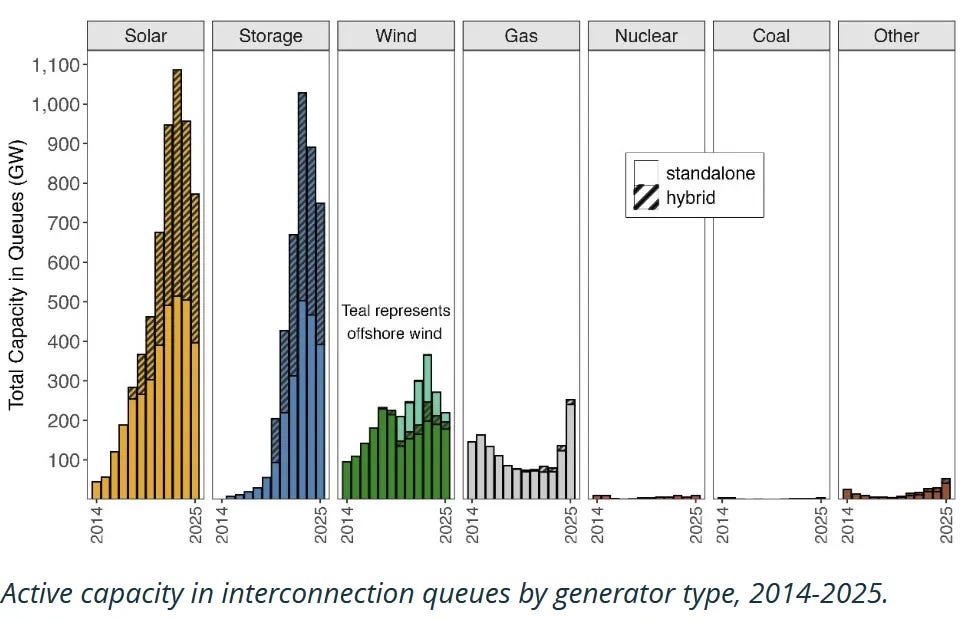
What it seems to show is that most of what’s waiting in the “queue” to connect is sun and wind—ergo, if only we could get permitting reform we’d see a huge explosion in clean energy. But those numbers are starting to change—among other things there’s been a big recent uptick in gas applications. So, Symons reran the numbers, focusing just on “projects that entered the queue in 2025 and are still listed as active in the data set to give a better sense on what developers are most eager to build.” Here’s what that graph looks like:
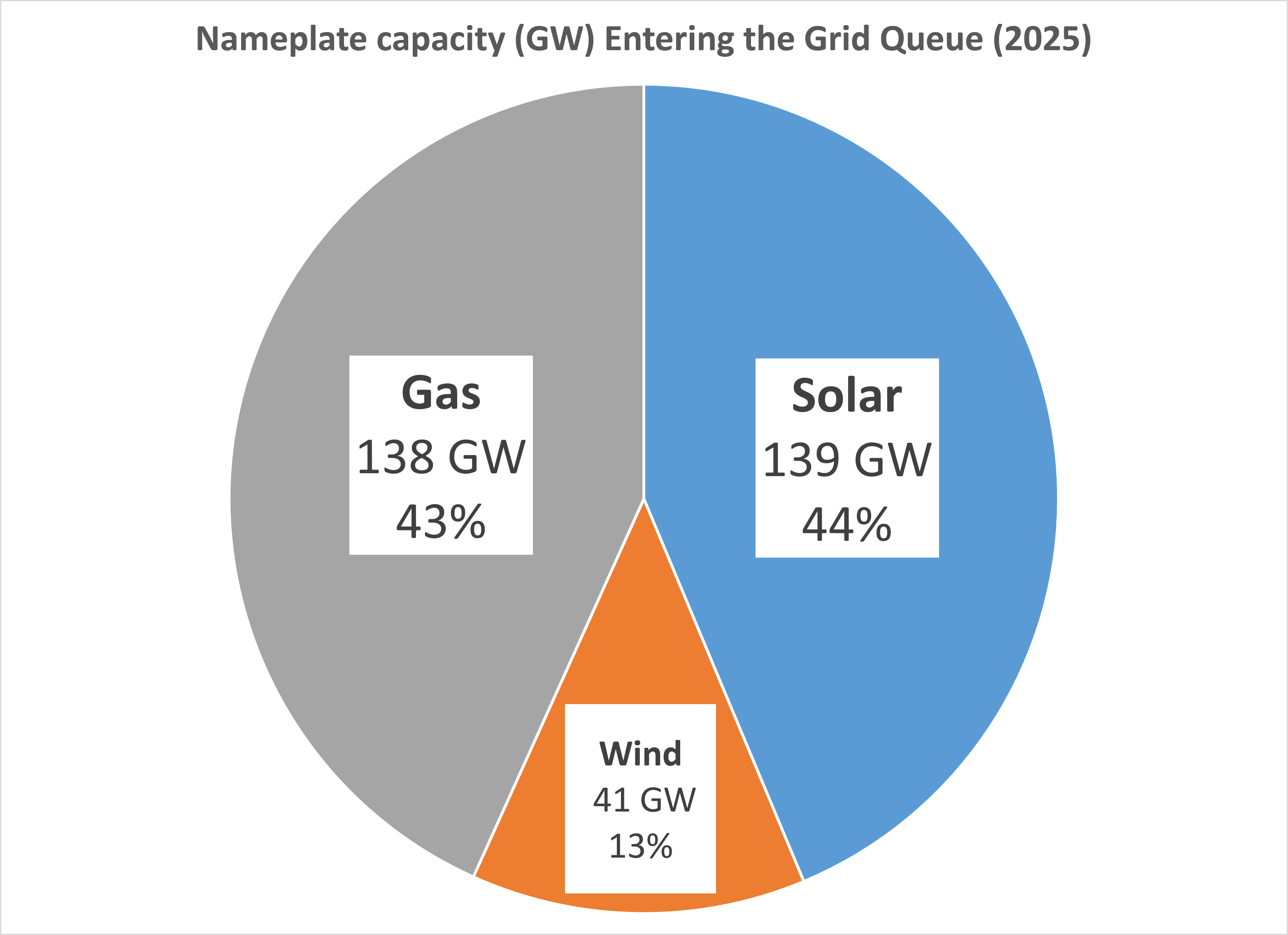
Remember, this is through 2025—not 2026, when the push for gas-fired datacenter development truly exploded. But even so it indicates a fairly even split between clean and dirty energy getting built, which is lovely for Big Oil and fine for solar developers, but not particularly useful for fighting climate change.
In return, one would give up many of the laws that have historically been the bulwark of environmental protection—the suite of regulations dating back to the 1970s that are sometimes maddening, and also the mainstay of communities trying to keep themselves from being sacrificed for the greater good/corporate wealth. (Just as a small example, consider the trees being cut in the picture at the top of this newsletter, which went down over the weekend to help the president build a bigger golf course in DC—lawyers are in an emergency court hearing today with a very angry judge, but of course the trees are already on the ground).
The way that proponents of this new law would argue it (and I’ve talked off the record over the last days with some of them, very near the drafting process) is that those laws should be sacrificed because slowing down fossil fuel on the “demand side” (i.e., stopping new projects) will never be anywhere near as effective as building clean energy on the “supply side.”
The contrasting argument—think of it as “two blades of a scissors” approach—is that we need both. Here’s an example which longtime readers of this newsletter will remember well, because you played a big role in it. In the last year of the Biden administration, a grassroots swell, led by local community groups along the Gulf Coast and by national organizations like Third Act, managed to win a pause on new LNG export terminals. That was a very big win, overturned of course on the first day of the Trump administration. Big as in: if the LNG guys build out their whole wish list of projects, they could be responsible for as much greenhouse gas emission as everything that happens on the European continent, every car and home and factory and powerplant between Athens and Helsinki.
Under BAAJA no one would ever be able to mount a challenge like that again. Indeed, under the series of lock-in provisions under the most problematic part of the bill, the last few years would set a kind of forever-quota for dirty energy. Under Section 1402, a fossil fuel developer would be able to make a court look back at the last five years of energy permitting (which will, by the time the law takes effect be dominated by Trump’s crusade against clean energy) and claim that their form of energy was being discriminated against by any agency denying it a permit. Here’s how former deputy assistant attorney general in charge of environmental cases Matt Littleton explained it (and I warned you this was going to get a little complicated):
The developer has to show a “pattern of disparate treatment,” meaning a substantial increase (as compared to the most recent 5 years) in the percentage of projects of this type that, in the judge’s estimation, were either delayed or “improperly denied.” Here’s where clean energy comes up short. Because the current Administration hasn’t moved those projects, an indefinite stall (including by a new President that continued it) would be no worse than the baseline. Lawsuits can’t be filed until late 2027, by which time the baseline will be dominated by Trump's practices.
Next, the judge decides whether the developer’s permit, were the agency to grant it, would be subject to cancellation for violating federal law. The question seems to be whether there is a hypothetical permit the agency could issue that would survive judicial review. That’s a low bar, given the deferential standard of review applied to agency factfinding and “public interest” determinations.
Section 1402 “entitles” a developer that wins its case to (1) “injunctive relief, as provided by applicable Federal law” (meaning an order that the agency decide on the application? issue the permit?); (2) attorneys fees and litigation costs; (3) “economic damages, including any costs associated with the applicable denial or delay, as the court determines appropriate” (what else is “included”?); and (4) “damages in an amount equal to not less than 50% and not more than 100% of the total reasonably expected cost of construction of the project.” The last of these four must be repaid if the project isn’t built; the developer keeps the rest of the money regardless.
A single claim under Section 1402 could top the total amount (~$40b) the government has paid out in all Judgment Fund claims over the last decade. This provision puts judges in real control over energy policy through the power of the purse.
Or as Symons, who was a big part of that fight to pause LNG projects, put it to me in an email, a company like Venture Global that is a huge developer of these terminals
"would have immediately sued under BAAJA. Even though DOE is required by law to consider the public interest, the courts would have ordered DOE to issue permits AND provide taxpayer awards for actual damages AND punitive damages of up to the full cost of the project ...billions of dollars. Venture Global would have to prove "a pattern of disparate treatment" that either wavered from the pattern of the previous 5 years or is a " result of an intentional course of action undertaken by the Federal Government to create such a pattern." [Biden Energy Secretary Jennifer] Granholm's announcement of the pause, let alone her December 2024 statement, would have been evidence in court."
Indeed, Symons predicts that if the bill passes
There will be a stampede of new proposals because people will hope to recoup damages under future presidents, and the damages are pegged to the potential cost of the project. LNG liquefaction are some of the most expensive plants out there.
Also: DOE authorizations that have already been issued (CP2 for example) are made permanent under BAJAA. They can't be amended except in extraordinary circumstances. Currently every authorization DOE has issued says in the authorization that they can be revised. This is a huge deal for local communities living in the shadows of these plants.
Trust me, I could go on—there are also a raft of these technical objections to Section 1401. Symons again:
Democrats have been especially interested in this provision because they want to put Trump in a straitjacket that forces him to reinstate permits for five huge wind projects. It’s a great goal, but it also needs perspective: It fixes a short-term Trump problem to speed about 20 GW of wind power, which is about a six percent bump to current wind and solar capacity.
The path that BAAJA takes to try to trap Trump instead gives Trump vast new powers to protect corporations from health and safety regulations that have nothing to do with building new energy projects.
I think that some of these problems stem from the secrecy that surrounded the drafting process here—it didn’t have enough eyes on it from the environmental side until it was released a few weeks before a vote. (I am pretty sure oil lobbyists were on the inside from the start). But in a deeper sense, I think the problem is with timing. In a way, BAAJA comes both too early and too late.
Too early, because it arrives just before this November’s election, and will be voted on by the lame duck Congress. If—as we should both work and pray for—this is a transforming midterms, then the bargain will have come before that’s reflected. As Whitehouse’s counterpart in the House, California Congressman Jared Huffman who is the ranking member on the Natural Resources Committee, told Jael Holzman this morning,
Let’s see how this election goes. To me, that’s common sense!
I think it’s particularly common sense since the election has largely been fought on the issue of data centers, and there’s at least reason to believe, thanks to the Good People at Oil Change International, that BAAJA will make it easier to permit data centers. Again, the potential numbers are large. As OCI says,
If the current slate of data centers and associated gas power plants goes ahead, data center gas demand will rise by over 15 billion cubic feet per day by 2035, according to an analysis by Bloomberg New Energy Finance. This is more than 40% of the power sector’s gas consumption in 2025 and equals Central and South America’s total gas consumption in that year.
And then there’s the sense in which the bill comes too late. If we had started down this path forty years ago when scientists gave their timely warnings about the greenhouse effect, then a strategy like this would have allowed for an orderly transition, as clean energy became more competitive and over time edged out fossil fuel. We did not do that, and now we are so far behind the curve that at some level we’re reduced to hoping for a Hail Mary pass of precisely the kind that this bill would prevent. If you have any doubts about how far behind the curve we are, an excellent essay by John Vaillant in this morning’s Times is a useful reminder
As of Oct. 5, more than 9 million acres have burned across the United States, the largest area set aflame by this date in more than a decade, and much of the country is still primed to burn. Oregon has declared 2026 the worst fire season in state history. Utah, Ontario, France, Spain, Britain and Belgium have either experienced their worst or are on track to do so…
When you place this summer’s fire events alongside persistent drought conditions that have brought water levels to historic lows from western Canada to Siberia, it becomes clearer that severe conditions are playing out across an entire hemisphere. Some might see these as random events. I see a superheated Earth. Add the Asian heat waves that broke 122 degrees Fahrenheit in Xinjiang, China, and “boiled” potatoes in the ground in Yanggu County, South Korea, and there’s no getting around the fact that we — as a species and as a planet — are now living in the future that climate scientists have been warning us about for more than half a century.
Connecting on that now now-necessary Hail Mary is unlikely but not impossible—as I’ve been writing, by next year the combined effects of El Niño, war-inflation weariness, and cheap batteries might give a Democratic candidate a chance to run on a truly visionary energy platform. But BAAJA would trade away that possibility; it can be viewed, I think, as a good hedge by the fossil fuel industry against precisely that kind of unsettling possibility.
Of course, you could make the timing argument the other way around too. Trump has taken the clean energy industry hostage right now; we may never get another chance for a better deal; every month that passes takes us deeper into the hole. And of course legislation is in the end the art of compromise—the simple fact that the Koch Brothers front group and the bizarro right wing Club for Growth loves BAAJA is not necessarily disqualifying. As the journalist Robinson Meyer points out
Many of the discussions of the bill that I’ve seen seem to fear that the United States might witness some enormous and unprecedented fossil fuel buildout were the bill to pass. But make no mistake: We are already witnessing such a buildout. The United States is slated to add more than 60 gigawatts of new natural gas generation capacity by 2030 under its existing laws.
In a sense, one’s opinion probably reflects one’s temperament, and it’s possible mine may be damaged by too many years of fighting these wars—perhaps I hate the fossil fuel industry too much. And of course the bill may still be amended to fix its deficits—that’s what Whitehouse pledged when he unveiled it last month.
But I think it’s pretty clear that normie opinion is turning against it, based on the flaws I’ve been discussing in the bill’s design. This morning I saw a post from Jody Freeman, a law professor at Harvard who served as counselor on climate change issues in the Obama White House. She is the furthest thing from a radical—indeed, groups of Harvard students not long ago demanded her resignation from the board of Conoco Phillips, a giant oil company. And yet the BAAJA bill is seeming a bridge too far for her
Quite apart from the environmental safeguards it gives up (a separate issue), a close read suggests it's structurally designed to lock in and subsidize natural gas & other fossil projects over cleaner renewables for years to come, using the courts and taxpayer dollars. I hope I’m wrong, but I fear I’m not, and few people have read the whole bill closely enough to see it.
You won’t see this effect if you read only the transmission provisions, which have a lot to recommend them: they empower the federal government to approve grid expansion over state inaction, help spread costs more fairly, and make the AI industry pay its way.
But look at the “project certainty” provisions, which make it harder for future presidents to block approved projects, together with the judicial review provisions, which direct courts to award huge damages to projects that complain of disparate treatment compared to prior projects. The concern is that Courts must measure “disparate” treatment against a baseline of approvals set during the current administration, which has blocked renewables and privileged fossil projects, so the baseline will tilt toward fossil. Judges would also gain unprecedented authority to dispense billions in public funds as damages for these same projects. Meanwhile, nothing in the bill compels the administration to lift its blockade of wind and solar…It’s one thing to clear regulatory obstacles and set up a competition to build out the grid because we think clean energy competes well in a fair fight. It’s another to stack the deck for fossil projects so the competition never happens.
Amidst all this, I was heartened by Congressman Huffman’s take yesterday. (Remember, he’s the House equivalent of Whitehouse, and seems all but guaranteed to be wielding a gavel next January):
I am sure negotiating with the hand they had over the past few months that they did pretty good work. Period. But I am sure with a better hand they and the rest of us could probably get a better deal.
I very much hope this doesn’t descend into a lot of finger-pointing among Good People. For my part, I’m going back out on the campaign trail. I spent the weekend in upstate New York and downeast Maine, knocking on doors and raising money. This week I’m on to Texas and Michigan. The job is to win a mood-changing margin in the midterms, and then see where that mood might take us. Perhaps the bill will pass; if it does, it’s up to all of us to try and make the best out of it that we can. It’s a long fight.
In the meantime, thanks to absolutely everyone trying to do the right thing.
In other energy and climate news:
+Nigeria is the megachurch capital of planet earth, with one congregation that draws a million worshippers. Now these giant houses of worships are ditching diesel generators and turning to the sun. As Alyssa Ochs reports
Not only are the churches’ solar panels keeping lights on, but they’re also reducing the noise and toxic fumes caused by the gas generators. As a result, parishioners can worship with greater peace and fewer distractions.
“As stewards of creation, we have a responsibility,” said one local church administrator, Niyi Lookman. “Burning diesel every Sunday wasn’t just expensive, it was contradictory to our values.”
+Global warming made the winds of Hurricane Isaias about 7 mph stronger when it blew in this week, which doesn’t sound like much. But as Jeff Masters points out
that’s about a 6% increase in the Isaias’s winds. And as I explained in my 2026 post, Global warming is making the strongest hurricanes stronger, a 5% increase in hurricane winds yields about a 50% increase in damage: Hurricane damage increases exponentially with an increase in winds (see NOAA’s damage multiplier table).
+Robinson Meyer makes clear just how effective the opposition to data centers around the country has been:
At least $260 billion of data center investments were canceled this year after sustained local opposition, according to new Heatmap Pro data.
The pace and size of those cancellations is picking up. About $130 billion in data center investment — or about half of the total — was canceled in the three months ending on September 30. And in dollar terms, the size of canceled projects in the third quarter of 2026 exceeded the size of all data center projects canceled last year.
Roughly $1 trillion in data center investment now faces some kind of sustained or meaningful local opposition, according to Heatmap Pro data. About half of all projects that have met local backlash this year were ultimately canceled, our data suggests.
+Oil is, as usual, at the core of our betrayal of the people of Ukraine. Our “negotiators,” Jared Kushner and Steve Witkoff, are apparently basically negotiating a big oil deal with the Kremlin
The deal, which is contingent on approval from the U.S. government and the Kremlin, is for a sprawling set of oil fields, refineries and gas stations around the world owned by Lukoil, one of Russia’s biggest energy companies.
The leading group seeking the deal includes an American investor, Todd Boehly, who has donated $2 million to President Trump’s political causes; two Middle Eastern groups that have done business with Mr. Kushner or Mr. Witkoff’s family; and an arm of the U.S. government itself.
Meanwhile, Trump announced a plan to buy some diesel from Putin—not, as it turns out very much. Ryan Dezember reports:
The amounts Trump outlined work out to a little more than 100,000 barrels a day this month and roughly 125,000 barrels a day in November. That compares with about 800,000 barrels a day that Russia shipped last year.
Analysts and energy traders say the volumes outlined by Trump are a drop in the bucket compared with the global supply deficit and may reflect Russia’s greatly diminished refining capacity.
“That won’t provide significant cost relief,” said Aubrey Hilliard, president of the Carolinas division at fuel marketer Texican Natural Gas.
But it may be enough to bring Russia huge sanctions relief, and it was certainly enough to get Trump to call on Ukraine to replace their president. Now try to imagine this chain of events in a world run on sun and wind.
+Leah Stokes’ book The Carbon Wave continues to generate lots of attention—here’s an interview I did with her for LitHub
When we think about making the world safe for our kids, it’s usually in a narrow sense: get a car seat, plug the outlets. I have a more expansive view of what it means to keep my kids safe—really, all living beings safe—and that is taking on the climate crisis. When we join with others through groups and organizations, we can have outsized impacts. That’s how we make sure the world we leave to our children and grandchildren, our nieces and nephews, our neighbors and cousins, is a safe one. With this year’s El Niño and the horrible tragedy in Nepal in recent weeks, all of us can see what happens if we don’t work together to change the course of history.
+From William Evans and Ben Elgin, a truly landmark piece of reporting that should not get lost amidst all else that’s happening right now. They set out to see if oil companies were making good on their pledge to reduce the flaring of gas, which pollutes neighborhoods and lungs. As it happens, no.
The promise to curb routine flaring by 2030 has become a common refrain among companies touting their sustainability efforts. Several oil giants have used it to push governments for more lenient regulations. Those claims mask a voluntary system riddled with loopholes that has made scant progress toward stamping out one of the oil industry’s dirtiest practices. The industry helped shape the initiative, which leaves companies to police themselves.
From the Niger Delta to the Omani desert to the arid plains of Patagonia, companies are trumpeting success even as their flares burn day in and day out, an investigation by Bloomberg News and The Examination has found.
In the decade since the initiative launched, World Bank data shows the total amount of gas burned in flares at production sites worldwide has risen 9%
+Short on land for solar farms? Do what they’re doing in crowded Japan and convert some golf courses. As Kai Wilson reports,
Some of the country’s biggest projects — known as “mega solar,” as projects are larger than a megawatt — have been built on former fairways, including Japan’s largest in Okayama Prefecture…
“If you can snap up a cheap golf course, which is nice and flat, gentle slopes, not mountainous, it’s probably cheap land,” Chapman said. “So it makes a lot of sense, especially if they’re going into regional areas.”
Japan has plenty of courses thanks to a construction boom four decades ago, when resorts and golf became a symbol of corporate wealth and leisure during the country’s economic heyday. But the game’s popularity has faded over the last few decades, particularly in rural areas with declining populations.
The Minohara Country Club typifies this trend. The fee for a day of unlimited play at the course is just ¥5,000 ($32) — far cheaper than in the U.S. or Singapore — yet it still barely attracts any customers.
“This establishment is losing money,” Kamisato Kensetsu’s Toya said. The course loses more than ¥2 million a year, he said. The developer bought the site with a plan to cover it with 152 megawatts of solar panels — one of the biggest projects planned for the country.
+Colorado high school students can earn a “climate seal” for carrying out a significant project in their community—and as Neal Morton discovers they are doing some remarkable things
As a student at a high school not far from Denver’s main airport, Anthony Muñoz wondered whether the jet fuel from airplanes flying above his campus was harming living things.
An avid gardener, Muñoz partnered with a local university to create a garden on the campus of his charter school, Vista Academy, filling it with native plants that could detect ground-level ozone pollution. He also worked with climate scientists from the National Center for Atmospheric Research, a federal office in nearby Boulder, who directed Muñoz on what data to collect
Muñoz built the “ozone garden” for his capstone project as part of Colorado’s seal of climate literacy, a statewide initiative that pairs climate-focused coursework with hands-on community service. To earn the seal – an endorsement on high school diplomas and transcripts – students must complete at least two advanced courses that cover the Earth’s climate systems and an approved project that tackles a climate issue in their community.
Since 2024, when Colorado lawmakers approved the seal, 26 of the state’s 179 school districts have adopted it, according to Lyra Colorado, an education non-profit that advocates for the seal. Now, the model is spreading to other states. Maine adopted its own climate seal earlier this year, and California just signed into law a bill to establish the seal for graduates there. Youth coalitions have pushed for the policy in Hawaii and Minnesota, with varying success.
+In Boston, battery-powered trains are starting to replace the electric cars with the overhead lines. Benton Graham:
The trains, built by the Swiss company Stadler, are slated for 2030. They will boost frequency of stops along the 10-mile route from every 30 minutes to every 20 and save 17,700 tons of carbon dioxide emissions annually compared to the diesels they will replace, according to the T.
Battery-powered trains allow transit agencies to electrify without the expense or complexity of installing overhead power lines, called catenary.
+Jim Wyss updates a story we’ve been following for a while: Cuba’s remarkable effort to survive America’s oil blockade by building lots of solar:
Trump’s de-facto fuel blockade and ever-tighter sanctions have chased away allies such as Venezuela and Mexico, dovetailing with the president’s push to reassert US dominance of the Western Hemisphere and curb the influence of China and Russia. That’s created space for American exporters to step in, with the resulting surge in cargo shipments helping both to stave off a complete humanitarian collapse in Cuba and to create a dependency on the US in the absence of other benefactors…
Cuba’s 144 solar parks now produce 1,418 megawatts of energy, or about a fifth of total national electric generation, President Miguel Díaz-Canel told state radio last month. In addition, the private sector now produces 20% of its own energy needs.
“Despite the blackouts, this is an area where we’ve made great strides,” the president said.
Meanwhile, Americans, facing Trump’s solar blockade, are getting to pay huge sums to keep antiquated fossil fuel plants alive. Zack Colman has some numbers.
The Trump administration’s orders requiring six aging fossil fuel power plants to stay online have cost utilities and consumers hundreds of millions of dollars and released millions of tons of planet-warming gases even though most of the plants have barely run, a POLITICO analysis found.
+Christmas for solar buffs comes each year when ace reporter Jenny Chase issues her annual report, always condensed in tweet form. Among other things, she makes clear just how stupid American policy is:
As a consequence of trade barriers, US solar module buyers are now paying more than 38 US cents per Watt, for generally worse products than free trade markets are getting for 12 US cents per Watt.
+A new lawsuit alleges the USDA acted illegally when it slashed promised solar funding for farmers. And as Ethan Howland shows, the discovery process has uncovered some pretty damning emails:
The USDA’s REAP announcement justified the policy changes saying that subsidized solar farms had made it “more difficult for farmers to access farmland by making it more expensive and less available.”
The lawsuit says that when asked to substantiate those claims, the Rural Business-Cooperative Service administrator stated in an internal email, “let’s let the comms shop find . . . the rationale behind their statistics,” while another USDA staffer wrote that she hoped that program staff could “drum up something.”
+A big new exhibit at the State Museum in Albany—all about Pete Seeger and his project Clearwater, the sloop that has sailed the Hudson helping clean its waters for decades:
What began as small concerts grew into a major annual gathering, bringing people together through music, dancing, storytelling, volunteering, and hands-on experiences. The Revival built a community around environmental stewardship and activism.
In the summer of 2026, Hudson River Sloop Clearwater, Inc., in partnership with Harper House Music Foundation, donated a collection of signs, programs, photographs, and other artifacts to the New York State Museum, ensuring this history of music, education, community, and activism will be preserved and shared. Clearwater’s story continues through public sails, education programs, music, and volunteerism, carrying its mission to protect and support the Hudson River and its communities into the future.
+To end on what seems to me a hopeful note: so many Europeans are now cycling that the continent needs 105,000 more bike mechanics. As Stan Portus writes at the reliable website BikeRadar,
“When bikes cannot be repaired, people ride less. NextGen Mechanics respondents link mechanic shortages directly to longer waiting times and increased safety risks from poor maintenance. These effects ripple across the transport system. If a vehicle cannot be relied upon, users shift to other modes, and even short disruptions can break cycling habits for months,” the report says.
The report adds that survey participants warned that riders frustrated by costs and wait times are turning to alternative micromobility transport, such as electric scooters and “out of regulation ebikes”. Safety concerns also extend to riders using bikes that are no longer roadworthy.
I’d say if you’re looking for a job AI may take a while to make obsolete, wrenching bikes is right up there!
I look forward to the day when any/all of Trump's golf courses are repossessed as payment for his crimes against humanity and those golf courses are then transitioned to solar farms - true Karmic retribution!
The photo of the huge, healthy tree being felled to expand Trump’s golf course made me sick. A crime against the Earth is also a crime against humanity.