

I’m bleary-eyed on a westbound jet, spewing carbon to campaign for House seats—if you can join Third Actors in Bakersfield over the weekend, please do (though be warned that there’s yet another huge heat wave building, and the forecast is for a toasty 102 degrees on Sunday). But I thought I might weigh in on yesterday’s news that a “permitting reform” deal of sorts has been struck between Senate negotiators, and that there will (maybe) be a bill (called BAAJA, for the Bipartisan American Affordability and Jobs Act, not the Mexican peninsula yesterday battered by Hurricane Polo) voted on in the lame-duck session following midterm elections.
For those who (lucky you) haven’t been tracking all this closely, permitting reform has become a grail of sorts over the years—a grand bargain that could allow the country to get on with the much-needed job of building out new energy infrastructure, especially transmission corridors, in the years ahead. The question’s not whether that would be a good idea—it’s one of the basic building blocks for converting more of our energy system to renewables. It’s how many pounds of flesh the fossil fuel industry would demand in return, and how close to vital organs that flesh would be located.
I’m going to try to lay out the competing arguments, and then offer some reflections.
Here’s Senator Sheldon Whitehouse, Democrat of Rhode Island and one of the most stalwart climate champions in DC, who negotiated the deal with his Democratic colleague Martin Heinrich of New Mexico, and Republicans Mike Lee of Utah and Shelley Moore Capito of West Virginia. And here’s Jane Fleagal, analyst at the Searchlight Institute, which exists to “disrupt the dominant paradigm of smallness, purity, and fear.” Fleagal describes the new bill as “awesome,” in large part because it’s
“a real path to get connected to the grid means way cleaner and more reliable power. More renewables and nuclear in the mix, and the gas that gets built isn't wacky turbines pulled off the aerospace supply chain.
Transmission people tell me this is some of the best language we've ever seen, better than they expected. Interregional AND regional planning, and a backstop process that actually works, with clear, uniform rules on cost allocation.
but there’s more! 3 serious interconnection reforms, advanced conductors, VPPs, local transmission oversight, judicial review parity with pipelines, and ratepayer protections with teeth.
She cites new modeling predicting it could cut co2 emissions from the electric system 9% in 2035 (it will take a while for this new stuff to get built). Basically, it could open up vast federal lands in the West to produce solar and wind, and the transmission corridors to get that power to the coasts. “You really have to contort yourself to believe tech-neutral reforms that make it easier to build big stuff, especially on federal land, won't help clean energy more than anything else,” she writes.
Here, with five count’em five bylines, is Heatmap’s big explainer on the bill, which includes enumerating the pounds of flesh, and they are large. For instance,
Current federal law requires an environmental review under NEPA for “major federal actions,” a term that is defined broadly to mean any action subject to “substantial federal control and responsibility.”
BAAJA would narrow that definition so that NEPA review would not be required for federal loans, certain grant programs, and repairs of essential infrastructure, among other actions. Geothermal testing, Federal Energy Regulatory Commission permits for transmission projects, and gas pipeline projects within existing rights-of-way would also be excluded.
And
BAAJA would also codify several regulatory changes to Section 401 of the Clean Water Act that Trump’s EPA proposed earlier this year to limit state power. Under current law, a federal agency cannot issue a permit to a project that will discharge pollution into a body of water unless the relevant state or tribe issues a water quality certification or waives that right. The permitting bill would give states and Tribes a maximum of one year to review a project or otherwise waive their right to certify. Senators also proposed that if the state or Tribe waives certification, the matter is settled — the federal government cannot then conduct its own water quality review. If the state or Tribe decide to attach conditions to a certification, or to deny the project altogether, the bill would place a much higher burden of proof on them to back up their decision. States would only be allowed to reject a project based on water quality — they could not cite air pollution or climate impacts.
It’s provisions like these that set off an immediate reaction from many climate and environmental justice groups. Here, for instance, is Colin Rees, of Oil Change International, a reliable fighter against big energy projects
“This backdoor ‘dirty deal’ will worsen the climate crisis and put families at even greater risk of losing their homes and loved ones to extreme weather. The science is clear: There are no new fossil fuel projects compatible with a climate-safe future. Yet this ‘dirty deal’ would make it easier and faster for fossil fuel companies to steamroll community opposition to their polluting, climate-wrecking projects.
“This ‘dirty deal’ threatens to raise electricity prices for working families by accelerating the buildout of energy-guzzling AI data centers and liquefied natural gas export projects. Our recent research shows that the Trump administration’s support for reckless AI development and greater gas exports drives up energy costs for households.
“We all deserve a voice in the decisions that impact our lives. The ‘dirty deal’ shuts communities out of decisionmaking spaces, especially the Black, Brown, and Indigenous communities that are disproportionately harmed by polluting fossil fuel projects. We urge all senators to stand firm against this bill.”
And here’s Jeremy Symon, who plays a role perhaps analogous to Fleagal’s on the other side of the question, as a respected independent policy analyst. He wrote me this morning to say “this thing is awful.”
The scariest thing about this bill is that it hands Trumps unprecedented powers to lock in forever permits his buddies want so that congress, the courts, and the next president can’t undo his vision of fossil fuel dominance. The day after this bill passes, Trump will hang an even bigger “for sale” sign on the White House door for corporations that want forever permits for bad ideas. If his campaign donors want permits to drill for oil and gas along the Atlantic Coast, then the next president’s hands will be tied because of this bill. If the new congress wants to try to give communities more power to challenge data centers, it will be too late. Under this bill, they would have to pay Elon Musk and Trump’s other tech buddies compensation -- with taxpayer money -- to reverse whatever permits Trump hands them over the next two years.
In some sense I straddle these worlds. I’ve been to jail with Colin Rees in the fights against various pipelines, and I worked shoulder-to-shoulder with Symons to convince the Biden administration to pause development of new LNG terminals—perhaps the biggest win of the decade for the environmental movement, though one overturned by the Trump election. And I’ve also—as readers of this newsletter know perhaps too well—devoted myself to the rapid buildout of solar, wind, and batteries as the main scaleable way to drive down carbon emissions. So let me try to add some context on how to think about it.
The first thing to remember is, the real goal for people who care about the climate above all is not to build more renewables, it’s to drive down the amount of carbon flowing into the atmosphere. Building more renewables is a key way of doing that—but only if they displace fossil fuel.
And here is an important divergence: for many people working in the clean energy industry, victory looks like doubling or tripling their output, even if fossil fuel is growing fast at the same time. Even if they got into this fight for the right reasons, their commitment is—because, capitalism—to their bottom line. It’s important not to confuse the two motivations, because physics only cares about the carbon. If transmission corridors are matched by new gas pipelines, we haven’t made much progress.
And it’s easy enough to say: well, if sun and wind and batteries are cheaper and cleaner, they’ll win out once we’ve lowered the barriers for everyone here. But that ignores the context, which, regrettably, is the Trump administration. This regime has done literally everything possible to sabotage, hinder, and destroy the clean energy idea—they possess what I think can only be described as a pathological hatred of these new technologies, and have specialized in coming up with ever-more-inventive ways of derailing them. (New wind projects, even in the middle of the country, are currently on hold because of “national security,” which is the rough equivalent of asking if the turbines were at the Atlanta Hawks game). That means that climate writer Lissa Harris has a pretty good point when she asks
why do we presume any of these mfers will do anything but wipe their ass with this deal when Boss Baby decides he hates a wind project next year?
The answer is that so far we really don’t have an answer to that. Whitehouse said yesterday that there had been progress on guarantees from the White House (such a fun sentence to write) but that they were as yet “unresolved.” Remember, these people were insisting as late as last week that solar power can’t work because the sun goes down at night. I mean, Lee Zeldin, secretary of the Environmental Pollution Agency, was in New Hampshire yesterday arguing for ending all auto emissions tests
It’s hard, therefore, not to be suspicious that the support of the oil industry for this bill masks their confidence that they are best positioned to exploit it, and to use other powers of the federal government to block their rivals.
It is obvious that federal policy necessarily proceeds by compromise—the question is whether the compromise risks too much. This may be a place where being involved for too long in these fights is a handicap, making one risk-averse from prior experience. Here’s my nightmare:
In December 2015, when pretty much the entire environmental world was in Paris working on the climate accords, the Congress quickly and without much debate passed a law ending the ban on crude oil exports from America, in return for tax credits for the renewable industry. I wrote what I think was the only oped opposing that idea—I can remember tapping away at it in some Parisian cafe, and handing the result off to Mike Brune, then head of the Sierra Club, for review. We hastily published it at, I think, the Huffington Post, and on the Club website.
Behind closed doors in Washington, Republican leaders are trying once again to commandeer the federal budget to the benefit of their fossil fuel benefactors -- and they are getting an assist from some leading Democrats as well. They are apparently negotiating with the GOP to end the long-standing ban on crude oil exports, a move that would dramatically undercut America’s negotiation position, and demonstrate that the oil industry maintains a firm grip on both our political parties. A vote on lifting the ban could come as early as Friday -- the very day that the world is supposed to be reaching its final climate pact.
Ending the oil export ban is a poor idea on many grounds: Unions oppose it because it will cost refinery jobs, conservationists oppose it because it will lead to more drilling in sensitive areas and increased pollution in communities of color. It makes a mockery of the idea that we’re actually interested in “energy independence.” We’d get 4,500 more rail cars a day full of explosive oil. It’s such bad policy that 69 percent of Americans, across both parties, oppose lifting the ban.
And if it’s bad policy, it’s even worse timing. Right at the very moment when we desperately need to be reducing emissions and investing in clean energy solutions -- right when President Obama in his Paris speech and his Keystone XL rejection has called for leaving carbon underground -- lifting the crude oil export ban would do the exact opposite: add 3.3 million barrels of extra oil production per day between now and 2035. That’s more than 515 million metric tons of carbon pollution per year, the equivalent of the annual emissions from 108 million passenger vehicles or 135 coal-fired power plants.
Who wants this shift in policy? That’s easy. Kenneth Cohen, spokesman for ExxonMobil, told the New York Times in October “the sooner this happens, the better for us.”
As we lobbied via email, I exchanged opinions with a Senator deeply involved in that fight, and in this one. He assured me I was wrong—that the compromise would be “big, and net carbon reducing.” As it turns out, it’s possible that the disastrous bill may have been more important than the Paris climate accords. Over the course of a decade they turned America into the world’s largest hydrocarbon exporter, and rewrote the shape of global energy markets. They gave American oil interests the power to, among other things, help install Trump back in office. It was a well-meaning and utterly and profoundly disastrous compromise, one that the Serious People in DC and the press supported, as they will this one.
I’m not saying this is the same thing, or that it means it’s wrong to back this bill—this is far better thought out. But it has the weird coincidence of coming at another moment when we’re winning—then, the Paris accords; now, fingers crossed, the midterm elections. It’s going to be very odd to win those elections, in no small part on the strength of people’s revulsion with data centers and their effect on the air and water, and then immediately follow it (under yesterday’s agreement, this will be the first order of business back in DC) with a bill that makes it harder for states and tribes and anyone else to challenge water pollution.
And the data center stuff also makes the challenge harder than ever—a year ago it was just possible to imagine building enough clean energy to get ahead of the carbon curve in America. Now, as veteran climate warrior KC Golden put it to me yesterday,
It’s like we’ve been on a treadmill, trying to outrun capitalism with clean energy, and they suddenly tripled the speed
Although, of course, you could argue that that increased demand makes these kinds of reforms all the more important—because in the current climate we'll otherwise just build everything with gas, and so far we haven’t really been able to stop that.
It is a conundrum and it may get ugly—it’s possible that the wisest, if least satisfying, take yet came yesterday from the California congressman Jared Huffman, who offers a bit of something for everyone:
Passing a good permitting reform package will be one of my top priorities for the next Congress, so I'm very interested in these Senate negotiations.
From what I've seen, Senators Whitehouse and Heinrich have done some good work, but they've been negotiating from a position of weakness and the tentative deal unveiled today raises significant questions and concerns that would have to be resolved before most Democrats could support it.
I'm all for streamlining transmission and clean energy buildout, but the threshold requirement before making major policy concessions is to actually end Trump's war on renewables so that hundreds of bottled-up clean energy projects can bring that affordable power to the grid. Further, we can't throw states, tribes, impacted communities, and threatened and endangered wildlife under the bus. And as we streamline and cut red tape, we must make sure the American people — not just powerful corporate interests — have a say in government decisions about what happens to our air, water, and public lands. That's what serious, responsible permitting reform looks like.
There's a way to get there, and parts of this deal are helpful, but some of it concedes too much. Hollowing out the Endangered Species Act through the delegation of authority and problematic definitions, for example, is so extreme that a milder version of it spooked several House Republicans off of Bruce Westerman's ESA bill earlier this year, so you can imagine how it's going to land with the American people who overwhelmingly support protecting wildlife. And the provisions that seek to guarantee fair treatment for wind, solar, and battery storage are novel, untested, and don't really end the war on clean energy, but they will still trigger cries of "Green New Deal" and fierce opposition from the House Freedom Caucus, clouding any path to pass this deal through the House unless it gets much worse. And knowing the GOP players, that's exactly what will happen if this bill advances in the lame duck.
The bottom line for me, and I believe most Democrats, is that November 3rd is coming and we are likely to soon have a far better negotiating position. Folding our hand now or in the lame duck makes no sense when we can keep working on this and, in a few more months, have a much better deal that works for everyone.
Here’s how Symons makes the point, less politely
Trump’s war on clean energy is a temporary problem, but this bill is a permanent giveaway to the fossil fuel industry.
There’s a reason the top lobbyists for oil, gas, chemical, and tech companies are demanding fast action on this bill before Democrats gain power in congress. The next congress might demand more instead of waving the white flag to the oil and gas industry.
Ultimately, this may come down to power. A truly convincing win in the midterms might embolden Democrats; a narrower win would convince them this might be the best deal they’ll get; a Democratic loss and the Republicans/oil industry might walk away from it, convinced that they’ll get what they want regardless.
And if we win, maybe we can also keep some immigrants from getting deported too, and maybe end the damned war in Iran, so I’m back to knocking on doors. But I’ll do my best to keep you posted on all of this, so stay tuned.
In other energy and climate news:
+Normally I’d be leading with this: A GIANT TRIUMPH in California where, with a few hours left to decide, Gavin Newsom signed the bill legalizing balcony solar in the state. As Sammy Roth reported,
California is playing catch-up here; nearly a dozen states had already passed similar legislation, starting with deep-red Utah. It would have been a shame if Newsom had vetoed it. But supporters were worried that he might, given opposition from Pacific Gas & Electric and San Diego Gas & Electric. (Southern California Edison didn’t take a position.)
The governor cut things close; as the clocked ticked down toward Wednesday’s midnight deadline to sign or veto legislation, SB 868’s supporters told me they didn’t know what Newsom would do. They bravely announced a Thursday morning press conference with the bill’s author, Senator Scott Wiener (D-San Francisco), basically crossing their fingers and praying the governor would come through.
Just after 5 p.m. Wednesday, he did. Bernadette Del Chiaro, senior vice president at the Environmental Working Group, was elated.
“Oh my God, we’ve doubled the market for balcony solar, just now, at 5:12 p.m.,” she told me. “The U.S. has just officially been opened for business for plug-in solar.”
As readers of this newsletter know, balcony has been a crusade of mine for a good long while—I think this is the first American outlet to write regularly about it. And I’m immensely grateful to my Third Act colleagues across the country who joined me in it. They, and others from places like Bright Saver and Solar United Neighbors, were crucial in passing the enabling laws in a dozen states, including New York and California. This kind of sweeping win is essentially unheard-of for a new policy in a single year—normally the reaction of state legislators to anything novel is, ‘come back next year.’
We have much work left to do—38 states to go, and regulations to be wangled from Underwriters Laboratory. But with California on board, a national market is now firmly established. By New Years I think you’ll be able to go into the big box hardware stores and price plug-in equipment. It’s a big win against strong currents.
And it wasn’t the only thing that Newsom signed. The folks at EarthJustice highlighted another win:
The Home Energy Choice Act (AB 2313), popular, commonsense legislation authored by Assemblymember Marc Berman (D-Menlo Park) which will offer California homeowners the choice and the support needed to electrify their homes. When a gas service line (the pipe connecting a home to the gas main line) is due for replacement, utilities will offer a voluntary incentive to electrify instead. This entirely optional program will enable more Californians to determine what energy powers their home appliances. Both owner-occupied and rental properties are eligible, and there will be additional support provided for families in disadvantaged communities.
There was also one sadness, as Roth reports:
Newsom vetoed AB 1813, which would have given a big boost to “community solar” projects — medium-sized solar farms that can reduce utility bills for nearby residents who sign up to buy the electricity. The Legislature actually voted to support community solar once before, tasking the Public Utilities Commission — whose members are appointed by Newsom — with designing an incentivize program. But the incentives were so atrociously low that Assemblymember Chris Ward (D-San Diego) said they were “wholly inconsistent with my bill.”
Lo and behold, California’s community solar market failed to take off — unlike in other states, where it’s thriving. So Ward tried again with AB 1813, which would have required the utilities commission to compensate community solar at higher rates. The bill passed overwhelming in the Assembly and Senate.
Newsom killed it anyway, suggesting in his veto message that forcing utilities to pay higher rates for community solar would “result in significant upward pressure on consumer energy bills.” It’s the same logic he’s used to undermine rooftop solar — that when certain utility customers go solar and save money on their bills, everyone else is ultimately forced to pay more to maintain the electric grid.
If you ask me, the “cost shift” argument might make sense for rooftop solar. But when we’re talking about a community solar market that barely exists, it’s just an excuse to avoid creating less competition for the utilities.
+Aaron Regunberg describes the effort in red states to limit suits against corporations for causing a public nuisance. He writes
Public nuisance was a primary basis for the litigation against Big Tobacco in the 1990s, and was the foundation of the opioid cases over the past decade. It’s played a prominent role in lawsuits on lead paint, predatory lending, water pollution, and “forever chemicals” like PFAS. It was the most important hook in recent successful cases against social media companies like Meta for designing their platforms to addict and endanger children. And most recently, it has been a key cause of action in litigation in several states against data centers for the air, water, and noise pollution they cause.
But not in Utah, Kansas, or Montana. Though it largely passed under the national radar, these states enacted laws this year or last that dismantle public nuisance as a cause of action—laws that, according to the Utah State Legislature’s own Office of Legislative Research and General Counsel, will make claims against data centers and other corporate wrongdoers “more difficult to pursue.” These states are not outliers, either—they’re forerunners. Their laws closely mirror a model bill published this summer by the American Legislative Exchange Council, the corporate oligarchy’s primary conduit for enacting right-wing laws at the state level. As I write this, ALEC’s Public Nuisance Reform Act is likely being distributed to Republican legislators in dozens of state houses around the country—and you can bet that Big Tech, eager to suppress a valuable tool of data center opponents, is lining up lobbyists to coax its passage.
Meanwhile, the crucial Supreme Court case on local efforts to hold Big Oil accountable for climate damage will be argued Monday, and Kate Yoder has an interesting account of the slightly scrambled support for the Boulder County Colorado’s efforts:
Much of the support for Boulder and the oil companies falls along familiar, partisan lines. Republican states and business associations tend to side with the oil companies; Democratic states and environmental advocates typically back Boulder. A watchdog organization found that 25 of the 38 briefs filed to the Supreme Court in support of Exxon and Suncor were written by groups with financial ties to the fossil fuel industry or foundations opposing climate science and regulation. But Colorado ranchers aren’t the only surprising source of support for Boulder’s case — some conservative thinkers are challenging oil companies’ arguments…
If someone has harmed you, you should be able to go to court and make the case that they harmed you and that they need to pay you for it,” Alejandro Camacho, a professor at UCLA School of Law, said. “It’s a centuries-old common law principle. And these companies are basically trying to say, ‘You shouldn’t be able make the case in court.’”
+Rooftop solar is now providing so much energy to New England that it’s making a major gas plant obsolete. As John Fitzgerald Weaver writes,
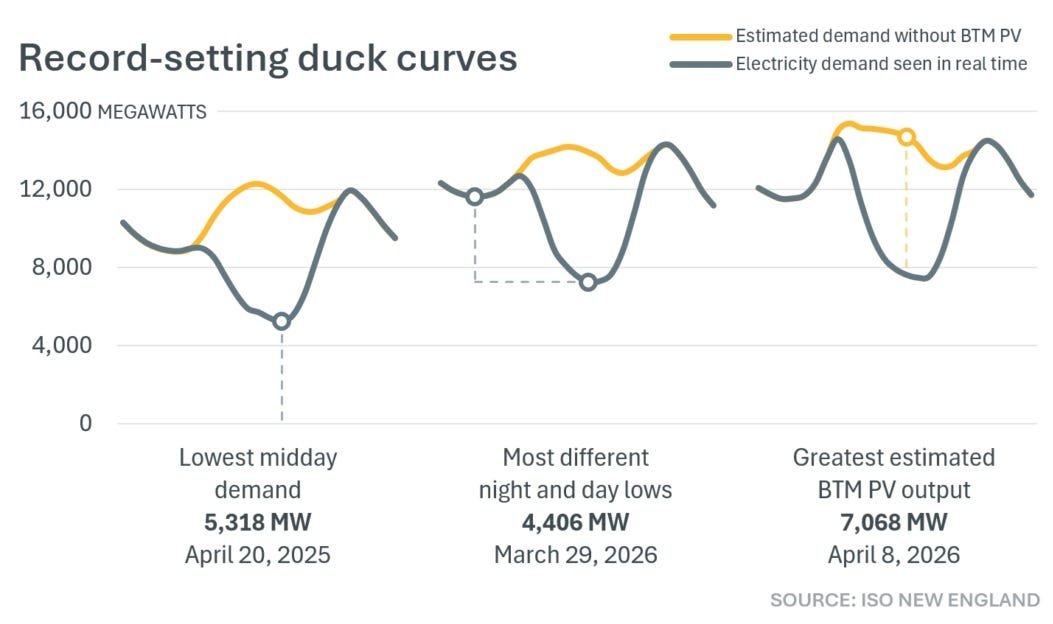
ISO-NE (Independent System Operator—New England, which oversees the regions grid) logged its 500th BTM (behind the meter) solar duck curve day on September 21, more than eight years after it observed the region’s first in April 2018. The grid operator has told federal regulators that behind the meter solar growth was a leading reason it no longer saw a reliability need for a new natural gas terminal.
Here’s what that “duck curve” looks like
Meanwhile, the BBC reports on my home state of Vermont, where the biggest source of electric supply is now…batteries in people’s homes.
The programme now provides some 110MW of power – about the same as a small-to-average-sized natural gas plant – and is the largest power source in the state.
Virtual power plants themselves don’t actually produce power, though the solar panels tapped into it do (around 50% of the houses in its programme with home batteries also have solar panels, GMP says). Instead, they use software to manage and conserve energy in more intelligent ways, making what we have already go further – especially at the times the grid needs it the most.
+”Catastrophic melt” reported on Swiss glaciers this summer, according to Irish radio
Switzerland’s glaciers, which are disproportionately impacted by climate change, have lost nearly 20% of their mass in five years, experts have said, with 2026 registering the second-biggest melt on record.
Swiss glaciers saw 5.5% of their volume melt away this year, the Glacier Monitoring in Switzerland (GLAMOS) network found in a new study, published after a record hot summer preceded by a winter with little snowfall.
“The glaciers this year have lost enormous quantities of ice,” said GLAMOS chief Matthias Huss, describing 2026 as “a catastrophic year”.
Perched on the Scex Rouge glacier, at an altitude of nearly 3,000 metres, he gazed across the landscape in despair.
“This is a glacier that isn’t surviving,” he said.
+A disturbing account from the Financial Times of what’s happening in the oceans. Attracta Mooney and Steve Bernard describe quick accelerations in sea level rise, and changes in the chemistry of seawater
Heatwaves and melting ice were bringing “profound changes” to the world’s ocean as a result of climate change, more than 120 scientists concluded in a flagship report, including salty seas getting saltier and the ocean more acidic.
The ocean has absorbed some 90 per cent of the world’s excess heat trapped as a result of human-caused greenhouse gas emissions. In 2025 alone, it gained an estimated 23 zettajoules in heat — or about 40 times the energy the entire world consumed last year.
The dramatic effects included an accelerated sea level rise observed by the study since 2012, the EU marine service Mercator Ocean International said in the report drawing together the work of international scientists.
“Warming, rising seas and ecosystem degradation are interconnected signs of significant and long-term change,” said Pierre Bahurel, director-general of Mercator. “The ocean is changing rapidly.”
+And finally, from Faseeh Mangi and Lili Pike, a stirring account of the ongoing solar rush in Pakistan
About an hour’s drive east of Karachi, Pakistan’s coastal mega-city of more than 20 million people, a coal-fired power station hailed as a flagship project in China’s $1.5 trillion Belt and Road Initiative is being engulfed by a sea of solar.
Glinting arrays crown steel plants and manufacturing sites across a vast industrial zone of about 400 companies flanking the Arabian Sea at Port Qasim, part of a rapid — and largely unplanned — advance of renewable energy that’s added new risks to the nation’s already precarious energy economics.
“There are solar panels almost everywhere one sees,” says Zaheer Allana, owner of a packaging factory, where the rooftop is crowded with photovoltaic modules that generate about a fifth of the facility’s electricity needs. “We have utilized almost all available space,” he explains, as workers load burlap sacks onto delivery trucks. “If we had space, we would take it to 100%.”
There's an issue up right now that illustrates sonething that makes people uneasy about this "grand bargain." Desperate to get Rocky Mountain coal producers an outlet on the West Coast to serve the Asian market, Trump officials have been shopping a coal export terminal in Oakland, California. It would be modest in size, with thoughtful environmental measures such as covering all coal in shipment or during storage to prevent blowing of highly polluting coal dust. The problem? They just presented the same project to investors, but three times the size and with no environmental protections at all. Would an administration already famous for the bait and switch claim that by approving the first proposal, Oakland and California have surrendered any right to review what they’re actually building? Of course they would.
Thanks for walking us through this, Bill. I’m with Jared Huffman. Let’s keep working on it until after the November election.