

As we head towards the midterms, the president’s closing argument has mostly been about various people’s posteriors, but he has also taken the time to make several, um, substantive points.
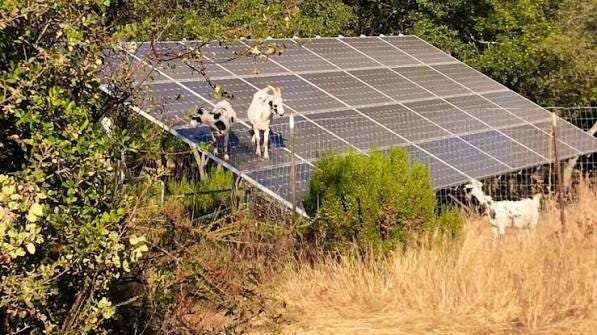
One is his theory that solar panels become incredibly hot to the touch during their operation, and hence will kill “all the animals.” As he explained his theory, "The animals jump on them and they fry because those black panels are hotter than your stove.” This is not true, as anyone with a functioning brain should be able to easily figure out; there are of course tens of millions of homes and apartments with solar panels, and no reports of burns from touching them. Literally here is a video of a goat dancing on a solar panel. It turns out in fact there are dozens of these pictures online—goats on solar panels are an entire genre.
The second point he’s been making this week is that he is going to lower diesel costs by buying some of the fuel from Russia, thereby abrogating our country’s own sanctions and replenishing the Kremlin’s war budget. Indeed, the diesel is traveling on previously sanctioned tankers. As Svitlana Romanko, the intrepid leader of Ukraine’s Razom We Stand points out, this is utter betrayal. "Every barrel on board these ships exporting Russian fossil fuels is money for the missiles and drones Russia fires at Ukrainian homes every night, bringing more civilian casualties.” But since it’s Trump, it’s also utterly stupid, in that the quantities are too small to budge the high price of diesel, which, as the zealots at that radical website OilPrice.com write is “set to persist well into 2027.” Of course, there’s another possible explanation—it’s all part of the grand corruption scheme that the Times has begun to unravel: as Anton Troianvoski and Eric Lipton document
An American energy company intends to buy Russian technology and use it to access a massive supply of natural gas in Alaska, liquefy it and export it to allies abroad.
The Kremlin and the White House were interested in the idea. President Vladimir V. Putin discussed the plan last month with President Trump’s peace envoys, Steve Witkoff and Jared Kushner, people familiar with the negotiations said, speaking on condition of anonymity to discuss sensitive diplomacy. It is one of a series of energy deals White House officials believe could help smooth relations with Moscow and eventually pave the way to end the war in Ukraine.
But it turns out that the company was not an all-American affair. The multibillion-dollar project has received secret funding from the same powerful Russian company that was to provide the technology, according to the energy executive who until last month led the U.S. firm and two others involved in company negotiations.
Anyway, there was a third point the president made this week, this one purely monstrous. It came in a speech in oilpatch Lubbock Texas, where, in an effort to boost flailing Senate candidate Ken Paxton he declared an end to any real federal oversight of methane emissions from the fossil fuel industry. As Sara Sneath reports
At a Trump rally in Corpus Christi earlier in the day, Trump shouted out Harold Hamm, saying the founder of Continental Resources was in the audience. In April, Continental Resources wrote a letter to the EPA pushing back against measures in the methane rule that prohibit routine flaring of associated gas.
Hamm, careful readers will remember, was the president’s chief donation bundler from the oil and gas industry during the last presidential campaign. Anyway, it’s worth remembering that
Last year, the US emitted more methane from its oil and gas sector than any other country in the world. Methane is responsible for at least a quarter of today’s warming.
Julia Kane, a researcher for Fieldnotes, said the Trump Environmental Protection Agency was giving oil and gas corporations exactly what they want. “The oil and gas industry says it’s a ‘good-faith’ partner eager to help craft regulations, but time and time again it’s worked behind the scenes to delay and weaken them,” she said.
All of this, of course, is pretty much par for the course. You could pick any week in the last two years and come up with roughly the same kind of idiocy and perfidy and graft; the Trump presidency is an ongoing evil MadLibs.
The trouble with his current gust of malignity, however, is that right now a pair of Democrats in the Senate—Sheldon Whitehouse of Rhode Island and Martin Heinrich of New Mexico—have been trying to persuade their colleagues, and by extension the rest of the country, to support a “permitting reform” bill that would make it easier to build energy stuff. It’s traveling under the name BAAJA, for Bipartisan American Affordability and Jobs Act, I guess on the grounds that “affordability” is something all right-minded people support (except, of course, for Trump who thinks it, like global warming, is a “hoax.”) Anyway, the grand bargain these two Senators have struck with the oil industry is hundreds of pages long, and would overturn much of the environmental review process in America.
If you have any doubts about the necessity of making changes in how we review things, read Ezra Klein and Derek Thompson’s Abundance. But the devil comes in the details—or rather, the devil is Donald Trump, and the pertinent detail is whether he can be contained in a meaningful way. Obviously Whitehouse and Heinrich knew that this would be an issue, and they did their best to build in some guarantees that it wouldn’t be able for him to use it push dirty energy at the expense of clean. But from the start there have been questions about this—I wrote two weeks ago about Harvard professor Jody Freeman, so centrist in this work that she actually served on the board of a major oil company, who said
a close read suggests it's structurally designed to lock in and subsidize natural gas & other fossil projects over cleaner renewables for years to come, using the courts and taxpayer dollars.
Since then, what you might call normie Democrats have been sounding increasingly urgent alarms in increasingly urgent language, and urging the drafters of this massive legislation—currently scheduled for a vote five days after the election—to figure out how to amend key provisions. Exhibit number one here would be John Podesta, the insider’s insider. White House chief of staff for Bill Clinton, counselor to Barack Obama on climate and to Joe Biden on energy policy, chair of Hillary Clinton’s presidential campaign—I think it’s safe to say he understands presidential power as well as anyone alive. So it landed with a thud two days ago when he told Jael Holzman that the bill as written would hand Trump a “loaded howitzer.” He focused on the sections around “permitting certainty,” which were written to try and keep the president from interfering (as obviously he has been doing) with clean energy projects. But:
This was “one place where I think they made a huge mistake,” Podesta said, calling the restriction on revoking or rescinding decisions “one of the worst provisions of the bill.” He complimented lawmakers for trying to address Trump’s attacks on already-permitted renewable energy projects, including stop-work orders on offshore wind facilities under construction, and for seeking commitments from the administration to continue permitting projects in exchange for a deal.
However, Podesta said they are “going to have to take it out” or significantly revise it because he believes this language would allow Trump to illegally approve projects on sensitive or protected lands and courts would not be able to force the government to undo approvals that violate the law. He argued this would mean Trump could permit development in many areas land conservation groups, tribes, and anti-drilling advocates have long fought to protect from industry, including the Chaco Culture National Historic Park in New Mexico, the Boundary Waters Canoe Area Wilderness in Minnesota, and the Bears Ears National Monument in Utah.
“I think they have handed Trump not just a loaded gun, but they’ve handed him a loaded Howitzer to go after public lands, to permit stuff that even if it’s illegal can’t be reversed by the courts,” Podesta said. “They’re going to have a permit gorge like you’ve never seen, not really caring about whether they’re going through the legal steps to do it, and under this bill, those can’t be reversed. That’s got to change if this bill’s going to pass.”
Abigail Dillen, president of EarthJustice, who have been leading the legal fight against Trump’s environmental extremism, followed up Podesta’s warning
Over the next two years, BAAJA would create more legal runway for this president to make corrupt deals and greenlight harmful projects of all kinds, and it would constrain any future president from repairing the damage. People can reasonably differ on long-term projections. But once you know what’s in this bill, how BAAJA plays under Trump should be clear as glass…
Most sweepingly, the bill’s certainty provisions would render Trump permitting decisions irrevocable with very limited exceptions.1 The next administration would likely inherit a raft of destructive and unpopular projects, and BAAJA would make it wildly risky financially and even impossible for the next president to revisit them. To be clear, the damage would not be confined to energy-related projects. Think detention centers, petrochemical complexes, data centers on public lands — whatever kinds of projects appeal to this president.
And here’s Carl Pope, former executive director of the Sierra Club and an environmentalist so centrist he once barnstormed the country with fracking executives touting the desirability of natural gas:
Title IV, “Permit Certainty,” is the draft’s most troubling section. Environmental policy has historically improved through two linked processes: identifying new risks and applying existing clean up technologies to abate them; in parallel, pushing research on clean up technology options and then adopting stronger standards as science and technology advance. Title IV works to obstruct both.
For example, a data center permitted to use fossil-fuel power could claim protection even after cleaner, cheaper alternatives become available for their needs. Likewise, if regulators later discovered dangerous contamination — such as PFAS, or “forever chemicals” in a watershed — the provision could impede stronger water-quality standards needed to protect nearby residents.
What BAAJA describes as a regulatory floor may function as a public-health ceiling. Instead of preserving agencies’ ability to respond to new evidence, it could lock in yesterday’s permits and yesterday’s pollution standards, under which millions of tons of unnecessary pollution are emitted by outmoded power plants.
For the first few weeks, this fight has been mostly confined to very elite and in-the-know circles. Earlier this week, for instance, Tom Steyer came out for the bill on the grounds that it “beats the status quo.” When I saw it, I flashed back to a gathering convened on his ranch fifteen years ago: I shared a cabin there with…John Podesta and Carl Pope. We shouldn’t have this closed a political circle on questions this large.
So it’s good to see that policy is increasingly joined by politics in this debate: given that we’re hoping for a blue wave in next Tuesday’s election, it may be hard to persuade Democrats to go along with Whitehouse-Heinrich plan, because the conventional wisdom is starting to harden around the Ossoffian ideal that the best way to deal with Trump is to stand up to him.
A fairly important straw in the wind came earlier this week when four key Senators—Oregon’s Jeff Merkley and Ron Wyden, Ed Markey from Massachusetts, and Tammy Duckworth from Illinois—wrote a letter to Whitehouse, Heinrich and their Republican co-sponors arguing that the Trump administration has clearly enforced environmental laws unfairly over the last two years and there is every indication they will keep trying to do so. As they pointed out, the Department of Energy has admitted to canceling billions of dollars in grants to states that had voted for Kamala Harris
This vindictive, partisan discrimination based on whether a grantee is in a State represented by two Democratic Senators that President Trump lost in the 2024 election is disgraceful. It violates core constitutional protections, harms communities comprised of Americans from across the political spectrum and, ironically, harms millions of Trump voters who live in these States. No American should be caught in the crosshairs of such a brazenly corrupt scheme. No one has explained why a Senator from a targeted State should help the Trump administration fast-track fossil fuel projects while it refuses to restore funding that Trump officials admitted was terminated on an illegal, partisan basis.
They propose a test of whether or not the Trump administration is serious going forward:
It would be compelling if, before the motion to proceed vote, the Trump administration directed DOE to 1) reinstate every award it terminated in October 2025 that it has not already restored, 2) to allow recipients to draw down those funds under the original award terms and 3) to commit in writing that it will not terminate an award because of the political identity of the recipient’s State or the party affiliation of its elected officials.
While such action may not fully address the wide range of concerns individual Senators have about various portions of this complex legislation, it would represent an important first step and carry far more weight with us and, more importantly, our constituents whose awards were illegally terminated, than mere informal assurances that the Trump administration will stop interfering with clean energy projects.
As Rachel Frazin notes in The Hill, this constitutes a high bar, especially since Merkley is likely to succeed Whitehouse as the chair of the Senate’s Environment Committee should the Dems win the chamber—it’s considerably higher than the sign off on a few wind projects that former DOE Secretary Jennifer Granholm suggested this week would be signal enough. (And as Heatmap reported this week, Trump hasn’t been signing off on those anyway—in fact, it appears that they’re thinking of banning the importation of wind turbine equipment on “national security grounds”). According to Frazin, the letter from the four Senators
represents a fracture in the Democratic caucus. It’s not entirely clear how widespread the sentiment is among Democrats, but if enough of them vote against the bill, it could hamper its chances.
And the odds of that happening seem to me to be increasing, because news of the bill seems to be escaping DC containment. Remember—this election is being largely fought over data centers, which Americans truly hate. Paul Krugman this morning called the polling on these data factories “astonishingly negative” and provided a nifty little chart to drive the point home.
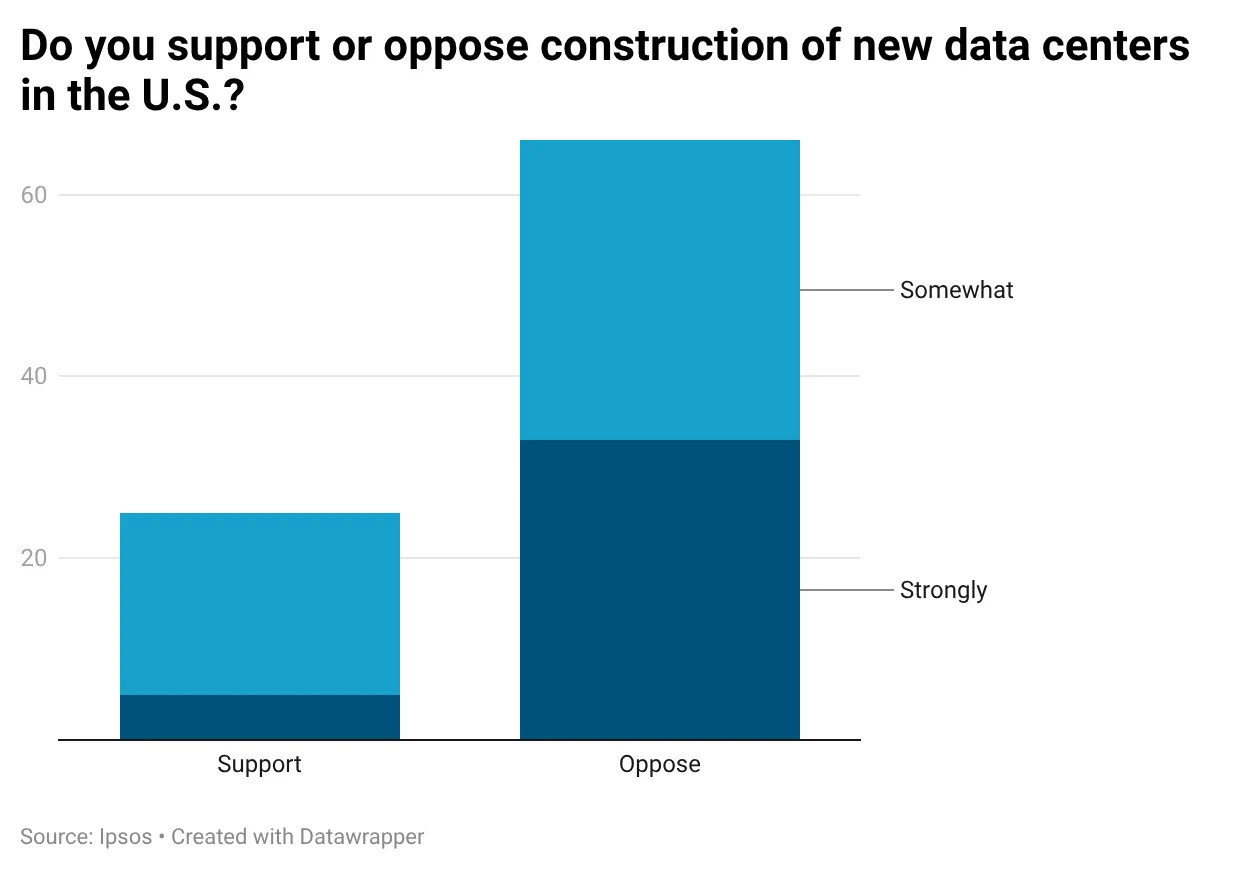
Essentially, no one (who isn’t an oligarch) strongly supports them, and most of the country hates them. So if the permitting bill might make it easier to build them—well, my guess is that many politicians in both parties are a little wary now of the data center issue, and don’t want to get crosswise on it. Too many traditional allies are up in arms—here, for instance, is the new NAACP resource for black voters opposing data centers, complete with a great picture of Justin Pearson waging a remarkable campaign for Congress on the issue. Here’s the letter from the Climate Justice Alliance, with more than a hundred frontline groups coming together to say
“Your closed-door deal bolsters the work of the Trump administration which is hell-bent on dismantling environmental justice at every turn, and we are beyond outraged at what you are saying our lives are worth. Reject this travesty.”
Equally pointedly, in Heinrich’s New Mexico this week, students walked out of classes to protest data centers and they linked their protest directly to the permitting bill.
“We will not get back the last 20 years of climate progress Project Jupiter will undo,” Isabelle Taylor-Ault, a student organizer and junior at NMSA, said to the crowd outside the Roundhouse in Santa Fe. “You, the adults, the ones supposed to be fighting for us, you may get the privilege of dying of old age, but our children will die from climate change.”
A handful of state lawmakers sitting on the interim Water and Natural Resources Committee — which was meeting on the Capitol’s third floor — headed down to watch the protest unfold.
In Albuquerque, protesters directed much of their ire toward U.S. Sen. Martin Heinrich (D-N.M.), who recently unveiled a sweeping, bipartisan permitting reform bill that protesters say reduces tribal input and empowers fossil fuel companies to quickly break ground on more harmful projects.
More than 100 protesters marched from the UNM bookstore down Central Avenue to Heinrich’s downtown Albuquerque office. In front of a large sign that read “Heinrich is a sellout,” protesters with YUCCA, as well as Indigenous and environmentalist groups, described the bill as a betrayal by a longtime champion for tribal and environmental causes.
Indeed, it didn’t take long after that demonstration for one of Heinrich’s colleagues—New Mexico congresswoman Melanie Stansbury—to come out swinging against the bill, saying she was “adamantly opposed” in what the New Mexico Political Report called a “rare public split” between members of the delegation.
The stakes are of course enormous. If the data center buildout continues (and in New Mexico, for instance, Oracle’s Project Jupiter depends on a gas pipeline), then a Sierra Club analysis just released says the new facilities would soon produce more greenhouse gas emissions than Mexico. As Eric Roston and Olivia Raimonde write
The US power sector would emit 2.1 billion metric tons of carbon dioxide by 2030, after factoring in planned AI projects. That’s 618 million tons more than 2025 levels, by the Sierra Club’s calculations, or about a 42% increase.
A year and a half ago, researchers at the nonprofit environmental group would have estimated that the buildout and its impact would have been a quarter or half of current projections, said Jeremy Fisher, the Sierra Club’s principal advisor for climate and energy. “The numbers continue to sort of boggle our minds,” he said.
It’s hard to predict exactly how BAAJA would affect that, which is part of the problem: the bill is a bit of a black box, and the only thing we know for certain is that for the next two years Donald Trump occupies that black box, snarling about solar panels that kill all the animals and eager to do any favor that the fossil fuel industry demands.
So the key thing, of course, far beyond debate on this bill, is to try and defang that monster, and the chief method for that is simple: win the elections Tuesday in as sweeping a fashion as possible. If you’re looking for a way to pitch in, there are plenty. For those of us of a certain age, Third Act’s Party Line senior-to-senior phone and text banking is operating day and night; if you’re a youngster, Seed the Vote can figure out ways to put you to work. I’m hunkered down for one last long weekend of all-out effort, and I hope you are too. We could come out of next week a different country, and wouldn’t that be sweet!
In other energy and climate news:
+David Fickling reports that “cockroach” clean tech, thriving even as Big Oil tries to kill it off, is in turn
killing off the assumptions underlying projections of future fossil fuel demand growth in the countries that matter most for that, emerging markets…
Solar and wind accounted for 85% of the world’s net new electricity generation capacity in 2025 and, in a remarkable milestone, they will surpass the world’s installed base of fossil-fuel power plants this year, according to BloombergNEF. US solar, wind and battery deployments, meanwhile, are projected to hit a record this year and then break that record next year. Plus, the US retreat on electric vehicles is an anomaly, not a template for the rest of the world.
The primary reason for all this concerns cost: “Unsubsidized renewable energy remains the most cost competitive form of new-build generation,” according to Lazard’s latest benchmarking analysis. Gas turbines have the advantage of being dispatchable — that is, not dependent on weather or time of day — but they are bottlenecked, driving up costs and delivery schedules. Grid storage is also amplifying the value of intermittent renewable energy — look at Texas. Batteries, spanning power, transportation and defense applications, are fast becoming a foundational technology for this century, similar to internal combustion engines in the last one.
And from Jocelyn Timperley at the BBC, a cheerful article about how solar has become so “offensively cheap” that
solar electricity generation quietly overtook nuclear power (just) in 2025, according to statistics from UK-based energy think tank Ember. And BBC analysis of Ember data over the past 12 months up to September 2026 shows it clearly outstripping nuclear, producing 13% more power.
“[Solar] generating more electricity than all the world’s nuclear power plants is a pretty insane stat, for sure,” says Dave Jones, co-founder of Ember.
Meanwhile, a new report from Lauri Myllyvirta in Carbon Brief gives some sense of the sheer scale—and meaning—of China’s booming green energy business:
China’s exports in 2026 of clean-energy technologies, such as solar panels, batteries and electric vehicles, are on track to cut emissions beyond its borders by 2%, reveals new analysis.
The impact of these Chinese exports on carbon dioxide (CO2) emissions around the world grew by 26% year-on-year in the first three quarters of 2026, having already risen by 36% in 2025.
If the latest trends continue for the rest of the year, then Chinese clean-tech exports in 2026 alone will avoid around 450m tonnes of CO2 (MtCO2) – roughly equivalent to Brazil’s annual emissions.
+Good profile of Jan Lundgren, who has done some of the important work on regenerative farming
In August, Lundgren published the first flagship paper from the project, a study comparing conventional and regenerative farm outcomes measured in 2022 and 2023 on 200 large-scale farms growing corn, soybeans, wheat, and other field crops.
Among other outcomes, the researchers report in the study that the most advanced regenerative farms stored nearly 40 percent more carbon in their soils compared to the conventional farm controls. If all field crop farms converted to these systems, Lundgren concluded, cropland soils in the U.S. could hold carbon equivalent to 1.5 years of the country’s annual greenhouse gas emissions.
+Reuters reports that heatwaves have become so huge and powerful that we should start calling them “heat storms.”
Heat waves have evolved from sporadic, isolated episodes to massive, cascading weather events that can blanket vast swaths of the planet for months or even years at a time.
To continue calling such sprawling phenomena “heat waves” would be like calling a monsoon a rain shower. To understand the new reality of these immense expanses of heat, Reuters consulted with two dozen climate researchers and analyzed temperatures around the globe for every hour of every day since 1960. From those results, we developed a new concept: the “heat storm.”
Scientists and researchers often discuss global warming in the context of risks that will arise if the planet’s average global temperature rises more than 2°C (3.6°F) above pre-industrial levels. What is an ordinary person to make of that? Not much.
Heat waves are the connective tissue between the science of global warming and our everyday experience.
But supersized heat waves used to be rare. No longer. Now they swarm the planet.
Naming events is “a powerful way for people to understand that something is happening,” Anthony Leiserowitz, director of the Yale Program on Climate Change Communication, told Reuters. Yet “we don’t currently do that with heat waves,” he said, even though heat has been estimated to kill almost half a million people a year.
+In a world that cared about justice, this would be a critical tool—the Equitable Transition Away From Fossil Fuel calculator. As Tom Athanasiou explains,
It allows users to see how national dependence on fossil fuels for jobs, public revenues and primary energy supply affect the pace at which countries can be expected to phase out extraction within a global transition away from fossil fuels.
The calculator also allows users to explore the financial implications of a global fossil fuel phaseout on extracting countries. In particular, poor countries that are economically dependent on fossil fuels (e.g. Algeria, India, Nigeria) need help if they are to phase them out quickly, and this even though the green tech revolution is here.
Meanwhile, a beautiful video outlining the first indigenous-owned solar park in Patagonia
+Yikes. Flooding on the Atlantic and Pacific coasts, as sea level rise and the sloshing water from El Niño are combining to pour water into communities even when the day is sunny and blue. From Bob Henson, Jeff Masters, and Irene Sans
For six consecutive days, strong onshore winds have combined with full moon-enhanced high tides to bring damaging flooding to much of the Southeast U.S. coast. Miami’s six-day streak from October 21-26 with moderate coastal flooding is the longest such streak on record. Since Miami’s tide gauge was installed in 1994 at Virginia Key, the city has seen five occasions with moderate flooding on at least four consecutive days.
And from the LA Times, reporting today on the flooding in Newport and Long Beach
+Just plain depressing: as Emily Pontecorvo points out, Net Power began as a company devoted to clean energy for things like data centers. Now, the company has
pivoted to building one of the dirtiest in order to meet data centers’ requirement for speed to power above all. Net Power was founded to pioneer a new form of natural gas power plant with zero emissions, but it has given up on that technology and recently acquired 10 natural gas reciprocating engines that it plans to co-locate with a data center on the site intended for its first commercial plant.
“We believe the clean piece is important,” Net Power CEO Danny Rice said during an August earnings call when he announced the company’s pivot to building unabated natural gas plants. “But just as it’s always been, it will only come at scale once society’s basic energy pillars of reliable, affordable power are fully in place. Power demand is outstripping supply today.”
+Close to home, great reporting from Emma Cotton at Vermont’s premier online news site details just how deep the financial mud will be if the Green Mountain State floods again like it has twice this decade. It’s worth reading—and worth trying to get your local paper to do something of this depth:
Vermont was once considered a climate haven. But average rainfall has increased 21% since 1900, repeatedly swelling the state’s more than 7000 miles of rivers, accelerating erosion – and threatening its mostly rural residents. Flood damage in the state is projected to cost billions in the next century. In the past, Vermont has relied on the federal government for disaster help – more than almost any other state.
Now, the Trump administration aims to slash disaster support, shifting more recovery responsibility to the states. But Vermont does not have a disaster reserve, or traditional county governments that can help with recovery. Most of Vermont’s towns have fewer than 5,000 people, and their annual budgets are often less than $5 million.
All this means Vermonters are facing a precarious future. Without federal aid, another massive storm could gut the state’s savings – and pose an existential threat to some communities.
Meanwhile, Vermont has signed a pact with Nova Scotia to explore buying offshore windpower from the Maritimes—fine, but in fact that’s because the state has adamantly refused to use its own windpower resources because a few of its citizens noisily dislike looking at the turbines. It’s possible that the state’s longtime governor, and clean energy opponent, Phil Scott may be in electoral trouble on Tuesday, thanks to a spirited challenge from Amanda Janoo.
And even closer to home, Nan Jenks-Jay—my mentor at Middlebury, and the woman who as much as anyone else built the movement for environmentally sound campuses across America—died this week. Her obituary
Following her retirement from Middlebury in 2019, the Association for the Advancement of Sustainability in Higher Education awarded her a lifetime achievement award; Yale followed suit in 2021 when its School of the Environment presented Jenks-Jay with its annual award for distinguished achievement.
Meanwhile, a book about a former Middlebury student of mine who died much too young, Kye Walker-Moffat—it “delivers Kye’s twin message: ‘We are out of time,’ and ‘Have fun, take action!’” and its sales will benefit the climate action fund set up in his honor.
+Mathilde Augustin suggests we should view the recent unrest in France as, among other things, climate change protest
By the time Cléo made it to Greek class, she had gone completely pale. It was a Wednesday in June during France’s second consecutive heat wave this year, and the 16-year-old was struggling to cope with the rising temperatures.
She pushed through, thinking she was just tired. But the following day at her sweltering high school on the eastern edge of Paris, nausea and a desperate thirst gripped her. The school nurse, recognizing the signs of heat exhaustion, told her to go home.
This week, as she recalled the experience and worried about more heat waves to come, Cléo and her friends stood by a pile of green garbage cans, blocking their school’s entrance. For the past four weeks, scenes like this have multiplied at thousands of schools across France, where students are protesting to demand better learning conditions and more investment in public education.
+The Wall Street Journal on a new generation of heat pumps that fit easily in a window and don’t require a lot of ducting work.
Although there are some consumer models available, the pumps are largely aimed at potential bulk buyers like housing authorities and landlords, usually those looking to easily and inexpensively upgrade or supplement older heating systems. States, cities, utilities and nonprofits across the country are running pilot programs with the pumps to see if they deliver on their big promises and identify any flaws.
In one large-scale project, for instance, the New York City Housing Authority is installing pumps for thousands of tenants in municipal housing.
“We were trying to get something moving, especially for older occupied buildings,” says Jordan Bonomo, a senior program manager at the housing authority. Some of the old buildings have 80-year-old pipes and radiators. “They don’t even make the components anymore,” he adds.
Meanwhile, the Journal’s Christopher Mims took a trip in a Chevy Bolt from Nashville to New Orleans, through the deep South that is on paper the hardest place to find an EV charger. He reported no real problems:
This trip turned out to be only a little less convenient than it would have been in a gas vehicle.
Even as Americans have pulled back from buying new EVs, the country’s fast-charging infrastructure is growing at a blistering pace. Sales of new EVs may be down about 40% compared with last year, due in part to the expiration of federal tax credits, but the U.S. now has more than 80,000 public fast-charging plugs—and is adding nearly 20,000 a year.
And the EV retreat might prove temporary. High fuel prices are driving Americans to buy EVs—but used, not new. Sales of used EVs are up 21% from a year ago, according to wholesale auto marketplace Manheim, and their prices are up too.
+Bloomberg offers an excellent video account of the current title holder for the largest electric ship on the planet, a giant ferry plying the River Plata from Buenos Aires to Uruguay on an endless loop of 90 minute journeys, carrying 2,100 passengers.
+And from Amanda Royal, an update on the ongoing experiments with agrivoltaics, as humans learn to use the vast new canvass we’ve been gifted, the rows been solar panels
“In California, it’s too hot in many places.1 There’s a lot of fruit getting sunburned, not getting the quality they want because they are heat stressed,” Cox said. “Under panels, it does lower the surface air temperature.” Crops that have shown dramatic improvements in quality and yield are lettuces and berries, including blueberries, blackberries, and strawberries.
Solar panels can triple the amount of lettuce a farmer produces. They can triple the yield of chiltepin peppers, double yields for cherry tomatoes, and produce similar yields of jalapeños using 65 percent less water, according to research by Dr. Greg Barron-Gafford at the University of Arizona.
More than 250 studies from around the world have examined how shade from solar panels affects yields.
Microgrid Media reports: “The potential impact is enormous. Researchers at Western University in Canada estimate that agrivoltaics could add 1.8 billion tonnes to global crop yields annually in best-case scenarios. That would provide enough calories to feed over 2.1 billion people per year.”
Just as significant could be the benefits for farmworkers:
In California’s Central Valley, the “breadbasket of the world,” a typical summer includes 70-100 days of temperatures above 90°F (32°C). An estimated 28 farmworkers die each year due to heat-related illnesses in the U.S., a rate that is 20 times higher than other civilian workers. A simulation study published in August found the implied benefits of solar panels to farmworker safety could be significant. According to a summary in PreventionWeb:
“The average perceived temperatures for humans decreased by 4.46°C [8°F] during working hours, implying important occupational health and safety benefits for farmworkers.”
Which is a reminder of this week’s loss of the great Dolores Huerta, a driving force behind the United FarmWorkers Union. As the Times noted in her obituary:
On picket lines and in civil disobedience protests, Ms. Huerta and Mr. Chavez practiced the nonviolent civil rights strategies of the Rev. Dr. Martin Luther King Jr. She was arrested 22 times, roughed up by strikebreakers and once severely beaten by a police officer, suffering broken ribs and a ruptured spleen that left her disabled for months.
The mother of 14 children, Ms. Huerta sometimes changed diapers between organizing meetings and nursed her babies during breaks in negotiations. Her children often lived with friends and supporters, ate donated food and coped with frequent moves. Most grew up to become activists and professionals, including a lawyer, a physician, performing artists, a therapist, business administrators and a chef.
I was in Bakersfield in the Central Valley a few weeks ago, knocking doors for congressional candidate Randy Villegas on behalf of the Dolores Huerta Education Fund. Her name opened one door after another, and one of her daughters was there to launch the day’s hard work. It is one of America’s greatest legacies.

The federal government is run by lying greedy murderous traitorous irrationally clean energy hating fossil fuel loving fascist dictator loving extremely-good-at-using-power people. Hm, Should we trust them to implement BAAJA fairly?
What concerns me most is the possibility of confusing faster permitting with better energy policy. We do need to build infrastructure faster, but decisions made today can lock in emissions, water use and environmental impacts for decades. The real test of permitting reform is whether it accelerates the transition while preserving the ability to respond when better technologies or new evidence emerge. Speed matters, but so does getting the long-term consequences right.