
And so "climate" returns
The next--and most important--cycle in a long-running battle

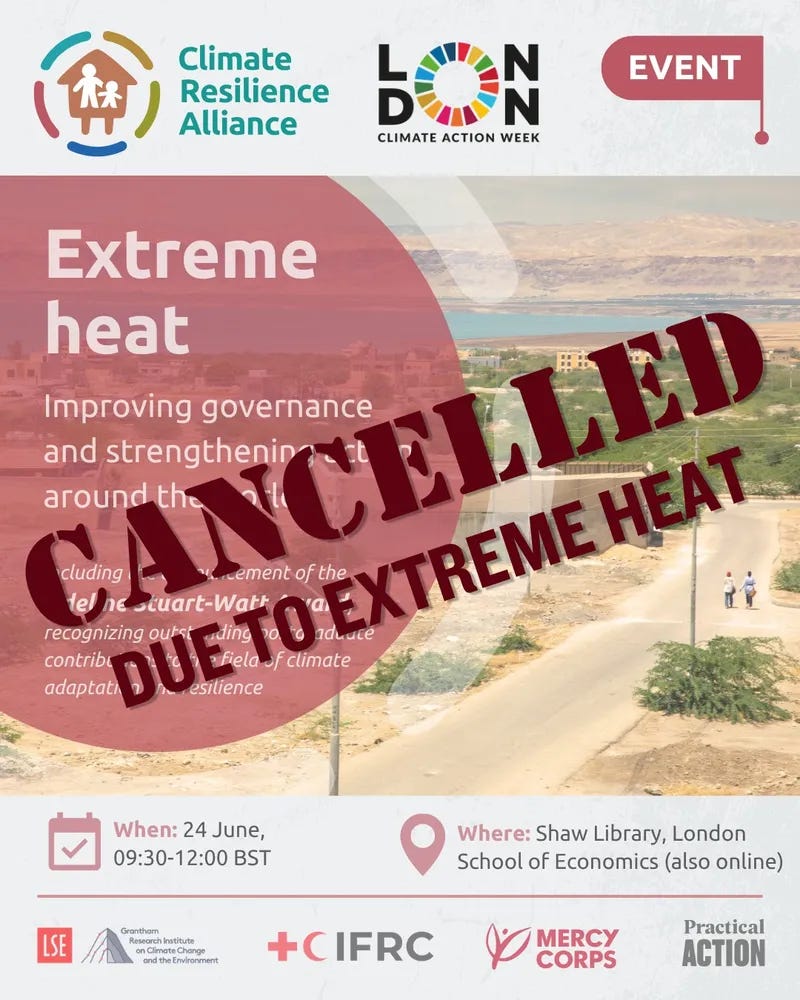
One benefit of having watched the climate story from the start is that I tend not to panic when “climate” is temporarily eclipsed as an issue, almost always thanks to the hard work of Big Oil. It happened at the end of the 1980s after the initial furor over the newly public “greenhouse effect,” and again after the Kyoto climate talks; when Al Gore made global warming a central issue in the oughts, the collapse of the Copenhagen talks put it on the back burner. Many of us built the movement that pushed it back to the front again in the oughts, culminating in the Paris accords; when momentum wavered Greta Thunberg and her colleagues emerged, building the consensus that took us through the IRA.
At the moment, of course, a resurgent fossil-funded right wing has killed off that landmark legislation, and done all it can to destroy clean energy in the U.S.; America is out of the global climate talks; around the world various strongmen have made protest far more difficult. The new authoritarians have managed to intimidate many of the centrist pols in much of the world who are no longer willing to talk much about “climate;” indeed, there’s a closet industry of pundits and consultants advising them not to.
But it’s never occurred to me that this state of affairs would last very long—physics is running this show, and it won’t be long denied. And now I think we can see the next of these cycles firing off—and this one, I think, will be climactic. We have a chance to insure that civilization comes out of this one focused on the physical world.
The politics of climate begins with…climate. Perhaps you’ve heard that Europe spent the past week suffering through a truly remarkable heat wave, with France reaching a new all-time record temperature, the UK recording its hottest day ever, Spain smashing all its old marks. It’s truly brutal—and it recalls, for Europeans, the heatwave of 2003, which ended up killing 70,000 people. Even today, the continent is ill-prepared for extreme heat—in France, for instance, Angelique Chrisafis reports that
The impact of the heatwave has been made considerably worse by the high proportion of French buildings and infrastructure not designed to cope with high temperatures. Paris, one of Europe’s most densely populated cities, known for its poorly insulated housing stock, has for years been considered to have the highest heatwave mortality risk of any capital on the continent. The French government has been criticised for a lack of preparation and for cutting funding for projects designed to adapt infrastructure to the climate crisis.
Half of all French homes have insufficient protection from high temperatures, leaving inhabitants dangerously overheated, a report for the NGO Fondation pour le Logement (Foundation for Housing) found this month. About 66% of French people struggle to tolerate the heat in their homes.
Maïder Olivier, the head of climate advocacy at the NGO, said France had a “massive and worsening problem of heat-trap housing”. She said climate inequality in France was growing, with low-income, suburban housing estates suffering the worst from heatwaves.
Apparently English homes, especially modern ones, aren’t much better. And the heat has caused a surge in British hospital admissions, even as it’s damaged hospital equipment. Andrew Gregory writes
Several NHS trusts in England have declared critical incidents as a direct result of the extreme heat. One hospital had done so after its machines failed in multiple areas, a doctor said. Labs used for testing were also affected and two linear accelerator machines, used to treat cancer patients, had stopped working amid the high temperatures.
The doctor said that although they were working in a relatively new care setting, it was “tacked on to an old Victorian hospital”, creating severe infrastructure challenges. “It’s hopeless, really,” they said.
The doctor also said their NHS trust had faced “major issues” with IT servers overheating on Wednesday. “We thought we were going to lose everything, so we were all asked to turn off non-essential computers and electrical equipment, including lights.”
But it’s not just dialysis machines going down—in France, nuclear reactors had to be taken offline because the river water used for cooling was getting too warm. Also, save some tears for the poor American tourists complaining to the Wall Street Journal that European restaurants offer too few ice cubes in their drinks.
Look, there’s no doubt why these records are being smashed—as Bob Henson writes at Eye on the Storm,
Extreme heat is among the most-studied consequences of human-caused climate change, and the connections between a warming planet and amplified, localized extreme heat are not only intuitive but well documented.
In this case the jet stream—powered by the temperature differential between the poles and the equator, and unsettled by the melt up north—has gone kaflooey, producing what’s called an “omega block” for its distinctive shape. The sun beating down on this heat dome is relentless. As Lauren Dalban reports for Inside Climate News
“There’s a sad inevitability to all of this, with scientists like me trotting out the same quotes year after year,” Friederike Otto, a professor of climate science at the Imperial College London who leads the World Weather Attribution, a group that works to link weather events to climate change, said in an email. “Simply put, we remain on a one-way trip towards a more dangerous future, and it’s time we hit the brakes.”
I could of course go on and on about the heat; it’s wretched. (And remember that we’re paying attention in part because there’s lots of media, some of it English-speaking, in Europe; similar hideous heatwaves have been plaguing much of Asia this spring). But what I really want to talk about is its political meaning—I think this heatwave is one of those events that will help bring “climate” back into fashion in our discourse.
Britain will be an interesting test case. Its politics have been roiled for the last two years by the odd static incompetence of Keir Starmer’s Labour government, now about to be replaced by the Andy Burnham government. A key question for that new administration will be the role of Ed Milliband, who has been serving as the energy secretary, and may be in line for a job as chancellor. He’s been (almost uniquely) effective in his role, moving fast to boost clean and cheap renewable energy in the UK.
But that’s roiled the fossil fuel industry, which is putting big money behind the rightwing Reform Party, which according to an April investigation by Sam Bright and Adam Barnett, has collected two-thirds of its funding from oil interests. Together with the always vile Murdoch press, they’ve mounted a full-on attack on “Net Zero” policies, alleging—a la Murdoch’s Wall Street Journal in this country—that they’re responsible for rising energy prices in the UK.
The entire status quo is in on this fight—including British labor unions. They aren’t venal the way oil companies are, but they are fighting against change, in the name of their current members. And they’ve focused their fire on Milliband. Sharon Graham, head of the giant UNITE union, has said
Jobs in Britain are important. We need someone in that role [chancellor] who understands that, and at the moment that isn’t Ed Miliband. … It’s been floated that Ed Miliband would be chancellor, that would be a noose around the neck of what we need to do on jobs.
Happily, we’re starting to see serious pushback to this endless irresponsible climate delayism. It begins with scientists. In France eminent climate researchers have started speaking out to Le Monde, complaining about the inability of scientists to effectively connect the dots between climate change and heat for the public. British scientists have gone one better: nine of them wrote the agency responsible for regulating the press to complain about the lame coverage.
“News stories about heatwaves often do not mention the influence of climate change or the burning of fossil fuels on increased temperatures – for example, three in five stories during the May heatwave did not – while two-fifths of those about net zero make no mention of climate change. In this context, it is unsurprising that the public often do not understand these issues or the connection between them.”
I think my favorite was a letter to the London Times from the veteran climate research Brian Hoskins of Imperial College London, which I reprint here just because I like its cadences:
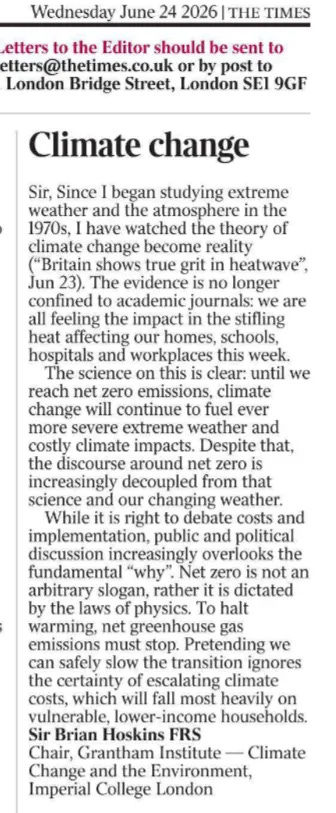
The sentence “net zero is not an arbitrary slogan, rather it is dictated by the laws of physics” should be a watchword in the years to come.
And here’s my guess: Milliband will be vindicated, landing in an important new job. Despite the complaints of union leaders, Britain’s green economy is one of the few things that’s booming on the island. He’s not backing down: at a press conference last week he heralded the fact that more than a hundred billion pounds in private clean energy investments had been made during his term.
Experts told the Guardian that the new investment data, as well as previous findings by the Confederation of British Industry that the UK’s net zero economy had grown faster than the rest of the economy and generated higher-paying jobs… [contradicted the claims of union leaders]
Miliband said: “I’m proud to have led a pro-business, pro-growth department in these last two years. This achievement didn’t happen by accident, but because of clarity of mission, government investment and building not blocking. As we have shown in energy, progressive government in hard times requires partnership with business to secure economic growth, built on an active industrial strategy.”
Indeed, forty progressive economists in the UK wrote to the labor leaders this week, rejecting their attack on Net Zero.
“There is no alternative to the green transition. The effects of climate change are with us now. Miliband is right to oppose further expansion of North Sea oil and gas.”
If Burnham were to back off the Net Zero pledges, he’d be disappointing the sixty percent of Brits who like the strategy. Starmer staggered in part because he took rightwing positions on immigration, giving the Green Party an opening; that door will grow much larger if he backs off on climate policy, so I suspect he won’t.
And the heatwave will give him political cover to do the right thing. As the head of Greenpeace UK said last week
The only way off this hellish treadmill is to reduce our dependence on fossil fuels. Our next prime minister needs to act on the evidence outside their window, and the advice of their scientific advisers, and stay the course on climate policies. The alternative is parched reservoirs, unaffordable food, shuttered hospitals and schools and wildly fluctuating bills each time a new oil war is kindled.
My further guess is that the coming El Niño will have the same effect on global climate politics—and maybe even in our caboose of a nation. We enter this new warming spell in rough shape: recent data shows the heat content of oceans at all-time highs. Things are grim enough that one (ghoulish?) investor has launched a fund designed to make money off the coming crisis
Hedge fund Moreton Capital Partners is targeting $500 million for a special-purpose vehicle to trade multiple commodities that stand to be impacted by the weather phenomenon, including South African corn, Malaysian palm oil and Australian wheat. The markets are underestimating risks, according to Moreton’s co-founder Les Finemore.
“We think it’s going to be a dramatic reshaping of the global food situation,” Finemore said in a video interview from Mexico City. “We feel like today the market is seriously mis-pricing that risk.”
American politicians may feel that the easiest course for the short term is to back off on climate talk—and the green movement is perhaps inclined to let them get away with it through the midterm elections, which will be fought largely as a referendum on the mendacity of the Trump administration. (Though it’s political malpractice not to be calling out Trump’s incredibly unpopular attacks on solar and wind energy). But next year, as primary season begins in earnest, El Niño will insure climate is firmly back on the agenda. And given the explosion in clean energy, the case will be easy for smart candidates to make.
That this cycle has gone on since the 1980s does not mean it can go on forever. We’re clearly reaching desperate physical tipping points. So this had better be the last turn of the wheel—by the end of the decade we need to have decisively broken the political power of the fossil fuel industry, so we can get on with the energy transition, and with building a world that can survive the damage Big Oil has inflicted.
It starts now.
In other energy and climate news:
+From Michael Coren, a fascinating column about emerging new models for affordable solar leasing schemes.
A new model from an upstart company called Terra Energy is shaking things up in Florida, Texas and soon California. After subscribing for three years, customers can cancel and have the panels removed from their roof free of charge. If they keep them, they lock in a low, predictable electricity rate relative to their local utility, like any other leasing model…
The elimination of a 30 percent tax credit for homeowners in the One Big Beautiful Bill last year effectively raised the cost of the average home solar system by $8,000.
While homeowners lose out, businesses enjoy the solar investment tax credit through 2027, making leases and PPAs more attractive. That’s scrambling two decades of “own, don’t lease” advice because only businesses like Terra and others can pass on the tax credit to homeowners.
Third-party ownership now makes up the majority of new residential solar sales, according to Wood Mackenzie, an energy research firm, up from a minority share last year.
“Our view has historically been that ownership is the best path,” said Thompson of EnergySage. “But not everyone can pony up $30,000 or get a loan. New leasing models are a vehicle that gives people the opportunity.”
Meanwhile Jeff St. John describes how Sunrun, Tesla and RenewHome are teaming up to make a really big virtual power plant out of all those home batteries. The three companies Wednesday
announced an agreement to “deliver more than 16 gigawatts of flexible energy capacity” to tech giants and utilities around the United States. Those gigawatts will be produced by hundreds of thousands of home battery systems managed by Sunrun and Tesla, as well as more than 8 million smart thermostats and devices managed by Renew Home.
These batteries and smart thermostats are already installed in homes and businesses across the country, Paul Dickson, Sunrun’s president and chief revenue officer, told Canary Media. Some are enrolled in utility or grid programs that call on batteries to discharge, or thermostats to turn down energy use, during the handful of hours per year when grid demand is at its peak, he said.
But he noted, “Most of the constructs for these distributed power plants are tapping into the resources a fraction of the time they could be realized.” This new partnership is meant to “further legitimize these devices as core dispatchable, capable resources.”
+Climate activist and writer Mike Tidwell’s recent book The Lost Trees of Willow Avenue will be part of a novel PBS series called “Sacred Ground with Tim Daly” that focuses on the heroic work of several North American climate activists. Episode two stays true to Tidwell’s chronicle of the impacts of climate change on his one DC-area street, from dying trees to Lyme disease to constant flooding. It also captures the inspiring work of people fighting back like Tidwell’s neighbor and climate activist Congressman Jamie Raskin. (You can also see some very vintage footage of…me.)
+Hannah Story Brown has an epic account of the epically foolish plan to build a new LNG pipeline 800 miles across the middle of Alaska
By pipeline company Glenfarne’s projection, construction of Alaska LNG could cost up to $55 billion. The real cost, if built, is likely to be much higher. A new report from Public Citizen analyzing the final cost of constructing operating LNG terminals in North America found that the average cost overrun was 59.7 percent. LNG Canada, the project most comparable to Alaska LNG for requiring a custom-built pipeline over hundreds of miles of challenging terrain, ran more than 130 percent over budget. As report authors Lois Parshley and Mekedas Belayneh note, “Alaska’s proposed pipeline route traverses a longer distance, and more severe terrain, in a labor market that is structurally thinner [than LNG Canada].”
Then there is rapidly escalating competition from renewables. Global electricity generated from wind and solar has increased by more than 350 percent since just mid-2020, and surpassed generation from natural gas for the first time in history in April this year. Nations around the world are frantically investing in green energy and industry to defend themselves from energy price shocks; any gas from this pipeline might go begging by the time it’s completed.
+Meanwhile, you know what actually makes money? Windpower. Here’s Paul Lovell’s update from Iowa, center of the midwestern breeze belt:
Consider Howard County. With a population of just under 9,400, limited commercial development and an economy heavily dependent on agriculture, Howard County saw its first wind farm in 2008. Today, the county hosts 147 wind turbines with a total capacity of 244 megawatts — enough to power about 50,000 homes — with two more projects in development.
These turbines have a total taxable valuation of over $115 million. This past year alone, they generated $2.7 million in tax revenue, representing 14.5 percent of the county’s total tax budget.
This revenue is critical. New property tax legislation signed into law this year limits growth in county and city general levies to about 2 percent per year. With inflation for materials and labor continuing above that rate, Iowa counties face painstaking budget choices. Expanding the tax base through wind development offers a practical solution to maintain quality public services.
Before the wind projects, Howard County could replace only one or two bridges per year, and rural gravel roads suffered from severe deferred maintenance. To turn things around, Howard County used tax increment financing, using future property tax growth from turbines to fund infrastructure bonds. Since 2010, TIF has helped the county replace more than 30 bridges, pave 20 miles of road, and purchase critical maintenance equipment. Road maintenance agreements with developers meant wind companies, not taxpayers, covered the costs of upgrading local gravel roads during construction.
Nova Scotia seems to have gotten the message, and is betting big on wind—not just to supply its one million residents, but to export power to the States, where Trump is preventing eastern seaboard states from setting up wind farms of their own. Emma Graney reports
The $60-billion project could generate as much as 40 gigawatts of power if all phases are developed. The first stage, at 5,000 megawatts, would produce roughly 24 terawatt hours of power each year – around twice the output of the Sir Adam Beck Hydro complex at Niagara Falls.
Wind West would initially provide electricity to Atlantic Canada, Quebec and perhaps Ontario, but Mr. Houston believes transmission cables carrying wind-produced power will one day run from Nova Scotia into the United States.
“The world has to change a little bit for that to happen, but it will,” he said.
Already, the province has made tentative overtures to its southern neighbours.
In February, Mr. Houston signed an agreement with Massachusetts Governor Maura Healey to work toward supplying the state with clean energy from offshore wind. He said New England and New York are interested in similar agreements.
+Great news from France, where a court has ruled that the fossil giant TotalEnergies is responsible for the emissions from its customers burning its products, a kind of liability the oil majors have done their best to dodge.
“Extracting, refining and marketing of a barrel of oil inevitably leads to its combustion,” the court said in detailing why Total played a role in clients’ emissions.
+New from Jason Dove Mark, a fascinating book about shifting baselines, and how they skew our sense of change. I just got to spend a few wonderful days with Jeremey Jackson, the ocean scientist who first popularized the concept; I’m glad it’s getting more and more attention.
+A new kind of travel show, that doesn’t burn any jet fuel. Check out Parke Wilde’s “Adventures of the Not Jet Set.” I hope everyone is enjoying some low-carbon adventure—my mantra is, despite all the damage this remains a beautiful world, and one of our jobs is to simply witness its beauty. It’s a task I take seriously! I’ll leave you with a picture I took last week at Shelburne Farms, one of Vermont’s most beautiful places. I was giving a talk there, but took a stroll beforehand, gazing out across Lake Champlain at my beloved Adirondacks. Sometimes people ask how I keep going year after year in this work, and this is a big part of the answer

Bill, the line that stays with me is "physics is running this show, and it won't be long denied."
Harry — the wilderness man in my novel Empty Earth — said something close to that his whole life. Not as a warning. As a fact he had already made his peace with. The politics would catch up eventually. The physics wouldn't wait.
What you're describing — the cycle firing again, this time with the economics finally aligned — is what Harry spent his life arguing was possible. He didn't live to see it. We might.
I'm in the UK and it's been horribly hot this week. It's really made me think about how well adapted our homes and infrastructure are for climate change. It's unbelievably frustrating that climate policy has stalled.
I work in the wildlife conservation sector and the triple crises of climate change, biodiversity loss and a reduction in people's connection with nature is accelerating. At the same time, the nature conservation sector is shrinking due to a funding shortfall; redundancies are regularly being announced.
Your point about the dial swinging the other way is very reassuring, as is the reality that so many people want to see action, and are doing what they can to effect it.