
Five days out!
As we roar towards Sun Day, the official documentary debuts this morning!

Sunday is…Sun Day, a nationwide celebration of the innovative power of clean energy. We’re working as hard as we know how in these last hours—closing in on 500 different events across the nation. In Virginia, volunteers will climb rooftops to install solar panels on Habitat for Humanity homes, kicking off a national push to put 10,000 systems on affordable housing. It’s part of a $40 million drive to help low-income families save money and gain access to clean energy. In Portland Oregon, there’s a parade across one of the city’s big bridges, with giant puppets, Aztec dancers, and marching bands, followed by a "Sun Ball" celebration. A free concert in Monument Valley Utah, Monument Valley, Utah, with Latigo, an Indigenous country-western band,performing outdoors and using solar panels and lithium batteries to power their sound. (Navajo tacos will be available.) In New Paltz New York the mayor is inaugurating a net-zero fire station; in New Hampshire the Mallett Brothers are giving a concert powered by the batteries in Ford F-150 Lightnings.
Earlier this morning, we released the documentary you can see above, which will be shown many places—and which will help power this work in the years ahead. Jackson Hyland-Lipski worked overtime to produce this over the past few months; it has beautiful footage from places like Puerto Rican clinics now run by the sun. It also has some great footage of Bernie Sanders in the backyard of his Burlington home, which runs off solar power—and which, his wife Jane rummaged through documents to assure me, means they use 80 percent less power off the grid and “our bill has been reduced by about the same amount.”
Obviously this is hard going—the Trump administration continues its all out war on clean energy (and in the Times this morning Ben Shapiro tells Ezra Klein that Bernie Sanders is “a putrescent Marxist pimple on the posterior of the body politic,” ha ha).But this weekend we get to play offense as well as defense, to remind the world that we now live on a planet where the cheapest way to make energy is to point a sheet of glass at the sun. The beautiful and liberating power of the sun—instead of being chained forever to paying a bill for yet more fossil fuel—deserves to be celebrated, and so we shall. I’m in San Francisco right now, headed for Seattle tonight, Portland tomorrow, and Los Angeles the next; but I’ll be back in New York City for the day itself, where we’ll gather at Stuyvesant Square Park to watch the pictures pour in from around the country.
I want to take a moment to thank some of the many people who’ve helped coordinate this work: Deirdre Shelly, Jamie Henn, Duncan Meisel, Cassidy DiPaola and Tolmeia Gregory at Fossil Free Media, Anna Goldstein, Deborah Moore, and Janina Klimas who have worked tirelessly at Third Act. They’ve enabled a huge crew of volunteers across the country to come up with gorgeous events—David Solnit, as usual, has made sure that there’s beautiful art, much of it drawing on the gorgeous logo that the team at Collins came up with—thanks Eron Lutterman, Beth Johnson, and all your colleagues.
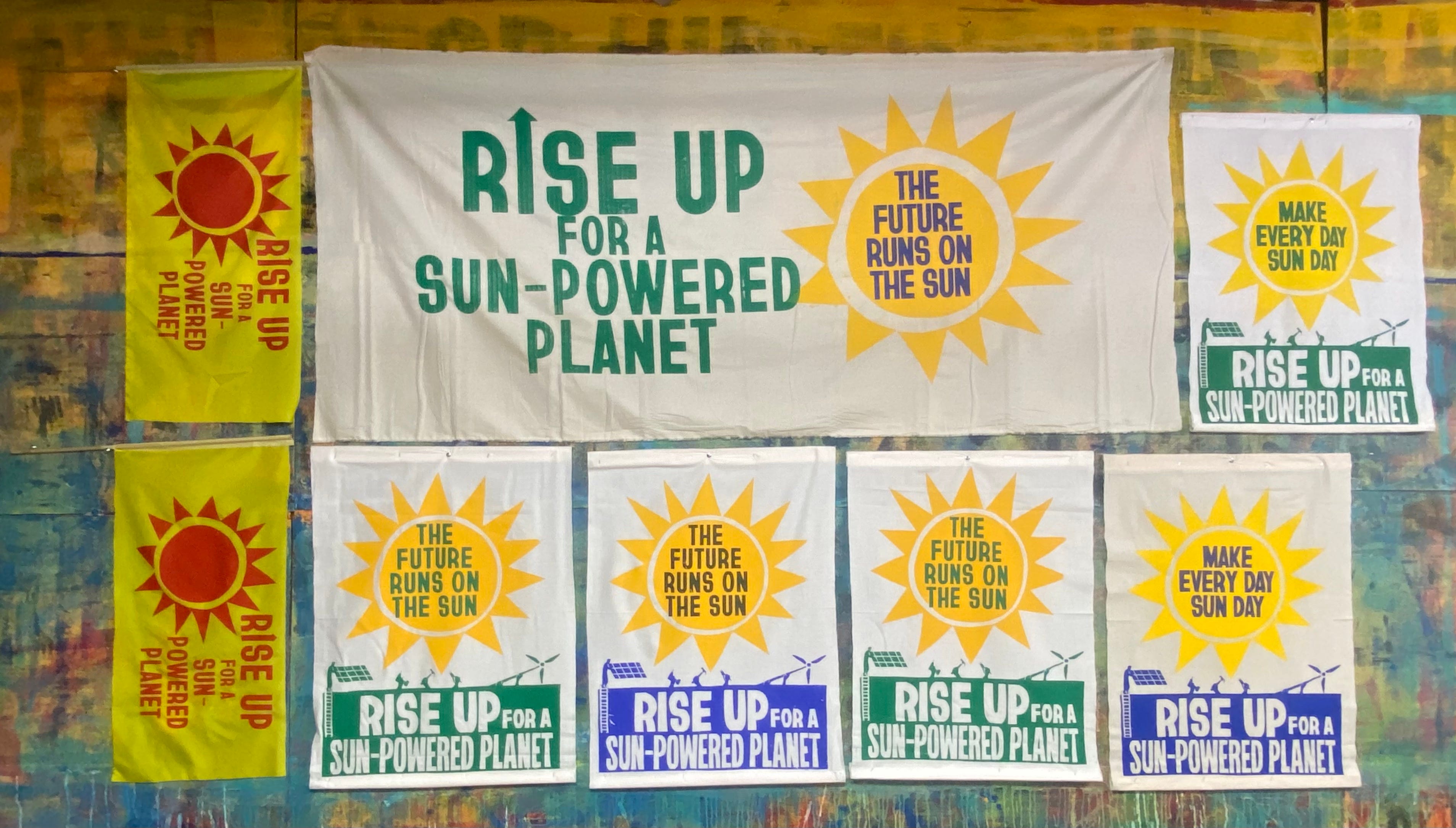
I’m leaving many people out but I want to get this account out while there’s still time for you to figure out where you’re going to be on Sun Day!
I’ll report back with a full account after the big day, but I want to say thanks to this community as well. It was here that I tested a lot of the ideas for Sun Day, and your feedback and support has been crucial. I am grateful for this community every single day.
In other energy and climate news:
+A huge and crucial new report today from the European think tank Ember on the “Electrotech Revolution” around the world. They argue—correctly—that supplying clean electricity from the sun and wind is just half the battle; the other is rolling out the stuff to make use of all that clean power. And they say that revolution is going remarkably well, especially in the developing world
Fossil fuel commodities get more expensive as extraction continues, and their prices are elevated by major producers controlling the supply. Electrotech is manufactured and modular, resulting in clear technology learning curves, with costs falling by around 20% every time deployment doubles. Electotech is already capturing two-thirds of global energy investment and is responsible for all the expected growth in energy jobs. Electrotech contributed 10% of global GDP growth in 2023, including 22% in China, 5% in India, 30% in the EU and 7% in the US.
As the authors insist:
Electrotech has grown exponentially for decades. The difference today is that it's too cheap to contain and too big to ignore. If current exponentials hold for five more years, global fossil demand will fall off its plateau.
+From Australia, a funny piece about Australian farmers who have to reassure people that they can farm just fine amidst solar arrays.
Gayle Lee’s voice ripples with the special kind of incredulity rural people reserve for certain city folk as she recalls an anecdote about electricians and sheep.
Early in her family’s experiment keeping sheep and solar panels in the same paddocks at their western Victoria farm, she fielded queries from worried electricians in Sydney, contracted to maintain the new power plant.
Who, they’d demanded, would put the sheep to bed at night?
Also from Australia, and less funny—the University of New South Wales is for some reason encouraging its students to use AI, and offsetting the huge energy demand with…carbon offsets.
+Here’s this year’s crew of Climate Breakthrough awardees, announced yesterday. For instance:
Liming Qiao (Singapore) is a pioneering strategist in Asia’s energy transition with over two decades of experience in everything from climate negotiations to renewable energy deployment. Through the program, Liming is creating the first coalition targeting grid flexibility and energy storage bottlenecks in the renewable energy transition across the ASEAN region, the world’s fourth-largest energy consumer.
+Amory Lovins—energy seer for more than half a century—has a new article predicting that nuclear energy will have a hard time competing with sun and wind
Each year, nuclear adds as much net global capacity as renewables add every two days. Soaring renewables generate three times more global electricity than stagnant nuclear power, whose 9% world and 18% U.S. shares keep shrinking. In 2023-24, China added 197 times more solar and wind than nuclear capacity, at half the cost. In May, China added 93 GW of solar, or 3 GW per day..
He also has a fascinating update from the newest “microgrid” in the country, at Redwood Energy in Sparks, Nevada
Twenty MW-DC of photovoltaics are laid flat on level ground. Water-recovering Roomba-like crawlers clean them nightly. About 800 battery packs from retired or crashed cars — the world’s largest use of second-life batteries — are wrapped in white plastic and set on cinderblocks, safely separated. They’re good for another few years, then hot-swappable. Novel power electronics and software meld those diverse batteries into 63 MWh of storage with 2-48-hour nominal duration. (Redwood Energy is already engineering similar microgrids an order of magnitude larger, enough to run most existing data centers.)
The resulting 100%-solar microgrid produces 10 MW-AC of ultrareliable 24/7/365 power that runs modular Crusoe data centers onsite, eliminating transmission costs, losses and approvals. This all-solar power is more reliable than grid power, cheaper than the utility’s 8¢/kWh retail price, and all built in four months.
+A troubling new study in Nature indicates that northern forests may not be anywhere near as large a carbon sink as we’ve imagined.
If the weak land sink hypothesis is correct, then the role of CO2 fertilization in enhancing forest carbon stocks might be overestimated. At the same time, projections of carbon accumulation in reforestation and afforestation projects, as incorporated into nationally determined contributions, may also be overly optimistic. A lower-than-expected land carbon sink would also imply that the land biosphere may be closer to transitioning from a net carbon sink to a net source than current models predict.
Meanwhile, as Matt Simon describes in Grist, a new way of measuring glacier retreat in Greenland is coming up with some uncomfortable data
Researchers have laid a fiber optic cable on the seafloor near a glacier in Greenland, revealing in unprecedented detail what happens during an iceberg-calving event, when chunks of ice drop into the ocean. That, in turn, could help solve a long-standing conundrum and better understand the hidden processes driving the rapid deterioration of the island’s ice sheet, which would add 23 feet to sea levels if it disappeared.
If you’ve seen video of a calving event, you know how dramatic that excitation can be, as a wall of water rushes away from the ice. (That’s technically classified as a tsunami, though a much smaller one than those that move across whole oceans after earthquakes.) But the DAS system also picked up a hidden movement of water beneath the surface, as waves — some as tall as skyscrapers — pulsed across the seafloor cable, raising and lowering the interface between cold surface waters and warm deep waters.
Typically, warmer, saltier water sinks to the bottom because it is denser, while colder, fresher water from glacial melt sits at the surface. The latter also forms a sort of insulating layer at the edge of the glacier, preventing more melting. But the fiber optic cable showed that as an iceberg dropped into the fjord, it stirred those warmer waters to the surface and disturbed the insulating layer, thus encouraging more melting of the glacier. And as the iceberg drifted away from the glacier, it stirred still more water, like a boat creating its own wake, but invisible under the surface.
+A new program in DC works to make sure that technicians properly recover refrigerants instead of venting the greenhouse gases into the atmosphere
As part of the pilot’s early success, Hugee Corporation, a local Certified Business Enterprise (CBE) operating as a HVAC and refrigeration provider since 1984, has already recovered and returned more than 200 pounds of refrigerant, saving approximately 400,000 lbs. of equivalent CO2 emissions. These savings are equivalent to avoiding the CO2 emissions from burning over 20,000 gallons of gasoline. This effort helps prevent potent greenhouse gases from entering the atmosphere and provides the District with an additional avenue to reduce its carbon footprint.
+Big Oil’s astroturf efforts to support a new North Carolina pipeline may have backfired, according to Mike Soraghan at EnergyWire
By the time Dan Besse clicked open the email message from "sexdemon@mocospace.com," he knew something strange was going on with the campaign to support a local gas pipeline expansion.
The message urged Forsyth County’s elected commissioners to support a proposal to lay 24 miles of new pipe alongside the existing Transcontinental pipeline in the area.
Hundreds more near-identical messages flooded in to Besse and the other six members of the Board of Commissioners, clogging inboxes and junk folders. But according to two commissioners, when they responded to the messages, their constituents said they hadn't sent the emails and didn't know what the commissioners were talking about.
+Chinese engineers have apparently figured out how to build two-blade wind turbines that can produce as much power as the traditional three-blade models
The design offers several practical advantages. With fewer components, lower weight, and improved transportability, two-blade turbines may offer cost and logistical advantages in markets where modular deployment is essential.
Lou Yimin, the company’s senior vice president and chief production officer believes that the company’s with the technology could pave the way for broader adoption in remote or developing regions where infrastructure constraints limit the use of bulkier three-blade systems.
+An important new study from the International Energy Agency finds that production from oil and gas fields is declining, in some cases quite rapidly
Decline rates vary widely across field types and geographies. Onshore supergiant oil fields in the Middle East decline at less than 2% per year, while smaller offshore fields in Europe average more than 15% per year, according to the report. Tight oil and shale gas decline even more steeply: without investment, output falls by more than 35% over one year and a further 15% over a second year.
So much for American “energy dominance” based on the Permian Basin. But as another part of the IEA document out today makes clear, we don’t need any more oil and gas development anyway, at least if we’re at all serious about climate change. As Simon Evans reports
In the 1.5C-compliant “NZE scenario”, the IEA says that a “huge acceleration in the pace of energy transitions relative to current trends” would see oil and gas demand falling dramatically.
It adds that if this drop in demand were to happen, then no investment in new oil and gas production would be needed, as shown in the figure below. Specifically, the IEA report says:
“The pace of demand reduction in the NZE [1.5C] scenario is therefore sufficiently rapid that, in aggregate, no new long lead-time conventional upstream projects would need to be approved for development.”
+Better to laugh than cry. A Mother Jones story out today shows that the Trump administration’s war on wind has one very big exception: a brand new bitcoin mining firm in Texas with heavy involvement from his sons which relies on…wind turbines.
The Vega center was built over the last year next to the Canadian Breaks wind farm, a 200-megawatt facility in North Texas. Since 2019, the wind farm had supplied inexpensive green energy to Texas’ power grid. But last year, the farm’s owners agreed instead to sell the facility’s energy to a subsidiary of a company called Hut 8, which owns that new bitcoin mine. The deal was a triumph for Hut 8. Crypto mining is profitable only if the electricity it runs on is cheap, and, the company’s CEO told investors, the new mine “benefits from some of the lowest locational wholesale power prices in North America.”
While watching this beautiful documentary, I noticed that the solar panel fields featured are being mowed (most likely by a fuel powered large mowing machine). An alternative management of the fields would be to allow the fields to become native plant habitats for local insect communities to find the resources they need to live and survive. This is being done in some communities already with great success. You may look into (I'm not related or have a financial interest in the business) a brand new business which provides wildflower sod to use when turning lawns and fields into native plant habitats. If you're interested go to https://www.meadowlab.com
Thanks for the continued great work.
This is one of the best and most comprehensive articles I've seen on this in a long time. Too much else ends up snatching our attention away from the life or death effort to save a livable, cleaner planet.
Remember while we wait for Sun Day there is another safe, silent, but strong at-home and about-town way to cut pollution and send a message to the dominating corporations: This is the first day of the economic blackout dubbed Blackout the System, from September 16 to 20. The media won't cover it, but if it makes a dent in their bottom lines the billionaires will care. Encourage your friends, as consumers, to show our power by not spending money at major retailers and chain stores. Do instead use small local businesses, family owned businesses and farmers' markets. You might find some new favorites and send a message with your $... or lack of it pouring into their pockets. For those already protesting, writing and calling representatives and engaging in other forms of active resistance this is an easy add.