
Just my imagination
Driving away with me

It’s probably because I spent the weekend with the mensch and novelist Kim Stanley Robinson—nice long hike on Saturday, and then listening to his superb Middlebury College commencement speech on Sunday—but I came away thinking more about the role of imagination in this work we do. In many ways, of course, the climate fight is just a hammer-and-tongs battle between Big Oil and Big Common Sense, with the first employing cash and corruption and the second relying on science, sincere affection for people and place, and scripture. (Speaking of which, a shout out to Pope Leo for this week’s bracing encyclical upholding the idea that humans should still play a central role even in this brave new AI world).
But sometimes, the combatants in that fierce battle can forget that most people aren’t engaged in it at all, and that there are ways to open their minds to new possibilities. It’s why, for instance, Sun Day last year featured not just great art and music, but also many people opening their doors—front, and driver’s side—to let others see their heat pumps or their solar arrays or their EVs, demystifying and then in some good sense remystifying the choices suddenly available to everyone. That’s one reason that there was such a surge of legislative action in Sun Day’s wake, and why we’re now closing in on ten states that will let their citizens employ plug-in solar units. (New York’s legislature is oh so close at this writing—if you’re in the Empire State, remind your Rep or Senator to pass the SUNNY Act).
In a small essay a couple of weeks ago on the trouble that Honda is having coping with the changing American politics around EVs, I thought Zachary Shahan made this point about imagination pretty well:
I actually see a lot of ads for electric vehicles. Many or perhaps even most of the car ads I see are for EVs, and not just on the internet where they are tracking my activity. I see ads for all kinds of electric vehicles on TV. However, they all seem to follow a similar formula — run a normal car ad, and maybe show the car plugged in for a second or two. I don’t recall ever seeing an auto ad highlight in an eye-opening or funny way how convenient home charging is, or how nice it is to never have to visit a gas station. I never see an ad highlight the unusual, fun, and useful benefit of instant torque. I don’t see them showing how much more relaxing and enjoyable one-pedal driving is. I don’t even see them making a point of the HUGE potential fuel savings!
That strikes me as a fairly important idea. Something like 16 million new cars will be sold in the U.S. this year, and the percentage of them that run on gas really matters; among other things, it’s key to breaking the political power of the fossil fuel industry. And this should be a great moment, with gas prices going Strait up. And yet if you watch a baseball game, the car ads are mostly the same as they always have been, with chevroned squads of cars tracking across a desert or bounding up a snowy road. (I have dear friends whose house in Castle Valley Utah is closest to the butte where carmakers helicopter in their latest models for those ads, which always struck me as particularly funny—displaying automobiles in pretty much the one place on our continent you can’t actually drive them).
What if, instead, you had an ad where somebody just looked at the camera and explained that they’d had theirs for a year and never visited a gas station because the gas station was in their garage. What if you had, say, a mechanic who was sad that EVs never needed fixing because they had so few moving parts? (Yes, I’m old enough to remember the Maytag repairman ads, which debuted in 1967, describing the sorry life of a man whose job it was to repair an appliance that refused to break. Those ads were good enough that I can remember them sixty years later). You could do worse than having this telegenic Stanford professor simply explain that driving an EV would save you somewhere between $20k and $40k over the life of a car.

In an ideal world, of course, you’d also be seeing ads reminding you to take the train, and pitching the virtues of an e-bike. And it’s not as if consumer choices alone are going to bend the curves that need bending steeply enough. But it’s more about changing peoples’s cognitive map (to borrow a phrase from Kim Stanley Robinson’s commencement talk), because that map is now outdated. In a world where ads made fun of gas guzzlers, it would be easier to elect politicians who upheld mandates.
Which, I suspect, is the reason we don’t see such ads. Most of the big EV makers also produce gas cars; they’re disinclined to cannibalize their sales. (And they know that car dealers generally hate EVs, precisely because they’re low-maintenance, to the point that they actively sabotage sales). It is a genuine stroke of bad luck that the main guy who just made EVs turned out to be a Nazi-saluting nutjob whose obituary will feature prominently the fact that he managed to kill a few million people in a weekend by shutting down USAID.
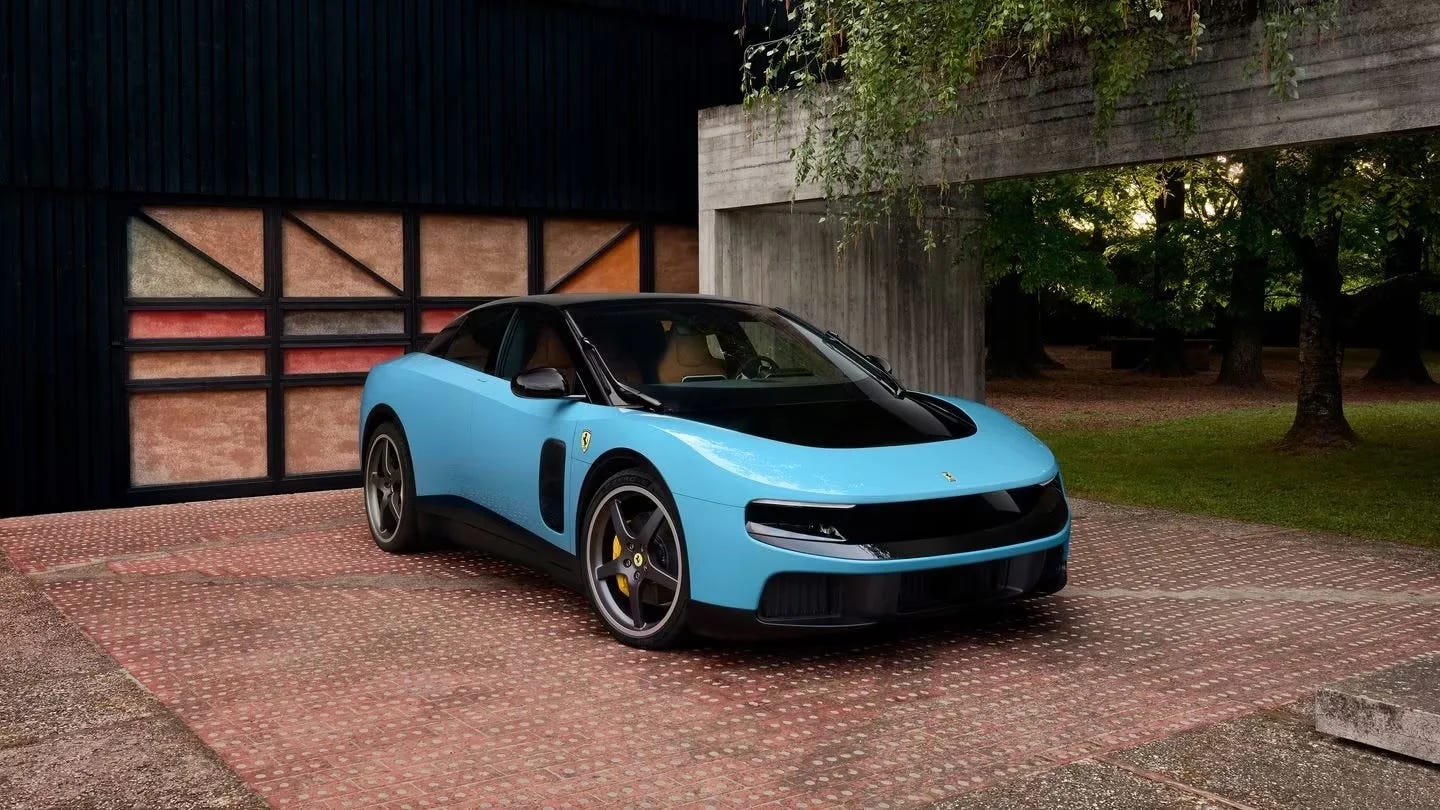
So we’re probably not going to see a slew of great ads. Instead, we’ll fight ongoing battles to ban Big Oil’s pitches (Amsterdam just put city-owned buildings and vehicles off limits, and Miranda Green argues the idea should spread). We’ll need Duncan Meisel to keep up his fight at Clean Creatives, pressuring ad agencies to stop collaborating with fossil fuel. But there are always glimmers. Here’s a brand new electric truck, no larger than a Mini-Cooper but which through some design legerdemain not only carries eight people but also your stuff. I’d watch an ad about that. Here’s the first electric Ferrari, designed by Jony Ive of iPhone fame and revealed this week to the, um, masses. But hey, the simple fact that the badge most associated with speed now comes in silent electric, with the Apple seal of cool, is something.
Politics is the place where the lack of imagination is most important, of course. The Canadian analyst Seth Klein, whose substack Emergency Measures crosses the 49th parallel in style, had some observations on this topic last week, timely in the face of sad retrograde action like Kathy Hochul’s in New York or (again in Klein’s telling) Mark Carney’s north of the border. As he points out,
even when governments are prepared to spend billions of dollars, these expenditures almost always take the form of tax credits, loan guarantees or even more wonky ideas like “carbon contracts for difference” – all efforts to incentivize private sector actors to make climate-oriented investments – rather than a willingness to spend big on public infrastructure.
This, in a way, was Joe Biden’s failure—the IRA was the right policy, but hidden behind such a welter of obscurities that the public never connected it with much of anything. Not surprisingly, Klein praises Kim Stanley Robinson, but also Molly Crabapple, whose 2019 animated portrayal of a working future—narrated by Alexandria Ocasio-Cortez—helped build the support for a Green New Deal that eventually got the IRA passed, albeit in badly amputated form. (Klein’s brother-in-law Avi Lewis wrote the script for that video; he is the newly crowned head of Canada’s left-wing party the NDP, not to mention the husband of Seth’s sister Naomi, who’s always had the deep imaginative gift for figuring out what the moment demands).
Climate communications guru Jamie Henn and former Rhode Island state rep Aaron Regunberg, writing in Jacobin, says making this kind of connection is absolutely necessary.
Fox News and the Koch network and the fossil fuel industry, flush with war profiteering cash that can be funneled into lobbying campaigns to further rig the game against renewables, will keep spreading disinformation and polarizing against climate action. And in the absence of a potent social demand for that action, the political will for real decarbonization — in the face of obstacles, trade-offs, and entrenched opposition interests — risks collapsing.
There are lots of important questions and debates we can and should be having about how to rebuild an explicit popular climate discourse over time. But the argument that we shouldn’t be trying to do that at all contradicts the polling data and is an argument for accepting climate catastrophe — something all of us should resist.
And here in fact is a government official making the case—David Hochschild, California’s energy czar, speaking on David Fenton’s podcast. It’s powerful stuff—after all, his state is using 60 percent less natural gas to make electricity than it was three years ago. (Oh, and for Californians, Leah Stokes making the correct case not to cut back on the state’s “demand-side grid support program.” Gavin Newsom is going to be running for a president with a lot of enviros asking questions).
More of this please. As Klein says,
Dire as things are, we all need to be alive to the hopeful trends: China looks to have peaked its GHG emissions, years ahead of schedule, and is producing a coal-power plant’s worth of solar panels every day; Europe is driving down emissions much faster than Canada; in Norway, 97 per cent of new vehicle sales are now zero-emission; in the UK, emissions are now lower than at any time since the start of the industrial revolution in the late 1800’s; Pakistan, Vietnam, and the Philippines are all cancelling plans to import LNG, turning instead to solar; and around the world, the adoption of renewable energy is exploding.
These, of course, are the stories I try to tell here, and for just the reason that Klein describes: we need to
bust open our collective imagination, so we can resolve to meet the emergencies we face, and mobilize around solutions as big as the crises we confront.
I confess that I, like the Pope (and that’s a fun phrase to write) have great faith in the powers of the particularly human imagination. Climate change, to me, has always seemed like a test of whether or not the big brain was a sound adaptation: obviously it can get us in a lot of trouble, but can it get us out of that trouble? The longer I live, the more I’m convinced that the answer to that question has mostly to do with the size of the heart that brain is attached to. In the end, “imagination” is about enlarging that heart.
We are ruled for the moment by a man with no discernible heart at all. (I mean, he skipped his own son’s wedding last weekend, doubtless annoyed at the thought of two hours where the focus was not on him). As a result, his “imagination” is confined to building every-bigger memorials to himself. May our revulsion take the form of building monuments to something much bigger: a working human future.
The day may come when imagination is no longer so necessary in this fight. David Roberts interviewed my old friend Pier Lafarge on his podcast last week, and they argued that the rapid spread of batteries may someday reduce electricity to the status of “cheap, abundant, and boring.” But getting there is going to mean more imagination, not less. It’s our job now.
In other energy and climate news:
+The climate world lost a key figure last week with the death of Rafe Pomerance, deputy assistant secretary of state for environment and development from 1993 to 1999 and an author of the Kyoto Accords. There have been many good obituaries, but I’d rather quote from his last essay, published a month ago from his Florida home, which argues that policy makers should set an “upper limit” on sea level rise in order to guide their planning.
Last week, the Upper Limit Project submitted a recommendation to the United Nations as part of its global consultation on a forthcoming Declaration on Sea Level Rise. The goal of that declaration is to strengthen international cooperation around one of the most immediate and irreversible consequences of climate change.
Our message was simple: The world needs a clear, measurable “upper limit” on sea-level rise to protect our communities and economies.
For years, global climate efforts have rallied around the goal of limiting warming to 1.5 degrees Celsius, as outlined in the Paris Agreement. That benchmark has helped focus policy and stimulate investment. But when it comes to communicating the necessary urgency, temperature rise alone misses the mark. It does not tell people what climate change will mean for their homes, their communities or their coastlines.
Sea-level rise does.
It translates abstract warming into visible, lived consequences: flooded streets, collapsed homes and infrastructure, eroding shorelines, disappearing wetlands and forced migration. Without a defined upper limit, we are navigating toward increasingly dangerous outcomes without a shared understanding of where the danger lies — or how to avoid it.
We measure what we value. If we value the survival of coastal communities, we must define the limits of what they can endure.
Establishing an upper limit on sea-level rise — a metric set to achieve the lowest possible rate of increase — would complement existing temperature goals and provide a tangible benchmark to guide decisions. It would help governments, businesses and communities better assess risk, plan infrastructure, and determine when adaptation is no longer enough and relocation becomes necessary.
+If you have a balcony solar system in Europe, you can now go to Lidl and put down 299 euros for a battery that will titrate the flow of electrons from your panel and supply your home through the night. This is not much money. Meanwhile, in Germany a virtual power plant comprised of hooked-together home batteries in just one company’s network this spring surpassed a gigawatt, making it as big as a nuclear power plant.
This allows us to use electricity exactly when it is available in abundance or feed it back into the grid when prices are high and supply is scarce," says Philipp Schröder, CEO and Co-Founder of 1KOMMA5°. "While politics continue to debate the construction of new gas-fired power plants as a reserve for times with little wind and sun, we at 1KOMMA5° see the enormous, existing potential in millions of private households."
+A state of emergency declared in Utah after their “no-pack” (as opposed to snow pack) winter.
“For much of the state,” AccuWeather Senior Meteorologist Tom Kines explained, “It’s been since October that they had a month of precipitation above the historical average.”
The forecast isn’t good. While the weather pattern over the summer might lead to more numerous thundershowers, especially during July and into August, it probably won’t be enough to end the drought since the rainfall deficit is large, Kines said
+The invaluable Jeff Masters reports on the latest findings in hurricane research, just as this year’s Atlantic season officially gets underway. In essence, we’re likely to see a bifurcation between years with little hurricane activity (as more wind shear in a warmer world knocks the tops off storms) and years with skeins of monstrous storms.
A 2025 study led by Avantika Gori of Rice University, Sensitivity of tropical cyclone risk across the US to changes in storm climatology and socioeconomic growth, looked at how damages from wind, rainfall, and storm surge would change under a moderate global warming scenario. The study found that the fraction of increased hurricane damages because of climate change would grow by the end of the century to be roughly equal to the increased damages from higher exposure (assuming a 2% annual growth in GDP). The combined increased costs for hurricane damage for the future (2070-2100) period compared to the historical (1980-2005) period would be truly extraordinary, if no additional adaptation measures are taken: a 633% increase, the paper said.
Gori’s prediction is by no means a worst-case outcome, because the study assumed a moderate global warming scenario. Even in a best-case scenario — which I’ll explore in a future post — development is going to continue in flood-prone places. And there are at least four ways that hurricane scientists are very confident that climate change will make hurricanes worse:
The strongest hurricanes will get stronger.
Hurricanes will rapidly intensify more quickly and more often.
Hurricanes will dump more rain.
Storm surge damage will rise because of rising sea levels.
+As northeastern governors falter in their efforts to bolster clean energy, they’re increasingly allowing new natural gas pipelines to be built—the kind of penny wise and pound idiotic step that will leave ratepayers stuck for decades to come. Enbridge’s Project Beacon would expand the size of existing pipelines in New England, for instance, as Miriam Wasser reports
" New England's energy challenges are not going be solved by increasing the supply of fossil fuels," said Caitlin Peale Sloan of the Conservation Law Foundation. "We fundamentally need to be looking at decreasing peak need for gas overall, and we need to be really carefully reckoning with the cost that these resources put on to customers and people who have to breathe air when fuels are being burned."
Opposition is forming to the plans as well. In New York, the once-rejected Constitution Pipeline is back on the books, and if you want to send a letter protesting the idea, here’s the address. If you’d rather hike, there’s plans for a 113-mile “Women’s Water Walk” later this summer but I am reliably informed that men will be welcome as well. As the organizers say
The pipeline would cut through 125 miles of forests, wetlands, wild habitats and rural farm communities and provide a corridor of power for AI data centers, fracked gas power plants and deafening compressor stations.
We refuse to allow these projects that put profit over life. We choose thriving communities, rich soil, productive farms, abundant fish, waterfalls, wildlife, clean water, healthy air, a stable climate, and the rich biodiversity of our forests.
+Coal plants not only fill the air with co2, they also fill the air with pollution that makes solar panels less effective. A new study spearheaded by Rui Song attempts to quantify the damage
A global, facility-level dataset shows that aerosols reduced global PV generation by 5.8% in 2023 (111 TWh). From 2017 to 2023, annual aerosol-induced PV energy losses from existing systems were, on average, equivalent to one-third of the energy added by new PV installations. In China, aerosols caused the largest PV energy losses worldwide, reducing national PV generation by 7.7% in 2023.
+From the excellent minds at the Pacific Northwest’s Sightline Institute, an argument that the climate solution “hiding in plain sight” is…apartments.
Erecting an abundance of apartment buildings, along with duplexes and other so-called middle housing, in cities and towns across America, is an impressively effective way to trim emissions of greenhouse gases. That’s largely because apartments are overwhelmingly more electrically powered than standalone houses, they use less land and building materials, and their residents require less transportation energy to go about their daily lives. Helpfully, too, there’s already a growing movement fighting for and winning the right to build more of these much-needed apartment homes: the pro-housing movement.
Climate leaders, dispirited by watching so many of their dreams dashed, could log gratifying victories for the climate in the immediate future by joining this swelling, bipartisan pro-homes progress. Indeed, they can reap large emissions reductions by shifting even slivers of their time and money toward pro-homes advocacy.
+Those radicals at the Wall Street Journal have decreed that the best and cheapest car deal in America is…used EVs.
With rising oil prices and more used EVs coming off leases every month, the total cost of ownership equation has flipped. A recent analysis by researchers at the University of Michigan found this holds true across a variety of vehicle types, U.S. cities and charging patterns.
“The reason why we’re seeing sales of used EVs grow so much is that they hit the right price points,” says Kevin Roberts, director of economic and market intelligence at the car-search site CarGurus.
“In an expensive, affordability-constrained environment, used EVs represent the best value for consumers now,” says Roberts.
+Speaking of cheap, as Jan Rosenow explains, Spain’s massive buildout of sun and windpower is producing some of the cheapest electricity in Europe for its citizens.
In a wholesale electricity market, the price in any given hour is set by the most expensive plant that needs to run to meet demand. For most of Europe, for most of the last decade, that has been a gas plant. The merit-order link from gas prices to power prices is the reason European households got an electricity bill shock when Russian pipeline gas collapsed in 2022.
What has quietly happened in Spain is that gas now sets the price far less often. In 2022, gas was the marginal plant in roughly 55% of all hours. In 2024 it had fallen to 27%. By the first four months of 2026, it was just 9%.
+The good folks at Faith in Place have been handing out test equipment to more than a hundred Chicago households, so they can monitor the air inside their homes—and if you ever wanted a reason to spend $60 on an induction hot plate, here’s what they found.
The majority of Chicago households are unknowingly living with and breathing unhealthy pollution (especially Carbon Monoxide and Nitrogen Dioxide) inside their homes that in some cases far exceeds health-protective standards for outdoor air.
They listed five key findings:
Carbon monoxide found in 8 in 10 homes; half of the homes exceeded outdoor standard.
It’s not the food. It’s the fuel. Stove use increased indoor pollution within minutes—quickly exceeding levels set for outdoor air quality standards.
In some homes, pollution was detected beyond the kitchen after stove use.
Kitchen ventilation was often limited or weak.
Testing changed how residents understood their homes.
+Climate activism—a potent force among the young for the last decade—is producing a remarkable set of leaders. Will Lawrence, co-founder of the Sunrise Movement that brought us the Green New Deal, is in a tight congressional primary in Michigan, and this week won the endorsement of fellow climate champ Bernie Sanders.
“Will is running an energizing, people-powered campaign and building a strong grassroots coalition that is prepared to stand up to Big Money interests,” Sanders said. “Will is exactly the kind of leader we need in Congress, and I’m proud to support his campaign.”
This is how it’s supposed to work, us old guys pushing forward the next generation.
+Finally, since we’ve been talking about imagination, here’s a quite wonderful stop motion animation from Sophie Davis and Luke Fatora, entitled Light.
An important aspect of electrifying transportation is that, once the internal combustion industry (ICE) is dead, it's dead forever - and for everyone. Between now and when the last gas-burning engine is sold, some 600 - 800 million ICE vehicles will be sold. That represents a lot of pollution, a lot of oil being purchased, and more military excursions funded by oil revenues. And of course, it provides billions in funding to the most right wing men in the world.
Progressives should not be buying gasoline.
Globally, some 25% of new car sales last year were electric. Here in the US, it was less than 8%. Digging further, I learned Americans bought over 15 million brand new gas-burning cars last year. That's over 41,000 every day! Every single one of them could easily afford an EV, but they chose the dirtier vehicle instead.
Given the electorate is 50/50, this means Dems are buying around 20,000 new gas cars every day. None of them should be doing this, and all of them are perpetuating the ICE industry as well as the sale of gasoline.
I would like to see Mr. McKibben address this issue. How can climate warriors dissuade folks on our side from ever buying a gas car again?
Keep in mind that once we kill the ICE industry, even MAGAs will have to buy EVs because we're going to eliminate their choice to buy a polluting car. That's some serious leverage we should be using.
Sometime soon we will reach a point where the shift to renewables takes off. It will be so fast and comprehensive that in retrospect it will seem inevitable. There's no telling what will trigger it, though I have a suspicion. Certainly high gas prices will be a factor. But it may end up working in our favor that our president, who thinks he's a master negotiator, is actually crappy at it, and all of our adversaries know it. He'll go into talks with the Chinese, and in exchange for a free flow of rare earth metals and another 20 years of freedom for Taiwan, we'll allow China to sell the EVs in the US that American car makers don't want to sell anyway. India will follow, and suddenly it will be like the 70s, when nobody drove an American car anymore.