
Night Into Day
The thing changing the world this year is...batteries.

I am beyond heartsick at the war and America’s role in it—there was a remarkable piece of reporting in the Times this morning showing the technology we’ve been spending our money and talent on. Apparently there’s a brand new missile, from Lockheed, called PrSM, pronounced prism and short for Precision Strike Missile. It’s a short-range ballistic missile, designed to “detonate just above its target and blast small tungsten pellets outward.” And on the first day of the war, when we were blowing up that girls school in Minab, we apparently detonated one of these things just above a sports hall where there was a girls volleyball tournament underway, and 21 people died.
Ground-level and satellite images of the aftermath show the sports hall with scorch marks and a partly collapsed roof. Footage from inside the school shows blown-out windows, fire damage and splotches of blood.
So I can’t talk about the war—my analysis from its first day a month ago is I think sound, and as you’ll see in the links below it is now becoming gospel: the conflict will drive people and countries towards renewable energy. But God not at this price.
Instead, today, I’m going to talk about what technology can do when we aim not for destruction but for progress. In particular I’m going to talk about batteries. If the last three years were about solar panels and wind turbines, this year—and the next few years—are going to be just as much about the storage systems for the energy they produce.
Back when the car was invented, people understood immediately that in most ways electric vehicles were superior to their gasoline counterparts—quieter, cleaner, cheaper to run. The trouble was always the battery: it was hard to store more than about fifty miles of driving, whereas a tank full of gas was energy deeply concentrated: 20 gallons could drive you Boston to New York no problem. In 1914 Henry Ford confirmed that he was working with Thomas Edison to develop a cheap electric car. “The problem so far has been to build a storage battery of light weight which would operate for long distances without recharging,” he said—and he never figured it out. Add two degrees to the temperature of the earth.
In fact, the range of electric vehicles stayed pretty much the same throughout the century. Some people had ideas, but they didn’t get too far, at least not quickly. If you really want to feel sad, here’s the story, from Charles J. Murray, of the original lithium-ion battery.
The first iteration, developed by M. Stanley Whittingham at Exxon in 1972, didn’t get far. It was manufactured in small volumes by Exxon, appeared at an electric vehicle show in Chicago in 1977, and served briefly as a coin cell battery. But then Exxon dropped it.
But others kept beavering away—an Oxford boffin, John Goodenough, figured out some new chemistries in the 1980s, and a Sony scientist, Akira Yoshino, figured out how to make it much safer, allowing his company to launch the first commercial version in 1991. by 1996, they were partnering with Nissan on the first EV with a lithium-ion battery, good for about 124 miles of range. (In 2019, Whittingham, Goodenough, and Yoshino shared the Nobel Prize in Physics; at 97, Whittingham was its oldest recipient).
Since then, steady improvements in lithium-ion batteries have been at the heart of the energy storage revolution. They’ve gotten much much much cheaper, and much much much lighter, so now it’s not at all odd to have cars that can drive from New York to Boston and back on a single charge. David Fickling has a good metric to show the progress: the price for storing four hours of electricity is now well below $100 a megawatt, even as oil surges above the $100-a-barrel line.
In recent years those gains have been coming fast and furious, but it’s not just lithium. The Chinese (who are the masters of the battery game) have figured out how to do the same tricks with sodium: Marija Maisch was reporting in January that these salt-based batteries are nearing price and performance parity, if not for cars then for utility scale batteries.
The first commercial utility-scale battery energy storage facilities are now being constructed and commissioned, including projects at the 100 MWh scale. “This demonstrates that SIBs are on the verge of full-scale market entry. Once supply chains are established and economies of scale take effect, there is essentially nothing to prevent sodium-ion batteries from fully taking over the market, provided that existing LIB lock-ins are manageable,” a Finnish says.
Meanwhile, the possibility of a solid-state battery seems to be becoming a probability. I reported in January on the news that another Finnish team at a company with the improbable name Donut Labs had announced they’d be producing motorcycles with this kit before the first quarter of the year was out. The announcement was met with skepticism, which has continued, even as Donut has released more and more data. But the reason for the excitement is clear. As Dan Neil said last week in the Wall Street Journal, a battery like this would end once and for all the talk of “range anxiety” that still prevents some from jumping in the EV parade.
The talk of the CES 2026 in Las Vegas, in January, Donut Lab says its battery has an energy density of 400Wh per kilogram—roughly twice that of typical lithium iron phosphate (LFP) batteries in production. The Donut batt can charge to full in five minutes, says the company; has a practically unlimited lifespan (100,000 charging cycles); is unaffected by heat and cold (-30C to 100C); and contains no rare earth, precious metals or flammable liquid electrolytes. With all that, Donut Lab says it will be cheaper to produce than conventional lithium-ion batteries…
If, as a thought experiment, we plug Donut’s nominal values into the battery pack of a current-model year Tesla Model 3 RWD Long Range, for example, we get a midsize EV sedan with a nominal range of 870 miles, compared to 363 miles for the Donut-free version.
No one knows yet if Donut Labs has cracked the case—it’s released a series of engineering reports, but according to Fred Lambert at Electrek they haven’t yet proved their most consequential claims of energy density and long life. But even if the Finns don’t pull it off in 2026, similar solid-state batteries are not far off. The big Chinese firms—CATL, and BYD—have in recent weeks announced that they’ve begun testing solid-state batteries in cars that can go 800 miles on a charge. As Peter Thompson reports,
Changan Automobile said it will begin trial installations before the end of Q3 2026. With an energy density of 400 Wh/kg, the company claims its “Golden Bell” all-solid-state battery can deliver over 1,500 km (932 miles) CLTC driving range.
Chery, another leading Chinese car manufacturer, revealed its all-solid-state battery that can also achieve a range of over 1,500 km (932 miles) during its “Battery Night” event on Wednesday.
And though China has the lead, it’s not just China.
In September, Mercedes drove a modified EQS over 1,200 km (745 miles) using 106 Ah solid-state battery cells supplied by US-based Factorial Energy. Factorial launched the first commercial solid-state battery program in the US through a collaboration with Karma Automotive earlier this year.
In fact, America is not trailing China as badly in batteries as in some other technologies. Though the GOP managed to cancel most of the money in Biden’s Inflation Reduction Act, significant quantities made it out the door before Trump took office, and it has bankrolled, among other things, a useful number of battery factories, enough that, as Julian Spector reported last week,
the country has made surprising strides in making those energy storage systems itself, rather than depending on imports from China.
Already, the U.S. has enough capacity to meet demand for finished grid battery enclosures. That involves connecting battery cells to power electronics, controls, and safety equipment in weatherproof steel containers that are ready to install. By the end of this year, the U.S. will also achieve self-sufficiency in a higher-value part of the supply chain: the battery cells themselves. It’s a major industrial coup that is bringing thousands of high-tech manufacturing jobs to communities across the country.
“For the first time, the United States now has the capacity to supply 100% of domestic energy storage project demand with American-built systems,” said Noah Roberts, executive director of the U.S. Energy Storage Coalition, on a Wednesday press call. “That is a fundamental shift from where we were just a year and a half ago, when the majority of battery storage systems were imported.”
And here’s where things start to get really interesting, because those batteries are suddenly pouring into utility electric grids, and in the process making already-valuable solar and wind farms all the more powerful. In essence, they’re turning nighttime into sunny noon.
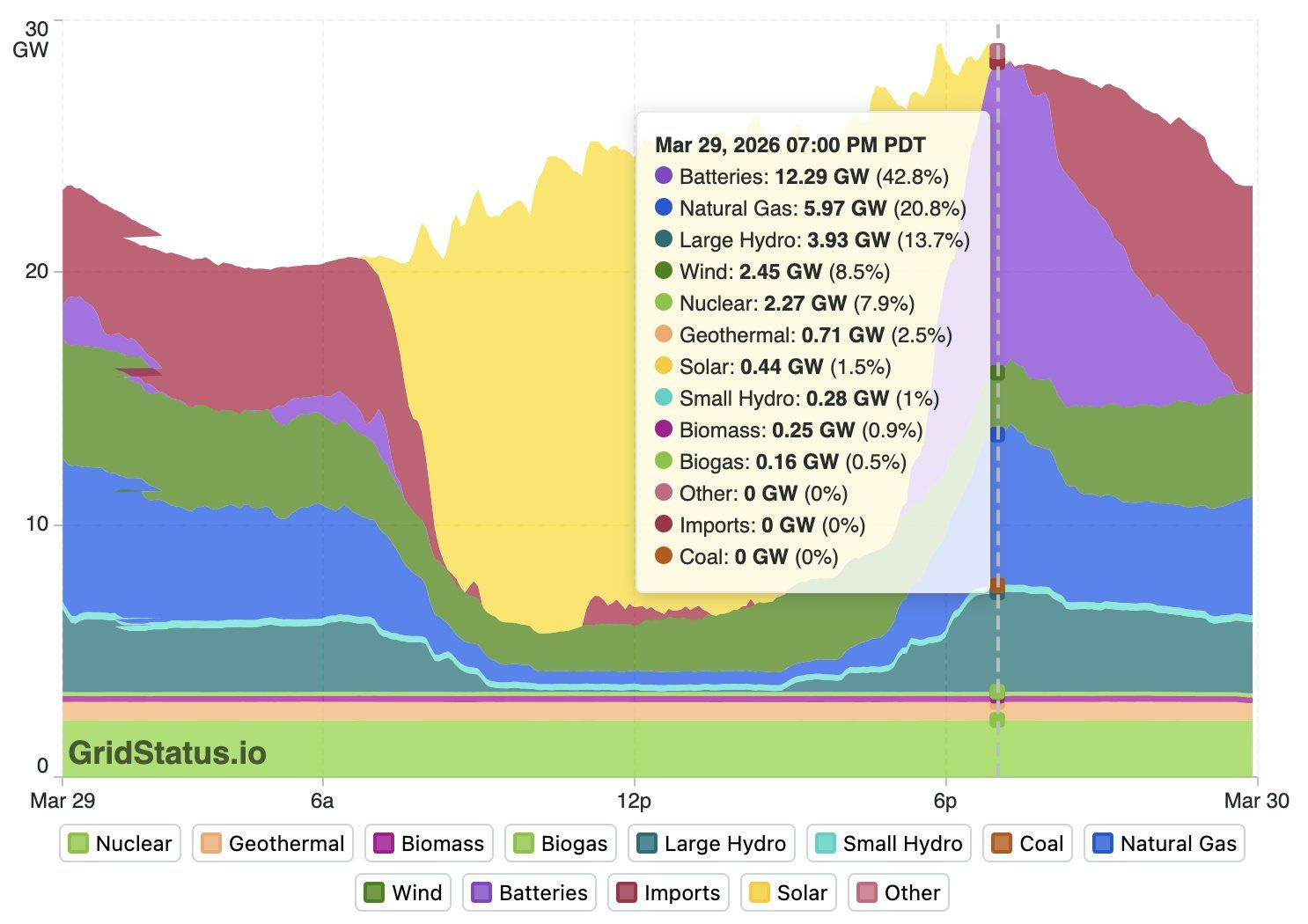
Which is why now is the time to scroll back up to the top of this article, and look at the graph there, courtesy of Nick Fulghum at Ember. It shows California’s electric grid yesterday. The huge yellow blob in the middle represents solar generation, the absolutely dominant source of supply from about 8 a.m. to 6:30 p.m. when it drops very quickly to zero. This is a phenomenon called sunset, which used to be the main argument against solar power.
But now look at the purple blob to its right—that’s battery storage coming online as the sun goes down. Those batteries spent the afternoon soaking up sunshine—cheap cheap sunshine—and now they’re distributing it back to the grid. As Californians get home from work, turn on lights, cook dinner, start charging their EVs, and run their frozen margarita machines (I may have an idealized idea of California life), batteries are providing most of the power, outstripping imported power (much of which is renewable too), natural gas, and other sources like nuclear. (You’ll notice wind picking up too, as the onshore breezes start to blow from the Pacific).
This is entirely different from how this graph would have looked even a year or two ago. Here’s how Fulghum explained it on Linked In, with some numbers that bear looking at
At 7pm, batteries reached 12.3 GW of output, meeting 42.8% of grid demand!
To put that kind of output during peak demand hours into perspective, it's equivalent to the output from:
- 15-20 combined-cycle gas plants
- 6 Hoover dams
- More than the all-time peak demand of Portugal or Greece
And it's not just a short peak anymore. Batteries stayed above 20% of grid demand from 5.50pm to 9.35pm, almost four hours, and above
And here’s the thing: this has all happened in the blink of an eye
More than 90% of California's battery fleet was built in the last five years. Total deployment is now over 17 GW, up from just 1.3 GW in 2020.
This could happen anywhere in the U.S., and in the world—it is happening in much of the world, especially China, of course. As Ben Payton points out in Reuters, the race is on for “round-the-clock” solar power. He cites a big project in the UAE, which (assuming it escapes the current rounds of insane bombing) is
combining the solar array with a massive amount of battery capacity, the aim is to store enough power generated during daylight hours so that a minimum of 1 GW of electricity – enough to power between 500,000 and one million homes – is available 24 hours a day, 365 days a year.
Across the world in Chile
On the other side of the world, Chile is looking to scale battery storage. The South American country has 9 GW of storage capacity in operation, construction or testing, with a further 27 GW in the development pipeline, according to the industry association ACERA.
“Chile is a very long country, so we rely very much on transmission to move energy from the north, where we have a lot of solar, and also from the very south, where we have a lot of wind,” says María Teresa Ruiz-Tagle, executive director of the Corporate Leaders Group for Climate Action (CLG) Chile. “So, to have battery storage projects in different points of the country could also help the system.”
She adds that storage is key to tackling the problem of the electricity grid being unable to absorb solar and wind power at times of peak generation. This is a growing problem globally, including in Chile. In 2024, 19% of all solar and wind electricity generated in the country had to be curtailed.
And the technological miracles are only beginning. For instance, Christopher Mims reported last week in the Journal on a new round of “thermal batteries” that store solar power as heat instead of electricity, perfect for use in high-temperature industrial processes.
The chemistry and engineering of this novel cement battery is deliberately simple, so as to make it scalable and cost-competitive. Take quicklime, otherwise known as calcium oxide, and just add water. The result is calcium hydroxide—ancient Roman cement.
This reaction releases a great deal of heat. It’s essentially the same thing that happens when you mix a bag of cement from the hardware store today. Roman engineers exploited that heat to create a fast-setting concrete, allowing them to build the Pantheon and other marvels.
But the reaction is also reversible: Add enough heat back to cement, and you can drive out the water and produce quicklime once more. When done right, it’s possible to recharge, discharge and recharge it again, many times. Just like a battery.
The technology, from an Illinois start-up, is being tested at an Ohio appliance factory
At Whirlpool’s Kitchen-Aid factory in Ohio, the company has found the system performs “even better than expected,” says Scot Blommel, Whirlpool senior manager of global sustainability.
Meanwhile, last week in Australia researchers announced the first fast-charging “quantum battery.”
CSIRO said quantum batteries leverage unique properties of quantum mechanics such as superposition and entanglement, while contemporary batteries typically rely on chemical reactions.
“The battery the researchers engineered has a multi-layered organic microcavity and is wirelessly charged with a laser,” CSIRO said. “The team used advanced spectroscopy techniques to confirm the prototype’s charging behaviour, which showed it retained stored energy for six orders of magnitude longer than it took to charge.”
In an article authored by Quach in The Conversation, he explained a counterintuitive twist to quantum battery storage unit behavior, where the units charge faster together than if they were charging alone.
“Let’s say your quantum battery has N storage units, and each unit takes one second to charge. Collective effects mean that if all units are charged at once, each unit will take only 1∕√N seconds to charge,” Quach wrote.
Do I understand a quantum battery? I do not, really. But I get the general drift, which is that we have world-changing technical prowess coming quickly online from many directions, which could—if we devoted all our efforts to deploying it as fast as possible—give us some chance in the climate fight.
It would also give us some hope of liberating ourselves from that old energy storage medium, the barrel of oil, before more people die in the ugly wars being fought over its ownership. But of course that would challenge the power of the richest people in America, which is why our current government will keep funneling money to Lockheed instead, so it can figure out how to kill girls playing volleyball with tungsten pellets.
We have to make a huge choice about where to point our intelligence, our technology, our hopes. November 3 can’t come fast enough.
In other energy and climate news:
+A roundup on coverage of the ways the war is driving a boom in greentech. At Bloomberg, Todd Woody finds
signs of a shift are playing out across the world. In Southeast Asia, buyers are flocking to Chinese EV giant BYD Co.’s stores, while electric rickshaws are selling out in Pakistan. A shortage of cooking oil in India is driving a run on electric stoves. From Germany to Nigeria, interest in rooftop solar is surging. And in the UK, some homeowners are taking the plunge on expensive heat pumps.
Here’s Rowan Hooper and Alec Luhn, at New Scientist, with a YouTube version making some of the same points—a fascinating conversation.
Around the world, showrooms for China’s BYD EVsare bustling as gas prices rise.
About 1,100 miles (1,770 km) away in Hanoi, Nguyen Hoang Tu Anh said his VinFast showrooms had to hire more sales staff after customer visits quadrupled, resulting in the sale of 250 EVs in the three weeks since the Iran war started. That works out to more than 80 a week, or double the average rate in 2025.
“Switching to EV will help us significantly save money,” said Lai The Manh Linh, a 41-year-old employee at a telecom company, who traded a gas-powered Toyota Vios subcompact car for a new, all-electric VinFast 5 compact crossover for his 60-70 kilometers daily commute to work.
If you want all this in more statistical detail, a new report from Ember is the place to go
This crisis will accelerate what was already underway. Asia, which imports 40% of its oil through the Strait of Hormuz, now faces the same reckoning Europe did in 2022 — but with increasingly cost-competitive electrotech alternatives available. The bull case for LNG as Asia’s transition fuel is now much weaker. And peak oil has been brought sharply forward: the International Energy Agency has already cut its 2026 demand growth forecast, and the peak it previously put at 2029 may already be here.
Similarly, from Ryan Cooper at the American Prospect,
Wherever renewables have been installed, they are turning out to be security gold. Experts tell E&E News that the Trump shock is certain to entrench China’s renewable focus, and it’s not hard to see why. When the dust clears, all nations with the slightest scrap of sense will be spending every available penny on energy security, meaning renewables. You’d have to be a complete clod, a world-historical imbecile, a man evincing such staggering stupidity that it calls his very sentience into question, to not get it.
+I like studies, and I like potatoes. New research finds that you can grow almost as many potatoes in a solar farm as if the panels weren’t there, you just have to tip them in slightly different directions at a few crucial points in the growing year. It just make me happy to think of academics out there doing this kind of stuff
“AT management during early tuber development partially mitigated yield losses, showing that dynamic light management can help balance agricultural productivity and energy generation in APV systems. Weibull-based modelling of tuber size distribution indicated a consistent shift toward smaller tubers under increasing shade, while tuber dry matter content remained stable.”
Somewhat more lyrically, Henry Carnell in Mother Jones has an excellent account of how some Oregon farmers are rallying behind solar farms, even as others continue to oppose them.
Unlike solar installations on sunnier, less-vegetated deserts or those on developed areas, agrivoltaics in temperate areas like Oregon get an efficiency boost because the vegetation cools the systems. Not all crops are suited for it; some see a yield reduction, and those that demand a lot of sun—like corn, soybeans, and cotton—are a better match for wind turbines. But other plants can actually benefit from the unique microclimate under the solar panels. Oregon State University hydrologist John Selker is researching a solar array in Corvallis, not far from Langdon’s property; he found that soil under agrivoltaics held water more efficiently, describing the panels as “miniature greenhouses.”
+A federal court in Alabama has ruled that the state’s utility can charge customers $25 a month for the privilege of putting solar panels on their own roofs.
“I am frustrated that Alabama Power solar customers like me have to pay an extra monthly fee in order to reduce our power bills,” said Mark Johnston, an Episcopal priest and retired executive director of Camp McDowell.
He added that “I want lower electricity bills and a better environment for my children and grandchildren.”
+Excellent news from Canada, where longtime climate activist Avi Lewis was elected on the first ballot to lead the country’s progressive New Democratic Party or NDP. Here’s Avi’s speech to the convention, with some great language about Canadian climate policy. His win was greeted sourly by the party leader in Alberta, who professed a desire to both reduce emissions and build pipelines; it’s about time someone called out this kind of magical thinking.
Meanwhile, Lewis’s brother-in-law Seth Klein has a fine piece about the LNG project that may be Canada’s next great carbon bomb.
While some may see the current crisis bolstering the case for Canadian-based LNG, it is equally plausible the war will serve to expedite the transition to renewables in the markets to which Canadian LNG producers hope to ship, as many are already doing. As Canada’s National Observer reported last week, two Nisga’a Nation members have just filed a lawsuit against their own government, claiming the Nation failed to adequately consult its own citizens about the purchase of PRGT, and that the project could become obsolete as other countries transition off fossil fuels.
+Book alert—Ayana Johnson’s magnificent “What If We Get It Right” is now out in paperback with book tour/dance party commencing soon. And veteran Canadian activist Maude Barlow takes on carbon markets and the like in her new Earth for Sale. Barlow led the fight against privatization of water; she’s always a voice to listen to.
+A beautiful account by Lucy Carrigan of the trial of six British protesters for breaking the windows at a big bank. I won’t spoil the (happy) ending, but do read it. Here’s a snippet:
Maggie Fay is the first defendant to take the stand. She has the look of a young Judi Dench. A sweet and kind, although worried face. She is an Admiral nurse, specializing in care for those who have dementia.
She acknowledges that she set out to purchase six center punches to “carefully crack” the windows at JP Morgan.
She mentions the link between air pollution and dementia.
In describing how she used that center punch, she makes the gesture of someone doing CPR on a patient, the firm and controlled back and forth motion of wrist against heart, the work that goes into keeping a person alive.
When the prosecution doubles down on her role in acquiring the center punches, she agrees. “I ordered them,” she says, forthrightly “I ordered six but I could only get four because they were out of stock.”
+Microsoft, whose founder Bill Gates has long pretended an interest in things climatic, is set to raise its companywide emissions 44 percent this year, by building a giant gas-fired data center in West Virginia. When people talk about the irresponsibility of the mega-rich corporations, here’s a perfect exhibit.
The research highlights how, in the rush to bring data centers online, companies like Microsoft “are essentially abandoning their pledges to protect the climate,” Rachel Kitchin, senior corporate climate campaigner at Stand.earth, said in a statement.
Microsoft has committed to reducing its carbon emissions, with a goal to become “carbon negative” and to power its data centers with carbon-free energy by 2030.
“You can’t claim to be a leader on climate and then build out massive fossil-fuel facilities that emit millions of tons of climate pollution and poison the people living next door,” Kitchin added.
+From the good folks at Mongabay, some reporting on the ongoing scandals around biomass. As Justin Catanoso writes,
Forest advocates are turning up the pressure in the Netherlands in an unprecedented way. In a possible first-of-its-kind action, the Dutch Public Prosecution Service is considering a criminal investigation against RWE, one of the Netherlands’ largest energy providers.
RWE faces allegations made by two forest advocacy groups that the company, which has collected billions of euros in Dutch biomass subsidies, misrepresented itself by claiming that hundreds of thousands of tons of wood pellets imported from Malaysia came entirely from sawmill waste.
The two advocacy groups, Comite Schone Lucht and Biofuelwatch, say their research establishes that those pellets come mostly from whole trees, contributing to Malaysian deforestation. The Public Prosecution Service, the sole authority responsible for investigating and prosecuting Dutch criminal offenses, is expected to decide how to proceed by the end of March.
+Damian Carrington reports on new satellite data showing giant methane leaks around the world—especially in the oil-and-gas country of Kazakhstan.
Super-polluting plumes were also seen in the US, the largest detected in 2025 occurring in Texas and leaking 5.5 tonnes of methane per hour, equivalent to running about a million fuel-guzzling SUVs. Venezuela (five) and Iran (three) also had multiple mega-leaks from state-owned facilities.
The Stop Methane Project also analysed super-polluting plumes from landfill sites, where rotting organic waste can release huge volumes of methane when not well managed. The worst sites ranged across the world, from Turkey to Algeria and Malaysia to the US.
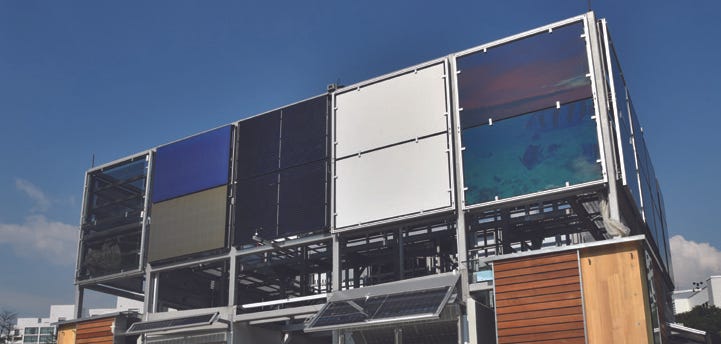
+Finally, a great report on solar panels that don’t look like solar panels, from the good folks at LandArt Generator. Here’s a glimpse of some of the designs on display recently
Cant happen fast enough. Without oil, theres no reason to fight over Hormuz. The dinosaurs are forcing one last battle as the meteor hurtles their way.
I'm eager to install batteries to translate our solar power into nighttime energy. But I can't bring myself to give a penny to Tesla. This battery news is promising and inspiring! #Gratitude