
Notes on winter
When the world turns whimsical

There are, increasingly, moments in our political life that defeat me, in that I don’t know how to respond. At all. When the president of the United States tweets out a picture of the Obamas as apes, it’s as if my cognitive mind slips a gear—I just found myself feeling incredibly sad, at the fact that America has gone into reverse. We’re working hard at Third Act to win November’s elections, because that’s the next big point of leverage, but sometimes, amidst all that work, one has to wonder if things can ever be right again.
Which is why I am so grateful that we’re having a stretch of true old-school winter in the northeast. It was twelve below zero when I went out to walk the dog this morning—the snow underfoot so dry it squeaks like styrofoam when you walk on it, the air so cold that when you breathe in the sides of your nostrils stick together a little. That this coincides with the start of the winter Olympics makes it even better—for a few short moments one can almost imagine that the world is spinning normally on its axis. This is the world that I remember.
I want to take a few short moments to talk about winter, precisely because we can no longer take it for granted—it is, by all accounts, in the process of more or less disappearing. And so I want to explain why I savor it. It is probably an indulgence, but I at least need the occasional indulgence to stay in the fight.
Many people, I am aware, endure winter rather than enjoy it. The weatherman on tv consoles viewers when a “blast of Arctic air” is on the horizon. Driving definitely gets more difficult when it snows. Because I ran a homeless shelter in the basement of my church (and indeed lived on the streets at a few points as a young reporter) I know how hard winter can be for people without good shelter. Shout out to Zohran Mamdani and the New York City Housing Authority for getting new electric heat pumps installed at a bunch of public housing units in the Rockaways. The new machines cut energy use 87 percent, half the cost of energy, and make homes comfortable.
“Regardless of whether or not we’re in a historic cold snap like we are now, families deserve to be warm in the winter. No one should ever have to see their breath in their apartments,” the Queens Borough president Donovan Richards said.
But if you’re not struggling to keep a house heated, I want to say a few words on behalf of this season. For my money, deep cold is far easier to deal with than deep heat—you just add another layer. And in return, you get the extraordinary bonus of being able to slide across the surface of the earth. If you think about it in slightly different terms, winter is not the season when it gets colder, it’s the season when friction releases its tight grip on the planet.
That’s what the entire winter Olympics celebrates, the giddy fact of slipperiness. If you went off a ski jump and just landed on dirt, you’d…stick. Figure skaters can revolve in dizzying pirouettes that ballerinas can only dream about, because ice. Downhill skiers hit 100 mph (sending good thoughts Lindsay Vonn’s way); here’s what that would look like without snow. But you needn’t be a great athlete to experience it, as the crowds at any alpine ski hill make clear. I can remember, many decades ago, cross country skiing through the Oslomarkka, the forest above the Norwegian capital. I’d watch very old men who would hobble across the parking lot, and need some help getting their skis on their feet—and then they’d glide gracefully off into the woods. (When I talked with them, they were likely to be veterans of the resistance, with wild stories of skiing off to recover arms caches airdropped by the Allies. “The Germans had the cities,” one told me. “But they weren’t such good skiers.”)
Looked at one way, then, winter is a moment of both silliness and elegance, a banana peel slipped under the assumptions of an ever-more-efficient economy, and a stretch when even the clumsy (like me) can acquire a bit of fluency.
If one tries to figure out what the point of everything is, it’s surprising to me how much human pleasure is derived simply from ways of moving across our planet: sailing, hang-gliding, canoeing, biking, motorcycling, roller-skating, running. Winter creates a whole other set of ways to be in motion. Speed skating: you’re going faster on a flat surface without gears than other form of locomotion, and when you cross over and push off on the corners you almost giggle at the force. I’ve gone down the Olympic bobsled run at Lake Placid, and mostly what I remember is the vibrating noise, speed made audible. Lie down on the luge and you’re pretty much in the hands of Isaac Newton and Lord Kelvin. (I closed my eyes).
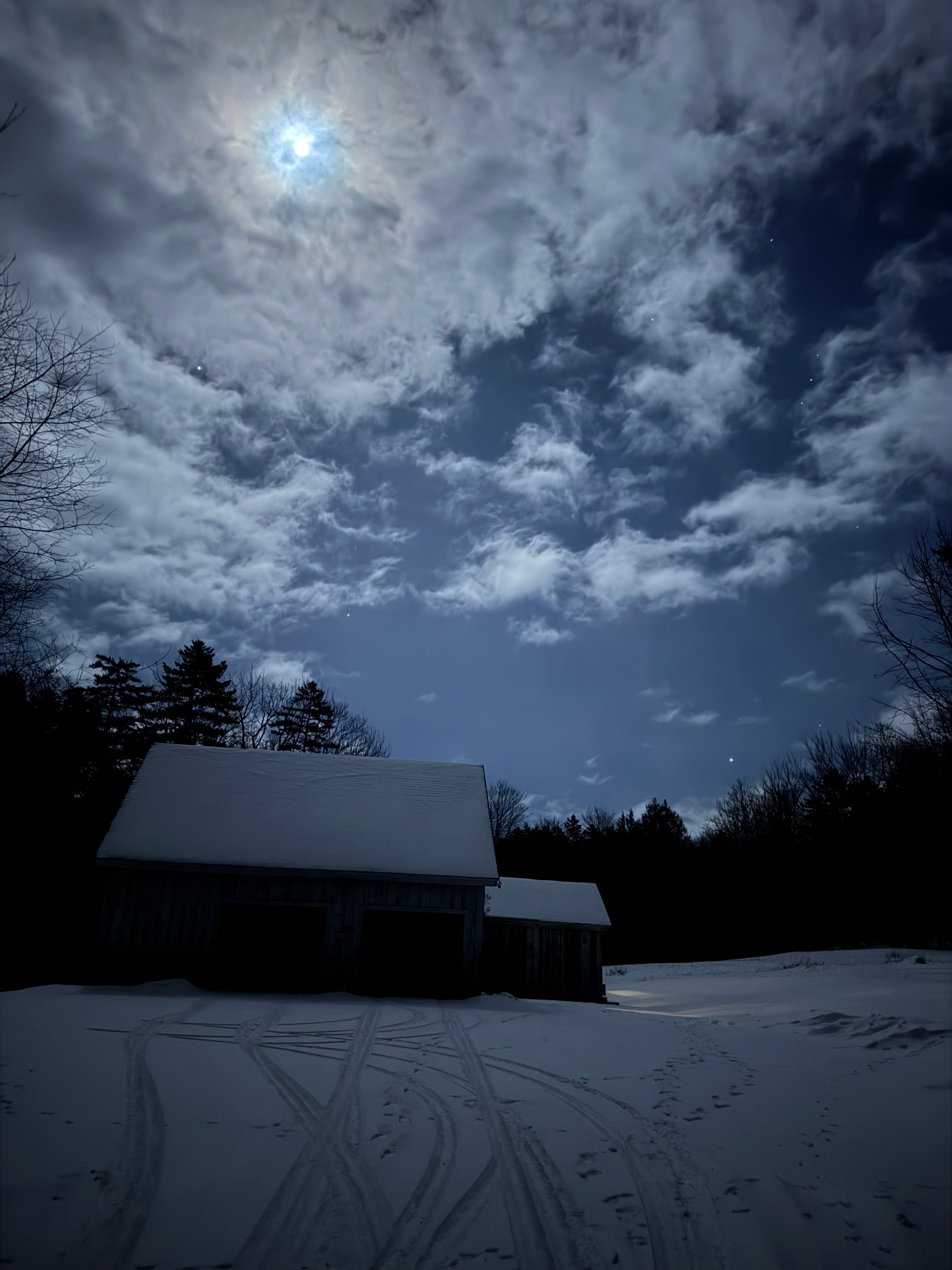
And of course winter comes with quieter pleasures too—indeed, the quietest place I’ve ever found myself is in a windless snowfall, the flakes muffling all sound. On cold nights like the ones we’ve had this past week, the. moisture is precipitated out of the sky and the stars just hang there, no twinkle or shimmer. Last week, when the full moon came out on the snow, Vermont was so bright it looked enchanted.
So does it get me heated that we’re losing winter? It does. I know that this year the West has been all but snowless, with record temperatures: a warm dry January left the region with the lowest snowpack in decades. As Amy Graff reported yesterday
Salt Lake City recorded a tenth of an inch of snow in January — a paltry amount there, compared with the nearly 13 inches the popular winter recreation destination records on average during the month.
“It’s embarrassing for a state that claims the world’s best snow,” said Jonathon Meyer, the assistant state climatologist at the Utah Climate Center.
“It was ice pellets that came down,” Mr. Meyer said. “You could make a claim that even though we did have measurable snow, residents of Salt Lake wouldn’t call it snow.”
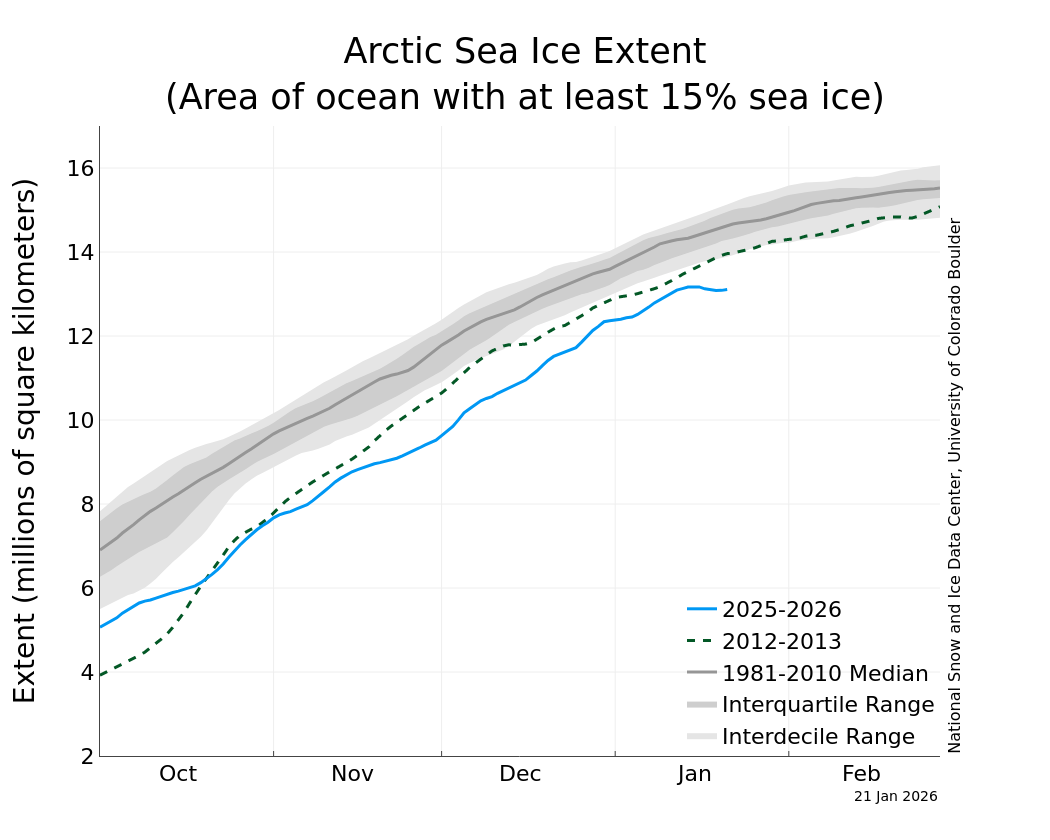
Our eastern cold comes from a “stretched polar vortex” that owes a lot to record melt of Arctic sea ice.
MIT’s Judah Cohen co-authored a July 2025 study that found more stretched polar vortex events linked to severe winter weather bursts in the central and eastern US over the past decade. Cohen said part of the reason is that dramatically low sea ice in the Barents and Kara seas in the Arctic helps set up a pattern of waves that end up causing US cold bursts. A warmer Arctic is causing sea ice in that region to shrink faster than other places, studies have found.
Arctic sea ice is at a record low extent for this time of year, according to the National Snow and Ice Data Center.
In any event, there’s. no question that we’re seeing ever less cold weather on average. Here in Vermont, Burlington has warmed faster than almost any city in the country, with 25 fewer days below freezing; on average, the coldest night of the year is ten degrees warmer than it was before the 1970s. Around the world the same. Here’s a chart of parts of the planet that were experiencing record heat this January (8.5 percent) and parts that were experiencing record cold (0.1 percent)
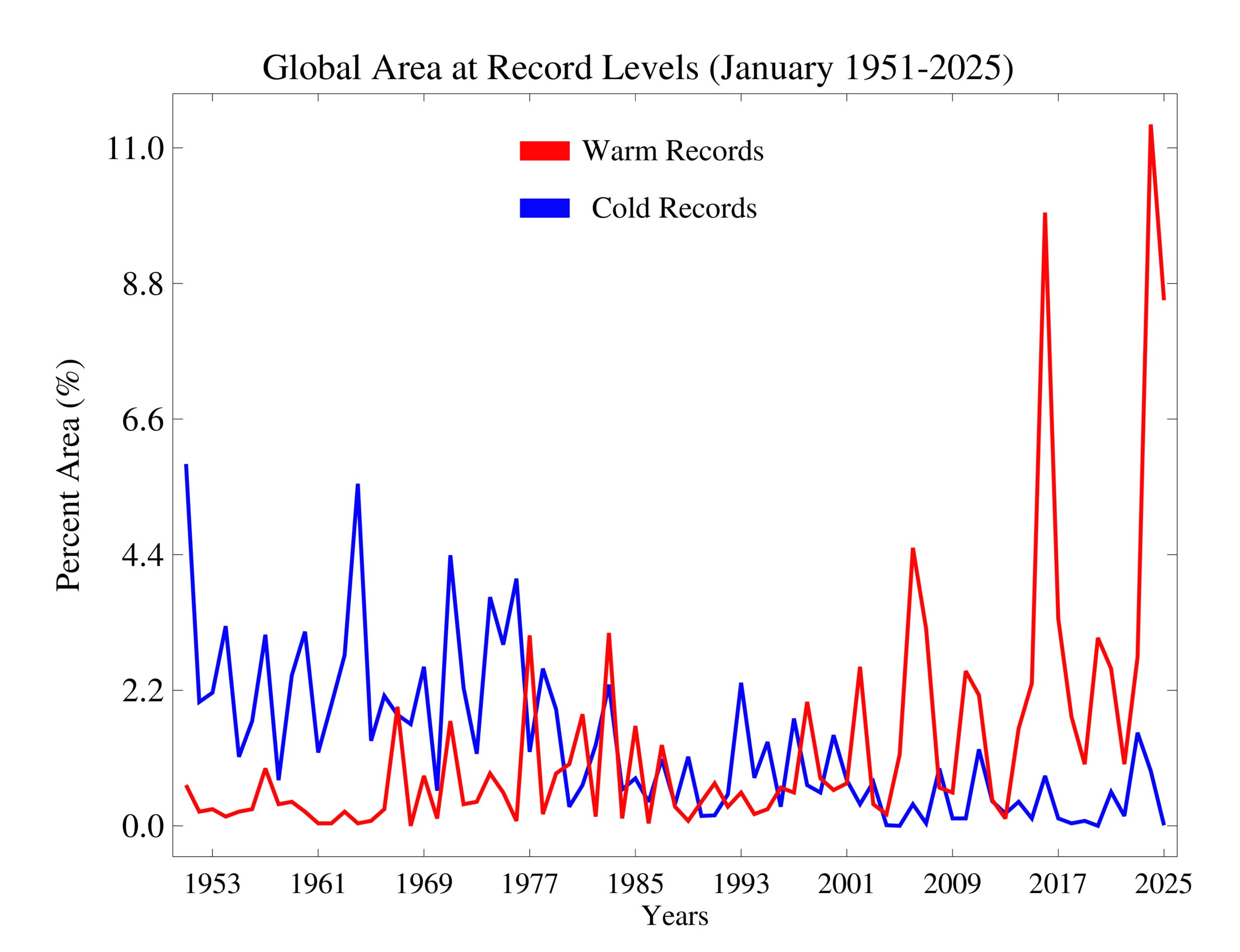
The last colder-than-average month on planet earth was in February of 1985, which means that no one under the age of forty has ever known one. What’s happening, right now?
Australia is reeling from a record heat wave that has pushed temperatures past 120 degrees Fahrenheit, or about 49 Celsius, in some areas, leading to fires and power outages. In central Africa, brutal heat has shattered records in recent days, with countries north of the Equator hitting temperatures above 101 degrees Fahrenheit.
All of this, of course, is the work of the fossil fuel industry, and so it was good to see a Norwegian skier handing the IOC’s head of sustainability a massive petition as the games began, asking that they consider the appropriateness of letting oil and gas companies sponsor these sports.
The petition asks the IOC and the International Ski and Snowboard Federation, FIS, to publish a report evaluating the appropriateness of fossil fuel marketing before next season. Nikolai Schirmer, a filmmaker and two-time European Skier of the Year, spoke exclusively with The Associated Press outside the hotel, and said the IOC informed him that it would not allow media to witness their meeting.
“It seems like the Olympics aren’t ready to be the positive force for change that they have the potential to be,” Schirmer told the AP afterward. “So I just hope this can be a little nudge in the right direction, but we will see.”
“The show goes on while the things you depend on to do your job — winter — is disappearing in front of your very eyes,” he said. “Not dealing with the climate crisis and not having skiing be a force for change just felt insane. We’re on the front lines.”
(Here’s a link so you can sign)
Lots of other winter Olympians have been hard at work trying to preserve winter too. Sammy Roth has a nifty profile of a Candian-Italian women’s hockey player who’s been deeply involved with Eco-Athletes
The nonprofit works with athletes around the world to promote climate action and sustainability. Jacqui Pierri is one of 260 EcoAthletes Champions, along with MLB pitcher Brent Suter and WNBA star Napheesa Collier. They use their platforms to advocate for a safer planet — although Pierri, with her unique combination of climate chops and world-class hockey talent, offers an especially informed perspective.
“If you play a sport outdoors, this is dramatically impacting the future of your sport,” she said. “Hockey we play indoors, but most hockey players fall in love with this sport playing outdoors as a kid. Especially if you’re a Canadian.”
In America, nordic skiers like Gus Schumacher and (world-leading) Jessie Diggins have been at the forefront of the climate fight, working with groups like Protect Our Winters. (Much gratitude and respect to Diggins, too, for speaking out about the atrocities in her home state of Minnesota: “I want to make sure you know who I’m racing for when I get to the start line at the Olympics,” she wrote on her Instagram. “I’m racing for [the] American people who stand for love, for acceptance, for compassion, honesty and respect for others. I do not stand for hate or violence or discrimination.”)
The rapid retreat of winter means that all that whimsy and serendipity and grace will keep disappearing—higher up the mountain, further north, for ever-shorter stretches of a vanishing season. (Or of course on Saudi Arabia’s planned manmade snow resort). As Laura Millan and Hayley Warren explained this week, “all the cities that staged the Winter Games since 1950 have heated up in the years since by an average of 2.7C (4.9F), according to scientists at Climate Central. That’s well above 1.4C, the warming average for the entire planet.”
Rocky Anderson was mayor of Salt Lake City the last time it hosted the Olympics in 2002. "I don't think we're going to see a Winter Olympic Games in Utah in 2034," he said recently.
So we keep up the climate fight, in the hopes of saving some of the world we were born into. And when we do get a lucky stretch of cold and snow, we savor it for all it’s worth. I’m headed out right now for some gliding through the forest.
In other energy and climate news:
+Sporting stars are also helping out with other climate crises: Morocco has seen record floods in recent days, and soccer great Achraf Hakimi is organizing relief efforts.
These violent floods resulted from heavy rainfall that struck the north of the Kingdom of Morocco in recent days. The city of Larache was especially hard hit, with at least 50,000 out of its 120,000 residents evacuated according to authorities.
When we talk about unprecedented rainfall, here’s today’s update on the situation:
The four provinces were hit by flooding since Jan. 28, as water levels continued to rise in the Loukkos River after the Oued El Makhazine Dam reached 156% of its capacity for the first time, causing it to overflow, according to official data.
The reporter said rescue teams are using helicopters, military trucks, speedboats, drones, and specialized relief equipment to evacuate residents from affected areas.
+The LNG industry is starting to admit the future doesn’t look so bright, even as the Trump administration underwrites its pell-mell expansion. From Priscila Azevedo Rocha:
The current arrangement, where 90% of LNG is sold to utilities under long-term contracts, risks running into difficulties because many companies and countries have made net-zero commitments, according to the CEO of industry leader Trafigura.
“If they have made those commitments, signing a 20-year contract or a 25-year contract that starts in 2030 is inherently problematic,” Holtum said. “And it doesn’t necessarily make a lot of sense to be doing that.”
+One sign that sanity hasn’t entirely deserted America: a pro wrestling crowd chanting “Fuck Ice” last week. Another comes from this annual sustainability report from, of all places, NASCAR. At one level, the car-racing enterprise seems to represent our MAGA moment: roaring consumption of fossil fuel, mostly in deep-red states. But it’s also a big company with real responsibilities, and those don’t get shed overnight. The report has sections on helping veterans, aiding with hurricane recovery, and though it certainly doesn’t call it DEI, it talks about the special “employee resource groups” for Black, Hispanic, Asian, gay and women’s communities. And on the environment, it details “exciting progress” in “cutting emissions.”
In 2023, NASCAR set a goal to achieve net zero operating emissions by 2035. Simply put, this goal applies to the fuel and electricity we consume in our operations at NASCAR-owned racetracks and league offices. Over the next 10 years, we need to reduce the energy we consume as a business and significantly increase our use of cleaner, more renewable energy sources
Now, there’s more talk of biofuels than seems entirely sustainable to me, but there’s also this news:
Through the ABB NASCAR Electrification Partnership, NASCAR’s first electric race car, the ABB NASCAR EV Prototype, was launched in July 2024. Built by NASCAR engineers in collaboration with Chevrolet, Ford, and Toyota. It features: a 78-kWh liquid-cooled battery with a powertrain that produces 1,000 kW at peak power, regenerative braking and three STARD UHP 6-Phase motors, Goodyear tires made from more sustainable materials, and Crossover Utility Vehicle body made of BComp, a plant-based flax composite
In 2025, Chevrolet and Ford also introduced electric NASCAR prototypes, each with 78 kWh batteries. The Chevy Blazer EV.R NASCAR prototype delivers over 1,300 horsepower from three 6-phase electric motors that instantly rev up to 15,000 rpm. The Ford Mustang Mach-E NASCAR prototype is a 100% electric racer and features three motors
No need to read more into this than you want—but it’s also worth noting that the NFL didn’t blink when the White House came after Bad Bunny. Some people can evidently imagine a different future.
+Along the same lines, Trump’s pollster this week discovered that whaddya know, MAGA voters like solar power.
It found that 51 percent of respondents support utility-scale solar—large power plants that feed electricity into the grid—while 30 percent oppose it.
Support jumps to 70 percent if the panels are domestically produced and free of Chinese components
+And further along the same lines, Canadian prime minister Mark Carney made it clearer than ever where he sees the future last week. After signing a trade deal that allows in some Chinese EVs, he has now announced a sweeping set of steps designed to make Canada a part of the EV game going forward. As Ian Austen and Jack Ewing report, it seems pretty clear that Carney can imagine a different future too, and doesn’t want it foreclosed by wasting the next three years.
“Canada is an auto nation, the auto industry is central to our story,” Mr. Carney said. “The auto industry is the core pillar of the Canadian economy.”
Mr. Trump has inflicted significant pain on Canada’s auto industry, which exports about 90 percent of its vehicles to the United States, imposing a 25 percent tariff on Canadian vehicles. Mr. Trump has said he does not want cars sold in the United States to be made in Canada and wants to drastically increase domestic production.
But Mr. Trump’s dismantling of the trade policies that have knitted together the North American auto industry has led to a sense of urgency for Canada to look for alternative markets and strategies.
Canada’s plan aligns the country with a shift to electric vehicles that is well underway in Europe and China. But Mr. Trump and Republicans in Congress are doubling down on vehicles powered by fossil fuels, eliminating incentives that encouraged people to buy electric vehicles.
Canada is a relatively small market for U.S. automakers, but it is a major supplier of components and finished vehicles. The biggest danger for U.S. automakers may be that they are becoming increasingly isolated from foreign markets and disconnected from technological trends sweeping the rest of the world.
Oh, and to round out the news about electric cars, a new satellite study of southern California finds that the air is definitely clearer where more EVs are on the road. Michelle Lewis has the story
The headline number is modest but measurable: for every 200 ZEVs added in a neighborhood, NO2 levels fell by about 1.1% between 2019 and 2023.
The study, just published in The Lancet Planetary Health and partly funded by the National Institutes of Health, adds rare real-world evidence to a claim that’s often taken for granted – that EVs don’t just cut carbon over time, they also improve local air quality right now.
+Academics: a new-to-America group—the Climate Justice Universities Union—is forming here. You can sign up
+It seems like I’ve been writing about sodium-ion batteries since this newsletter started, first as a glimmer in the eye of researchers, and increasingly as a reality. This week comes news that CATL, the Chinese concern that is the world’s biggest battery maker by far, is placing big bets on the technology. As Christopher Arcus points out
Sodium is the sixth most abundant element on Earth. Sodium-ion cathodes combine sodium and other abundant elements. The electrolyte contains sodium carbonate and a solvent. One type of sodium cathode, Prussian blue, contains sodium, iron, and nitrogen. In general, other sodium-ion cathodes consist of abundant materials like manganese. CATL uses a Prussian blue analog for the cathode. Layered oxides are another sodium cathode used for highest energy density. Sodium is two orders of magnitude more abundant and proportionally less expensive than lithium.
Meanwhile, the beat goes on for plug-in or balcony solar, which is getting closer to approval in many state legislatures across the country. Here’s the news from the Green Mountain State
Plug-in” solar units, sometimes referred to as “balcony solar,” since the panels are often hung off apartment or other home balconies, got a unanimous thumbs up from the Vermont State Senate last Thursday, Jan. 29. The bill, known as S.202, will modify provisions for residential solar generation and connection to home electrical circuits. It will eliminate the need for permits or a solar user obtaining a state “certificate of public good” before operating it. Instead, all a customer of an electric utility would need to do is fill out a basic notification form that they have installed such a device and plan to use it.
And more good news from the Old Dominion, which is steadily expanding the use of community solar.
On a plot of land along Route 58 in Suffolk, about 9,000 solar panels sat soaking up the sun on a recent afternoon.
“What we have in front of us here is much like what you might see on your neighbor’s house who’s got solar, but many, many more panels,” said Brandon Smithwood, vice president of policy for Atlanta-based solar developer Dimension Energy.
The property is about 20 acres, “much smaller than the big utility-scale projects we see here and elsewhere that can be thousands or more.”
This Suffolk site is one of Virginia’s first shared, or community, solar projects. The industry’s slowly building after lawmakers launched a pilot program several years ago.
+Fascinating—a new study finds that racial gaps in the use of rooftop solar is not due to differences in demand.
Racial patterns in consumer demand cannot explain the gaps in installation we observe: indeed, Americans of color are as or more pro-solar than White Americans. This is a simple finding but an important one, as it shifts the responsibility for racial solar inequality away from Americans of color and toward the supply side of the market.
+Damian Carrington has a fine essay in the Guardian about the flawed economic models that continue to mislead policy makers the world around. Those models focus on the average damage to GDP (itself a flawed number) and don’t account for the damage that increasingly comes from weather extremes.
Tipping points, such as the collapse of critical Atlantic currents or the Greenland ice sheet, would have global consequences for society. Some are thought to be at, or very close to, their tipping points but the timing is difficult to predict. Combined extreme weather disasters could wipe out national economies, the researchers, from the University of Exeter and financial thinktank Carbon Tracker Initiative, said.
Their report concludes governments, regulators and financial managers must pay far more attention to these high impact but lower likelihood risks, because avoiding irreversible outcomes by cutting carbon emissions is far cheaper than trying to cope with them.
“We’re not dealing with manageable economic adjustments,” said Dr Jesse Abrams, at the University of Exeter. “The climate scientists we surveyed were unambiguous: current economic models can’t capture what matters most – the cascading failures and compounding shocks that define climate risk in a warmer world – and could undermine the very foundations of economic growth.”
“For financial institutions and policymakers, it’s a fundamental misreading of the risks we face,” he said. “We are thinking about something like a 2008 [crash], but one we can’t recover from as well. Once we have ecosystem breakdown or climate breakdown, we can’t bail out the Earth like we did the banks.”
Mark Campanale, CEO of Carbon Tracker, said: “The net result of flawed economic advice is widespread complacency amongst investors and policymakers. There’s a tendency in certain government departments to trivialise the impacts of climate on the economy so as to avoid making difficult choices today. This is a big problem – the consequences of delay are catastrophic.”
Hetal Patel, at Phoenix Group, which manages about £300bn of long-term investments for its customers, said: “Underestimating physical risk doesn’t just distort investment decisions, it underplays the real‑world consequences that will ultimately affect society as a whole.”
+Roger Hallam, one of the founders of Extinction Rebellion in the UK, has a new book called Suicide: The Political and Legal Implications of Creating Endless Mass Death. Hallam, a veteran campaigner, spent much of last year in a British jail on dumb charges of conspiring to block traffic, after a dumb trial in front of a dumb judge. Happily he is now out, and back on the stump. Here’s a little taste:
The historian Arnold Toynbee once said “Civilizations are not murdered; they commit suicide.” That’s where we are now. This system - this neoliberal, capitalist machine - isn’t just extracting resources and exploiting the poor, as previous systems have done. It’s actively destroying the future of everyone, including the rich and powerful.
It’s a mass death project we need to stop.
The prisons we are building are not just physical cells like the one I’m sitting in now. They are mental and moral prisons created by a system that has lost the ability to think clearly, to reason, to act in defence of life itself. And it is this inability to think - the very thing that should define us as rational beings - that lies at the heart of the disaster we are entering.
+From the great Louisiana environmental leader Roishetta Ozane, a short video about the pipeline explosion in the Bayou State last week.
And the hideous Drax company, cutting down American forests to pour carbon into the British air, has a new whistleblower, who according to the Financial Times is suggesting the company has not been forthright about the source of its wood
+Finally, this is not new, but it is new to me, since my grandson is now nearly two and has reached the age where songs are a big part of his life. There is, eternally, Raffi (a devoted environmentalist, by the way), but there’s also Laurie Berkner, and her masterpiece Chipmunk at the Gas Pump, which is, as its title promises, about a chipmunk running a service station who eventually changes his ways. Anyway, if it doesn’t make you dance, nothing will
He was a very good worker
Who was fiercely independent
He made a fine living as a gas station attendant
But Harry loved the Earth
So he called all of his relations
They helped him turned that pump
Into electric charging stations
Thank you for sharing information about good things that are happening, and the good people who are making them happen.
Thank you. My ex and I went to a talk you gave 15 years ago near Woodstock Vt, promoting 350.org and sounding the alarm on global warming. He is an ex now. He simply would not and probably to this day, will not accept the facts of global warming. I live in Vermont full time now for ten years. This winter is a delight to me. The cold is very much appreciated by me. Vermont is my home BECAUSE there is still cold here.