I write this under an ashy, yellow northeast sky; smoke from wildfires in Ontario and Minnesota swept across the region in the middle of the night, and I awoke at 3 (as I too often do in these parlous times) with stinging eyes. But I will try to see clearly enough to discern some of the latest numbers in the climate and energy battle—numbers which prove to me the economic folly of staying on our current course.
To me, I admit, these are secondary—there’s not enough money on earth to make me want to condemn people to a few centuries of waking up in smoke, and I know without calculation that a clear blue sky is worth almost any price. But I also know how the world works, and so I want to provide people with the ammunition they need to carry on this fight—and the last few weeks have seen that ammunition piling up in the arsenals of logic and thrift. There is at this point no doubt that the world would operate more cheaply on clean energy, which is a lucky thing, and one that needs to be hammered home till the conventional wisdom (that sun and wind and batteries are a luxury) is finally routed.
If you find yourself flush at the moment, don’t burn the cash—take out a modestly priced and entirely voluntary subscription to help keep this project afloat. If you are in tough financial shape, then no worries, just read!
The most basic point, of course, and yet one often lost in the debate is that once you’ve installed renewable energy you no longer have to pay for fuel. IRENA, the International Renewable Energy Agency, put a number on that in its annual report at the end of last month.
In 2025, renewables helped to avoid an estimated USD 480 billion in fossil fuel costs and around 8.4 gigatonnes of carbon dioxide emissions.
If we round the number of our fellow humans off to about 8 billion, that’s $60 for every man, woman and child on the face of the planet, even though we’re still fairly early on the adoption curve for clean power. The numbers are stark:
Since 2010, the cost of solar PV has fallen by 89%, onshore wind by 71%, and offshore wind by 63%. This highlights how renewables are now the cheapest source of new electricity in most markets. In 2025, more than 90% of newly commissioned, utility-scale capacity delivered power at a lower cost than the cheapest, newly-installed fossil-fuel-based alternative.
If you move from energy generation to energy efficiency, the numbers are just as interesting. Mark Gongloff, in a charming essay that begins by noting GOP umbrage at Mayor Mamdani’s suggestion that during a heatwave 78 degrees would be a good setting for the AC, goes on to show how the Trump administration is gutting the ongoing federal effort to make appliances more efficient. Cost?
Higher standards available to the DOE could save the average US household $160 a year and all US businesses $15 billion a year in electricity costs between 2030 and 2050, according to the Appliance Standards Awareness Project (ASAP), a nonprofit research and advocacy group.
And what about making money? Dan McCarthy describes a new study from the “business-focused” think tank E2 that shows that the clean energy projects—at least 216 in number—cancelled since Trump took office would have supplied at least half a million good jobs.
Trump took office amid an unprecedented surge in the clean energy economy. The 2022 Inflation Reduction Act spurred the rapid construction of both renewable power projects and domestic factories intended to build solar panels, electric vehicles, batteries, and other crucial cleantech.
But the boom went bust pretty much as soon as Trump won the election in late 2024.
Just as an example, here’s a story from a few days ago about the administration stymieing four windpower projects in Minnesota that would have produced not just a gigawatt of badly needed clean electricity, enough for several hundred thousand homes, but also 1,100 construction and 4,400 “indirect jobs,” for a total economic hit of $168 million.
If you want to try to add it all up, here’s another analysis, from the people at Energy Innovation. Their model shows that, taken together, the result of the major Trump era moves on energy policy will be that
Households will pay an additional $650 billion for energy – an average of $460 per household in 2035 and $490 in 2040.
And their attacks on EVs, which mean that more Americans get to shell out at the gas pump year after year, will
inflate gasoline prices 14 percent in 2035 and 26 percent in 2040, atop near-term upward pressure from the Iran war and other market forces.
and the One Big Beautiful Bill, by removing incentives for a quick energy transition, will
cost the U.S. economy 820,000 jobs per year on average over the next decade, in addition to the 144,000 clean energy jobs lost[1] within the past 18 months.
And
Slowing down electrification and domestic energy manufacturing will lower GDP in all years, totaling $2.3 trillion cumulative lost GDP, with effects flowing into other economic sectors. The U.S. economy will lose $150 billion in GDP in 2030, peaking at a $250 billion net loss in 2032, then reverting to losses of $200 billion in 2035 and $120 billion in 2040.
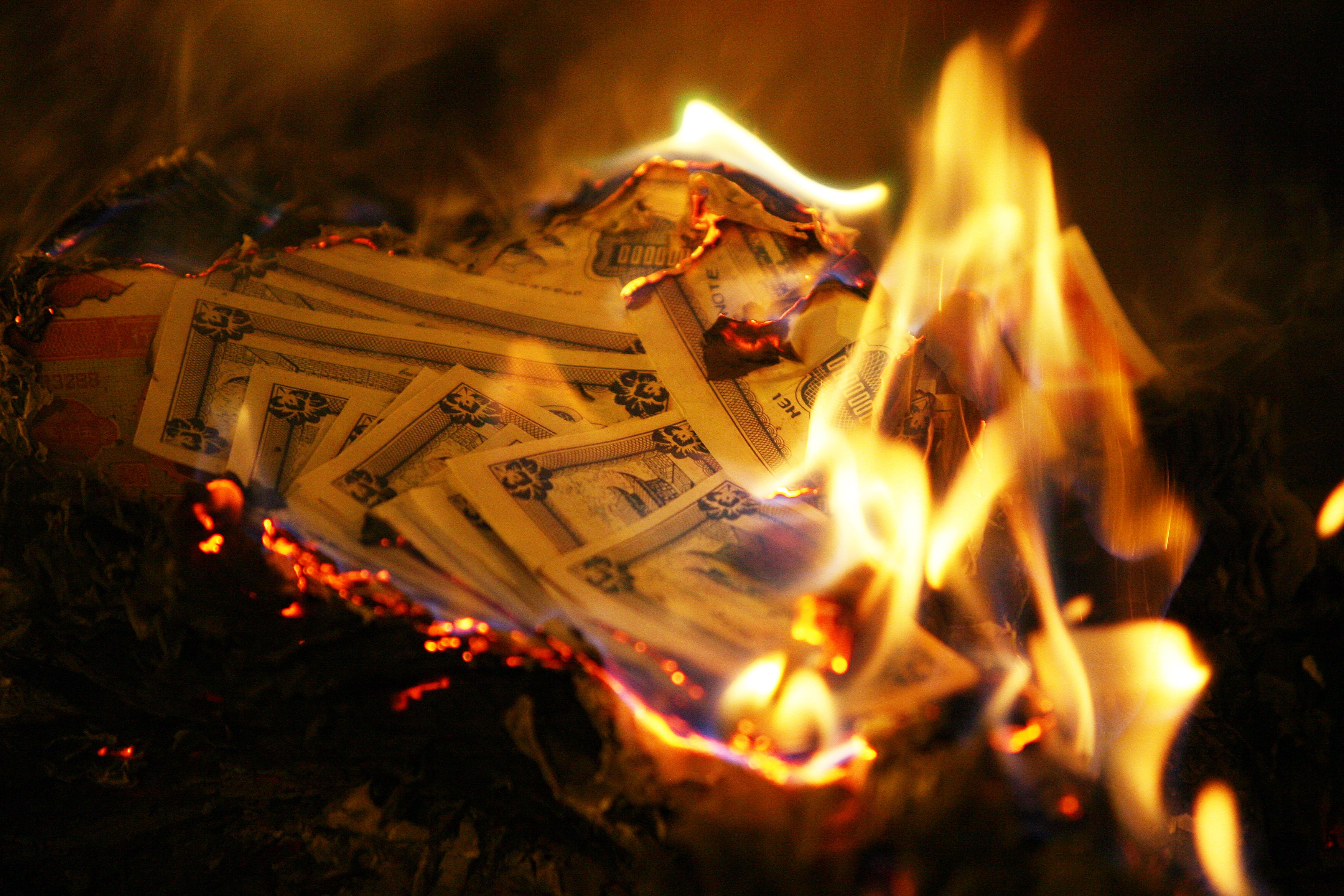
This all amounts to setting money on fire—almost unbelievable amounts. And real money—not notional SpaceX shares, now plummeting; not weird Kalshi bets. It’s money that families have to fork over, month after month, if they want to keep the lights on and the minivan trundling down the road.
And of course the numbers grow exponentially larger if you even try to calculate the public health and climate costs of burning ever more fossil fuel. The Energy Innovation study again:
Worsening local air pollution will raise healthcare costs by $43 billion, with annual increases of $4 billion in 2035 and $4.5 billion in 2040, contributing to rising household costs alongside rising energy prices and goods inflation.
And here’s a new report in the premier science journal Nature from Anders Levermann on the economic costs of a heating planet even before we hit the biggest and most expensive tipping points
By definition, tipping points are reached when a series of interlinked changes amplify one another until the whole system becomes unstable and shifts uncontrollably into a different state. Loss of sea ice at the poles, for example, reduces the amount of sunlight reflected into space, further heating Earth’s surface, which then accelerates ice loss. These vicious cycles of change define a tipping point, at which the climate cannot return to its former patterns.
Before that point, the climate system becomes increasingly unstable. It fluctuates considerably — a rise in variability is a well-established property of such ‘non-linear dynamical systems’ approaching a critical threshold. That society will face these fluctuations and that they will intensify through the tipping transition hasn’t been realized by scientists and policymakers, so far.
Earth will experience an increasingly erratic climate: more and stronger fluctuations in flows of melt water, ocean circulations and the extent of sea ice. These changes will lead to more frequent and intense extremes in temperature, precipitation and storms — leading not only to more heatwaves and droughts, but also to more cold spells and floods.
Modern economies are adapted to relatively stable climatic baselines. Agricultural productivity, infrastructure design, insurance pricing and financial risk management all rely not only on expected mean conditions but also on the predictability of variability.
Farmers need to factor in lost harvests; architects and urban planners need to account for extremes of temperature, wind and rainfall; and financiers and insurers need to consider the cost and scale of damages. But once these factors are no longer predictable, all bets are off — life becomes uninsurable and the world becomes unsafe.
In case you think scientists are the only ones worrying, Richard Partington discusses new analyses from leading bankers that attempt to put some numbers on these emerging dangers: the rapidly approaching El Niño, for instance, is threatening massive “food shocks” that will stretch into at least 2028:
“El Niño puts ‘climateflation’ back on the agenda,” analysts at the Italian bank UniCredit wrote in a research note. “Europe’s recent heatwaves are a reminder that the climate baseline is already shifting. El Niño could add a new layer of pressure later this year, as it amplifies the effects of global warming.”
According to analysts at Goldman Sachs, the strength of this El Niño could cause a 15.8% surge in global food commodity prices. That would have a knock-on effect worldwide, including for consumers in Europe, where it predicted food prices could rise by 1.3% across the eurozone.
Unlike politicians, bankers actually try to do something to limit their risk. As Ishika Mookerjee reports, private equity funds are unleashing an increasing army of “heat detectives” to figure out the climate risks of their investments.
A Bloomberg Green analysis of the latest sustainability reports published by 12 of the largest alternative asset managers show overall mentions of physical climate risks and related terms nearly doubled from a year before, with Carlyle Group Inc., General Atlantic LP, KKR & Co. and Partners Group AG seeing large increases. Funds tend to identify floods and cyclones as the most immediate risks. Most are now screening their portfolios for vulnerabilities to heat and treating it as a long-term, chronic risk, especially for their combined private equity assets totaling more than $700 billion.
Given all that, the endlessly maddening question is why are we still headed down this path. Why is Gov. Kathy Hochul not listening to the private equity sleuths headquartered in her state’s financial capital and instead signing up New Yorkers for 40 years of new natural gas pipelines, and why is Hawaii flirting with LNG? Why is the Trump administration doing everything it can to run our bill ever higher?
If you think the answer must be that there’s some competing policy formulation that comes up with different numbers, think again. Here’s the remarkable account from Jonathan Swan and Maggie Haberman of the first meeting between the oil industry and the Trump White House after the 2024 election.
At one point during the meeting, the executives began complaining about the Climate Superfund bills that had recently passed in Vermont and New York. As they spoke, Trump’s policy adviser, Stephen Miller was texting the attorney general Pam Bondi. “I’m on it,” Miller told the group. Less than two months later, the administration sued both states seeking to block enforcement of the laws.
In another instance, the ExxonMobil chief executive, Darren Woods, voiced concerns about European Union regulations that required big companies to monitor and reduce the environmental effects of their activities and develop “climate transition plans.”
Haberman and Swan report that, upon hearing this, Trump instructed Commerce Secretary Howard Lutnick to impose additional tariffs on the E.U. until they abandoned those regulations.
At another point in the meeting, held in the Cabinet Room on March 19, 2025, Miller asked the executives in attendance for a list of 10 projects the White House could help fast-track and requested that they “highlight how much more energy the projects would produce in the United States during the Trump presidency.”
And in one of the most fateful exchanges, the Chevron chief executive, Mike Wirth, pushed for an extension of the firm’s license to operate in Venezuela.
Less than a year later, the Trump administration had seized the country’s leader, Nicolás Maduro. Shortly after that, Chevron expanded its presence in Venezuela.
Yesterday I called Swan to discuss this reporting, and he described to me a room filled with some of the most powerful executives in the world, stunned by what they were witnessing.
“They were almost in awe,” Swan told me. “There was no semblance of a policy process, but rather the C.E.O.s were raising their grievances, and Trump was essentially saying, ‘Make it so, it shall be done.’”
Indeed, as David Fickling reports, Big Oil has no choice but to rely on gaming political systems, because private investors have shifted most of their money to clean energy. That means that subsidies are ever more important
The cost of these measures looks set to rise to about $1.1 trillion this year, according to a study last week by the United Nations Development Programme. If crude averages $110 a barrel over the full year, it could climb as high as $1.43 trillion. That’s almost as much as was spent on such subsidies during the year the Ukraine war started in 2022.
Whatever the final figure, the amount of government cash support pumped into the fossil fuel system this year will be running close to the amount that both public and private investors were prepared to invest in it. It’s an extraordinary situation for an industry that claims to be governed by capitalist laws of supply and demand, rather than statist central planning.
Just to reiterate: instead of speeding the conversion to clean cheap energy, which would save households huge amounts of money, we’re instead shoveling taxpayer cash to the fossil fuel industry, and in the process overheating the earth, which will be the most expensive thing that ever happened, by orders of magnitude. The most important thing the planet’s leaders could possibly do is flip this switch, and reverse these flows—we’ve clearly got the money, since we’re shelling out these huge sums in subsidies. Fickling again:
This support is so pervasive that in most places we don’t even notice or question it. That has to change. Governments must stop throwing sand in the gears of the energy transition.Far from reducing as the climate emergency intensifies and heatwaves claim thousands of lives, they have been doubling down on counterproductive support for polluting fuels, while loading tariffs and regulations onto clean energy.
The horrible irony here is that markets are coming much closer to getting things right than our political institutions, which are currently doing all they can to maintain the status quo. Our next real chance to disrupt that madness? November 3.
+Climate displacement is one of the defining crises of our time, and Josh Fox’s new film, The Welcome Table, finds a new way in: The veteran documentarian and activist gathers climate survivors to share their stories and show a path forward. The film is streaming now on HBO Max, but many groups are hosting screening parties, and raising money for local organizations; if you sign up to host a watch party they’ll send you a special screening guide.
+Chilean salmon farming is environmentally problematic, but a little less so when it runs on solar power, not diesel. Kelly Lipke reports on one farm where fish have found protection from sun and predators beneath the shade of floating panels.
+The always-important Tom Athanasiou has a long and eminently readable report from the “fossil fuel transition” conference in Colombia this spring. It’s the most eyes-open account of the session I’ve come across
Fossil fuel extraction must be phased out at a breakneck pace with almost complete cessation by 2050. Similarly, the build-out of fossil fuel infrastructure must stop immediately. There’s no room—even in poor countries—for new oil and gas fields or coal mines. All effort must go to the construction of zero-carbon infrastructure.
Yet none of this is even conceivable unless the overall effort is very widely accepted as fair. This judgement will be made in many ways and many places, and not in abstract terms. For example, the tension between “phasing down” and “phasing out” fossil fuels is anything but abstract, and it won’t be easily reconciled. At Santa Marta, the “oil-rich African nations” insisted they would keep drilling as they transitioned to renewables. Onuoha Magnus Chidi, an adviser to Nigeria’s regional development minister: “Not phasing out—phase down. That is the message… We are phasing down, and we are saying that there should be early planning. It must be fair to all.”
I find his point impossible to dispute. The alternative has to be: if a phase-down strategy is pursued with adequate ambition, and if it takes proper account of both the North/South and rich/poor divides, then it becomes a phase-out strategy that can honestly be defended as being “fair to all.”
+Matthew Shaer has a superbly reported piece in the Times today on the folly of America’s automakers, mostly standing by as they watch the world move towards EVs
According to the International Energy Agency, a Paris-based policy group, one of every four vehicles sold globally in 2025 was battery-powered. Analysts with Bloomberg have predicted that in the next decade, that number will more than double, putting gas-powered cars — for the first time ever — in the minority of overall new vehicle sales. Overseas, Asian and European manufacturers have spent years preparing for this eventuality, dumping billions into the development of battery technology. With predictable results: China now makes 75 percent of all E.V.s sold anywhere on earth. (The United States makes around 5 percent.) Many of those vehicles are produced by BYD, a Chinese company that recently became the largest manufacturer of battery-powered cars in the world.
+If you were worried that plug-in solar represented a safety risk, a new white paper should put your mind at ease; it’s nothing like the risk from gas and diesel generators.
Meanwhile, the fabulous folks at the Bright Saver nonprofit just dropped a new deal. Now that ten state legislatures have approved balcony solar (so many thanks to my Third Act colleagues around the country!), they’re going to be offering the panels at cost to anyone who signs up for a membership
The nonprofit is selling systems for “what it costs us to purchase in bulk from the manufacturers,” Bright Saver’s Cora Stryker said. She declined to name those manufacturers, noting that the organization is brand-agnostic and could switch at any time.
Bright Saver sells a 180-watt kit for about $285 and a 360-watt kit for $414. To access these prices, you first have to become a member, which costs $29 annually (with renewal optional). Otherwise, a 180-watt kit is $499, and a 360-watt kit is $699.
The organization aims to be the Costco of clean energy; only members can access the deep discounts. And more product deals are coming. Bright Saver plans to offer plug-in home batteries that work with balcony solar kits as soon as next year.
With the membership, the 180-watt kit works out to $1.74 per watt. The 360-watt system, which is just 5% the size of a typical 7,200-watt rooftop array, is significantly better priced at $1.23 per watt.
That’s a good deal in the U.S. Nationally, the average rooftop system costs $2.60 per watt before local and state incentives, largely because of the high “soft costs” of marketing, permitting, and installation. Balcony solar kits sold domestically by companies such as Craftstrom, APsystems, and EcoFlow hover around $1.50 to $2.50 per watt, although it’s possible to find systems on sale for less.
But even Bright Saver’s 360-watt-kit price is more than three times what Germans can pay. There, balcony solar through Ikea is a stupefying $0.35 per watt. Clean energy really is cheap energy, especially outside the U.S.
+Megan Mayhew Bergman, a superb teacher and one of my favorite nature writers, has a new essay on the need for real climate grief:
Just outside Manchester, Vermont, there’s a heron rookery I’ve driven past for nearly two decades. Each year, the elegant great blue herons and their nests dotted the skeletal marsh trees. The birds stood guard over their young through sleet and torrential rain, their stoic devotion a marker of Vermont’s tenuous spring.
Then, gradually, there were fewer herons. This spring, there was only one. I passed her on my way to dentist appointments and while driving my children to soccer games. The trees and marsh remain. But the once-visible community of herons does not.
This heron raises her young alone.
No one held a memorial service. There was no public acknowledgment that something beloved or integral to the landscape had diminished. Yet each time I pass the rookery, I feel an ache that does not seem entirely polite to share. It feels like a contradiction at the center of modern life: we experience profound environmental loss and largely pretend nothing is happening.
As a culture, we know what to do when a person dies. We gather, tell stories and hold sacred space. We make room for sadness. But what do we do when a species disappears from a landscape? What do we do when a coastline changes beyond recognition, when a forest is felled for wood pellets and lumber, or when a rookery we love becomes an empty, ghostly landscape of broken trees and still water, with nothing but the sound of the highway to drown out the chorus of the frogs?
+You know me, I like solar power. So trust me when I say, this is one of the stupidest—and really, most evil—technological ideas I’ve ever come across, which means that of course it’s been embraced by the Trump administration. As Hiroko Tabuchi writes,
The federal government has approved plans by a start-up company to test a satellite that would use a 60-foot mirror to reflect sunlight back to Earth after dark, as part of a project the company says would power solar farms, provide light for rescue workers and illuminate city streets.
In a license issued on Thursday, the Federal Communications Commission gave the green light for Reflect Orbital of Hawthorne, Calif., to launch its Eärendil-1 satellite into low Earth orbit. The company plans to deploy its test satellite this year but has said it eventually wants to send as many as 50,000 big mirrors into space.
The approval came despite a flood of opposition from astronomers, wildlife experts and others who say the light from the mirrors could distract airplane pilots, wreak havoc on astronomical observations and interfere with circadian rhythms, the light-and-dark cycles that help people, animals and plants know when to wake and sleep, to bloom or to migrate.
In other absurd federal government news, the White House is going to shut down its key agricultural research lab near DC
USDA announced plans 1 year ago to close BARC—a sprawling, 2600-hectare campus home to experimental agricultural facilities and labs where hundreds of researchers study invasive pests, cow genetics, bee biology, water conservation, and other topics. The agency cited a handful of dilapidated buildings and a desire to increase “efficiency” as the reason for shuttering one of its largest scientific campuses.
And if you can stomach one more, join Heather Hansman for the tale of Rec.Gov, the new reservation system for campsites on federal land which of course has been quickly gamed by bots
Even beyond bot usage, academics have shown that digital access through Rec.gov is inequitable, and that demand for camping and other public land access is outpacing technology and policy. Rangers can’t do anything about those empty campsites, which they want to see used. People like me are pissed they can’t get outside when they want.
And they’re also pissed that the government contractor Booz Allen Hamilton is profiting off of every single Recreation.gov transaction, to the tune of hundreds of millions of dollars.
As we work though our frustration about access, it’s worth considering why a consulting company Bloomberg once called “the world’s most profitable spy organization”—one that you might remember as Edward Snowden’s employer when he leaked global surveillance documents, and which recently lost 31 Department of Treasury contracts because a former employee leaked Trump’s tax documents—is holding the keys to our public lands.
+As the UK fights on and on about net zero, the biggest source of its carbon emissions is a single power plant that burns mostly wood logged in the U.S. The thinktank Ember has the latest sad chapter on the debacle that is Drax.
Despite being the UK’s largest emitter, Drax’s emissions from burning woody biomass are not counted in official UK emissions statistics. This is due to a United Nations Framework Convention on Climate Change accounting convention designed to avoid double counting emissions between the energy and land use sectors. This means biomass power emissions are not included in the UK Emissions Trading Scheme and biomass generation is eligible for public subsidies earmarked for renewable energy. In total, Drax has received £8.72 billion in public subsidies for biomass burning since 2012.
Biomass power generation is currently defined as renewable because it is assumed that carbon emitted during combustion is sequestered through replanting and removed from the atmosphere as part of the natural carbon cycle. However, the carbon payback period for woody biomass can be significant, as it can take decades for regrowth to sequester the same volume of carbon emitted. Bodies including the European Academies Science Advisory Council have cautioned against unabated biomass generation for this reason. The immediate, direct emissions from burning wood at Drax are almost twice as high as direct emissions from gas generation (see Methodology for further details). Including emissions from biomass power plants in analysis of UK emitters accounts for the fact that the carbon saving from biomass power is far from guaranteed.
+France is undergoing a truly dire heat wave, which in turn is forcing it to shut down many of its nuclear reactors because rivers have become too warm to cool them. As the Euro edition of Politico reports:
Monday’s broiling temperatures in France forced EDF to stop three of France’s 57 nuclear reactors and reduce production in another seven, the state-owned utility provider said in a statement. When the mercury rose to record-breaking levels last month, a trio of reactors went offline and five were slowed down, causing an 8.7 percent dip in power production just as air conditioners caused a rise in electricity demand.
But solar panels don’t require a river to cool them, and so they’re functioning awfully well right now. In fact, here’s a remarkable idea to end with. As Anna Adamsson, Marriele Mango, and Olivia Tym report, in New Orleans a new model for solar is emerging:
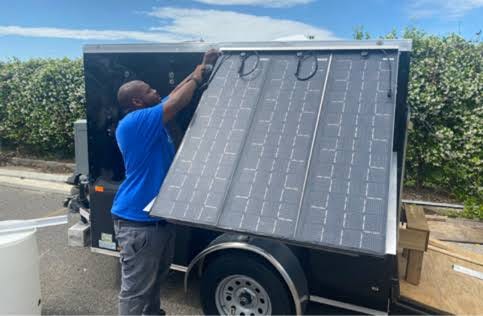
A Beehive Microgrid consists of a “Hive”—a grid-connected microgrid powered by solar and energy storage (solar+storage)—and “Bees”—a group of mobile solar+storage trailers. Bees are charged and stationed at the Hive. In preparation for severe weather or during a power outage, the Bees can be deployed throughout a region to provide services such as Wi-Fi, electrical outlets for charging phones and other devices, refrigeration for food and medication, and to serve as a hub for volunteers or medical providers. When there are no disasters or power outages to respond to, the solar+storage systems can generate economic benefits, such as utility bills savings, and the Bees can be deployed to power outdoor community events like concerts and picnics
Thanks for reading. Money isn’t everything, but if you have a little close to hand, taking out a modestly priced and voluntary subscription helps keep this project alive!
Bill, the heron passage is the one that's staying with me. "No one held a memorial service" — that's it exactly. We've built rituals for every kind of loss except this one, the slow kind, the kind that happens one missing bird at a time until the marsh just goes quiet.
I keep coming back to that same tension in my own writing — the $480 billion in avoided costs is real and it matters, but it's never what moves anyone to actually change. It's the empty rookery. It's the one heron raising her young alone. That's the number nobody can argue with, because it doesn't require a spreadsheet to understand.
Thank you for holding both of those truths in the same piece.
"once you’ve installed renewable energy you no longer have to pay for fuel." Not quite true, Bill. I pay Vt Elec. Coop $28/month for the privilege of having my solar panels hooked up to their grid. And depending on how much credit I get when there's more sun in the summer, I still end up paying something more -- anywhere between $100-$200/ month in the winter. And that's with heat pumps, a whole lot of insulation, and southern exposure solar gain.


Bill, the heron passage is the one that's staying with me. "No one held a memorial service" — that's it exactly. We've built rituals for every kind of loss except this one, the slow kind, the kind that happens one missing bird at a time until the marsh just goes quiet.
I keep coming back to that same tension in my own writing — the $480 billion in avoided costs is real and it matters, but it's never what moves anyone to actually change. It's the empty rookery. It's the one heron raising her young alone. That's the number nobody can argue with, because it doesn't require a spreadsheet to understand.
Thank you for holding both of those truths in the same piece.
"once you’ve installed renewable energy you no longer have to pay for fuel." Not quite true, Bill. I pay Vt Elec. Coop $28/month for the privilege of having my solar panels hooked up to their grid. And depending on how much credit I get when there's more sun in the summer, I still end up paying something more -- anywhere between $100-$200/ month in the winter. And that's with heat pumps, a whole lot of insulation, and southern exposure solar gain.