
Shameless Self-Promotion
You might want to skip this one

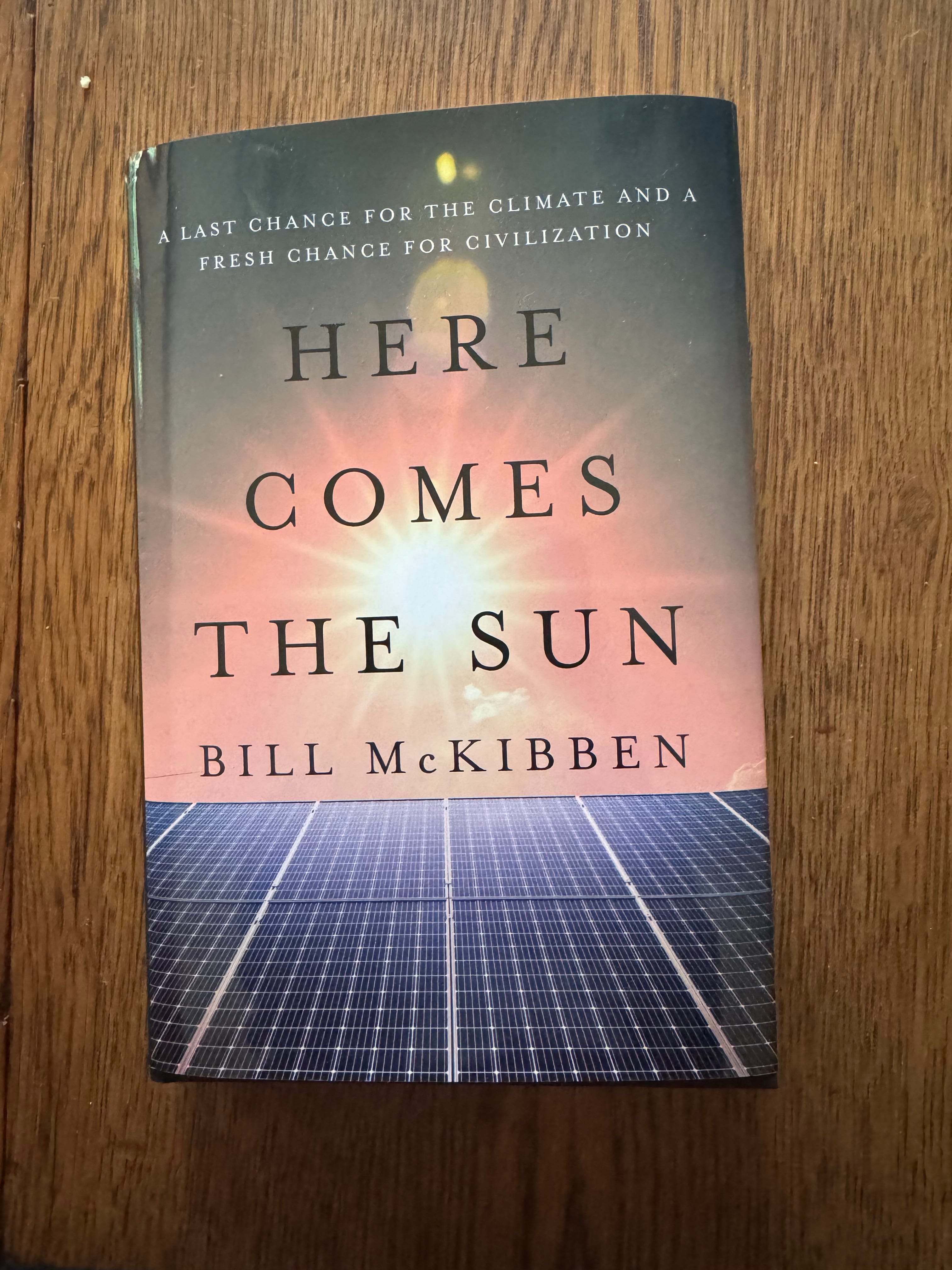
When I started this free newsletter—several hundred posts ago—one of the commitments I made to myself was that I wouldn’t use it for self-promotion. I’m happy to plug projects I volunteer on (SunDay, for instance), but I’ve zealously stayed away from even linking to my own stories or books—I come from a distant age when ‘branding’ was frowned on, and for me the joy of this project is the chance to push forward the wonderful work others are doing. (The expansion of climate journalism is a constant joy to me, because for many years back in the ‘80s, ‘90s and ‘00s I often felt alone in this work). Several hundred posts in, I’m grateful to have this small spotlight to shine on others.
But I’m breaking my rule today because I’m proud of my new book and I think it will be helpful for reasons I will try to explain in a moment. It will be on sale in a few weeks, but it’s available for pre-order now. Here’s the guide to doing that (and note that one of these sites—bookshop.org—supports local bookstores). The publisher insists that pre-orders are important, because they build visibility, attract media, and convince booksellers to put it on that table out front. Signs are good—there’s been remarkable response to the excerpt that was up on the New Yorker website last week, NPR’s Marketplace ran an extensive interview, and yesterday the Times ran an op-ed of mine that tried to lay out a little of the case that the book makes at length.
The basic idea of the book will be familiar to everyone who’s been reading the Crucial Years. I think that in the last couple of years we’ve finally started to see the thing that we’ve been hoping for all these decades: the rapid expansion of clean energy, so rapid that it’s starting to displace fossil fuel. (Natural gas use for electricity is down 40% in California in the last two years; co2 emissions are starting to fall in China).
This does not—as the book makes clear—mean that we’re anywhere near conquering climate change, nor does it mean we will actually make this transition anywhere near as rapidly as we could. In America, at the moment, a frightened fossil fuel industry has gamed our political system in every way possible to slow down this transition. But it does mean that for the first time in the global warming ear we have a scalable way to take on coal and gas and oil.
If you think about it, for the first 35 years of the climate fight, our problem was simple: coal and oil and gas were cheap, and hence utterly woven into the fabric of the global economy. But in the past few years we’ve passed some invisible line where sun, wind, and batteries have become cheaper, and that gives us a chance to unweave that dependence on fossil fuel. That comes with many bonuses—a world that runs on a resource that you can’t hoard or fight wars over, and that is available everywhere, could help erode the grotesque inequality that marks our world.
There’s nothing inevitable about this transition—or, at least, there’s nothing inevitable about it happening fast enough to make a difference in the climate crisis. Hence this book. I decided to write it last year when it appeared we might not be able to get SunDay off the ground; I was grateful for the skills acquired over 20 previous books that let me research and write at speed, and grateful for W.W. Norton, the worked-owned publishing house, that agreed with me it was essential to get it out quickly and have worked much much faster than usual. Now we will get to use the book tour in September as part of the final organizing push for SunDay. Here’s the current list of stops along the way, subject to change and addition.
Sep 8 Boston, MA WBUR/CitySpace
Sep 9 New York, NY Society for Ethical Culture
Sep 10 Washington, DC Politics & Prose
Sep 11 Houston, TX Progressive Forum
Sep 13 New Marlborough, MA Meeting House
Sep 14 New Haven, CT YIMBYtown conference
Sep 15 San Francisco, CA City Arts & Lectures
Sep 16 Seattle, WA Arts & Lectures
Sep 17 Portland, OR Powell’s City of Books
Sep 18 Los Angeles, CA Live Talks
Sep 21 Sun Day
Sep 22 Chicago, IL University Club Of Chicago
Sep 23 Boulder, CO Bookstore
Sep 24 New York, NY Climate Forward NY Times
Sep 26 New York, NY Explorer’s Club
Sep 28 Sag Harbor, NY
Sep 29 West Roxbury, MA Library
Oct 7 Breckenbridge, CO Mountain Towns 2030 Climate Summit
Oct 8 Crested Butte, CO Townie Books
Oct 22 Saratoga Springs, NY Northshire Bookstore
Nov 8 Katonah, NY Westchester Book Festival
Nov 10 Charleston, SC Literary Festival
Nov 16 Miami, FL International Book Fair
Nov 24: Toronto, Canada, University of Toronto
The point of both these endeavors—book, and day of action—is to change our way of thinking about clean energy. We’ve been calling it ‘alternative energy’ as long as I can recall, and that’s now doing damage. It’s not alternative—it’s the obvious, common-sense way forward that we should be embracing in every way. That’s becoming clear in most of the world, I think—in recent weeks we’ve seen astonishing statistics coming in from India to Poland. But in this country, of course, it’s very much in question—from Trump down the fossil fuel industry and their media partners are doing all they can to keep alive a series of myths: clean energy is weak, unreliable, dangerous to the environment. As our president said shortly before the election: “It’s all steel and glass and wires. It looks like hell. And you see rabbits get caught in it. … It’s just terrible.”
And so I try to lay out the inspiring story of how we got to this inflection point, and the facts about where we are: that we have the minerals we need, that we have the land we need, that it will save the world vast sums of money. I also—and this is the part I enjoyed writing most—get to talk about how the sun works, and what it means: how shamans and Popes and artists and musicians have come to terms with our local star, which already provides us with warmth and light and photosynthesis and now is happy to give us all the power we could ever use. It’s a story that spans the world, from urban Pakistan, home to perhaps the most exciting solar story of the moment, to rural Vermont and solar farms full of pollinator-friendly plantings attracting hordes of native insects.
Here’s how it ends:
Nearly four decades ago, on a long global book tour for The End of Nature, I found myself being interviewed by a Dutch journalist. After a lot of the usual questions about global warming, he asked me one more thing: what was my earliest childhood memory? He asked everyone he interviewed this question, he said, and invariably it was either a moment of joy or painful embarrassment. Mine, I told him, was the latter: as a young boy I lived in the Los Angeles suburb of Altadena, and one day, in shorts, I eagerly raced out to the swing set that was the fixture of so many suburban 1960s backyards. But it was a summer afternoon, and the sun had been heating the metal seat all day, and that seat burned my thighs—I felt the pain of the burn, and also of the humiliation; I’d been tricked, as it were. The sun is powerful.
I’ve been thinking about Altadena in the weeks that I’ve been writing these pages, because it burned in the great Los Angeles inferno of 2025. As I’ve noted earlier, the house I’d lived in those sixty years ago was consumed, after a year that featured the least rainfall and the highest temperatures ever recorded for the region. As I thought about that place, which I left for the East when I was five, more memories kept coming back. Most were happy, especially of the first hikes I ever took in my life, which were up the fire road that led to the observatory atop Mt. Wilson. In a lifetime of climbing mountains, this was the first time I ever had that sense of the world spilling out beneath me. That observatory almost burned in the LA fires too, but a skeleton crew was able to keep it safe, and thank…heaven. It was up there that the great astronomer Edwin Hubble, using the 100-inch telescope that was then the biggest in the world, first figured out that our Milky Way was but one small galaxy in a vast universe—and that that universe was expanding, setting the ground for our understanding of the Big Bang. But the telescopes on Mt. Wilson also explored our own solar system, and in 1962 an astronomer named Robert Leighton discovered oscillations all across the solar surface. Measurement of these waves allowed others to model the solar core, and to calculate the rate at which it consumes hydrogen. These are the numbers that assure us the sun will be around another five billion years or so.
Which is long enough for me. Someone else can worry about what we’ll eventually do when it turns into a black dwarf. For now it provides all we need.
When I got to the end of The End of Nature, I was very nearly catatonic. Wrestling with the import of global warming, especially at a moment when there were very few others to share my angst, had nearly done me in. If we were henceforth to inhabit a more hostile planet where every heatwave and every flood reflected our own folly, I wrote, then for philosophical comfort we’d have to look up at the great expanse of stars, beyond our reach, which still held mystery and wonder. Many a night since, under the dark mountain skies where I’ve lived, I’ve stared up at the Milky Way and felt that small relief.
I end this book saddened, too, of course—saddened by all that has happened in the last forty years, and by all that we haven’t done. But I also end it exhilarated. Convinced that we’ve been given one last chance. Not to stop global warming (too late for that) but perhaps to stop it short of the place where it makes civilization impossible. And a chance to restart that civilization on saner ground, once we’ve extinguished the fires that now both power and threaten it.
If we’re to do that, we’ll have to turn to the daytime sky. And to one star in particular. Our star.
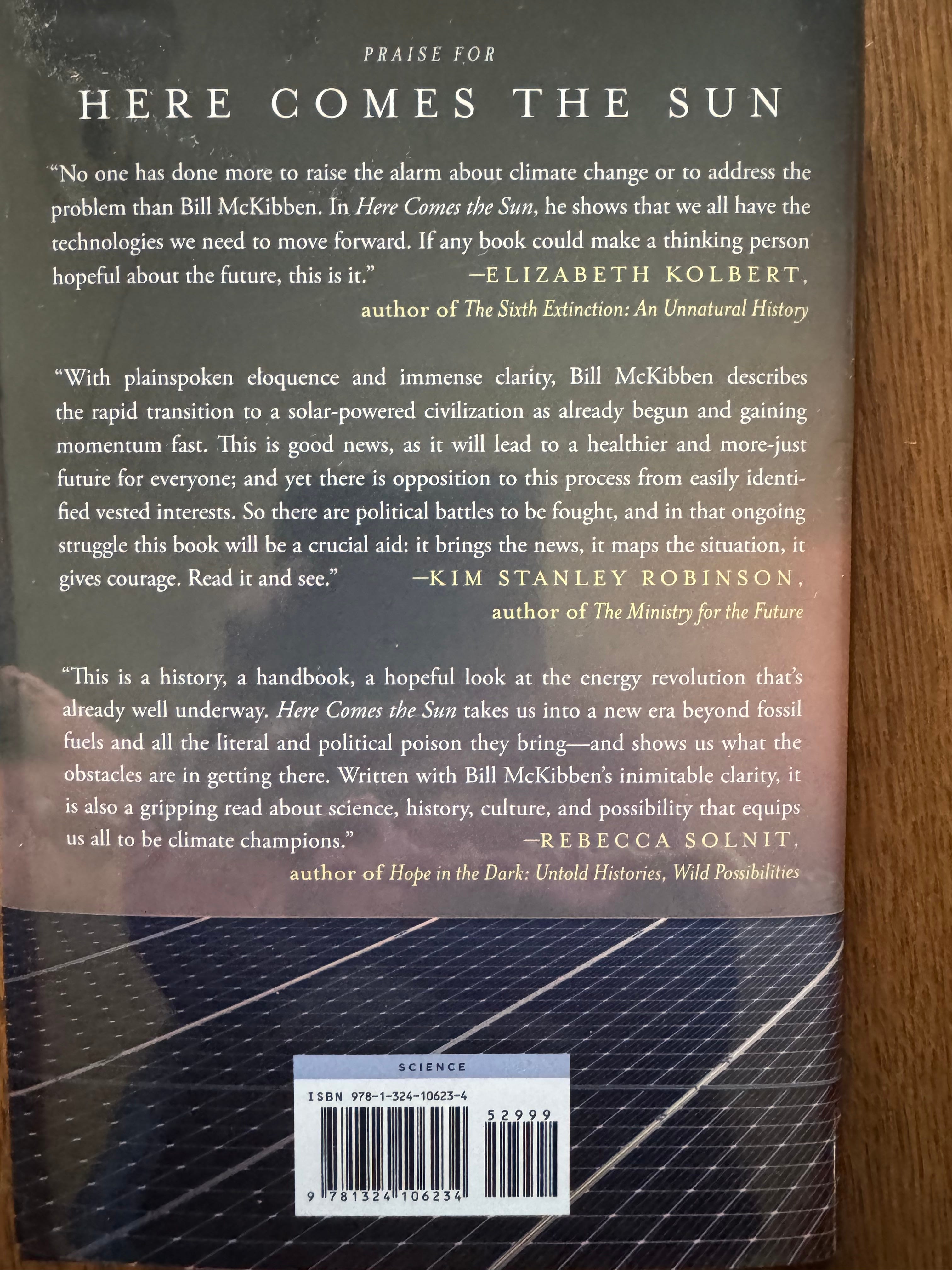
My first copy of the book arrived yesterday, and it was as much a thrill as ever to see one’s words turned into print. Here’s what a few of my friends had to say; I hope you take the chance to read it and see if you agree. And an end to this shameless advertising and back to regular programming soon!
In other energy and climate news:
+The Financial Times has an account of Meta AI’s excursion into ‘solving’ the climate crisis. As Kevin Bryan reports
The tech company said last year that it had helped researchers with the elusive problem of identifying materials to efficiently remove carbon dioxide from air, by publishing a “groundbreaking” data set on which it also trained free-to-use machine learning models.
But none of the 135 materials that Meta’s research said could bind CO₂ “strongly” had that characteristic, while some did not exist, according to researchers from Heriot-Watt University and the Swiss Federal Institute of Technology in Lausanne (EPFL).
“I wish they had computed a bit less and thought a bit more,” said Berend Smit, a professor of chemical engineering at EPFL, describing some of Meta’s results as “nonsense”. “You get the impression that the Big Tech mentality is do first, think later.”
+The UK’s Labour government, at least according to the polls, has had a troubled first year in office, but a very bright spot has been Ed Milliband’s climate policy. Some podcast coverage here, and here’s his first annual address to Parliament on climate change.
+Indonesia’s leader Prabowo Subianto says his country can “hit 100 percent renewable energy by 2035,” which would be amazing news if true.
“We are planning to achieve 100 per cent renewable energy within the next 10 years,” Mr Prabowo said during a press gathering with Brazilian President Luiz Inacio Lula da Silva in Brasilia on July 9. “The target, of course, is 2040, but my experts tell me we can achieve this much faster.”
Indonesia is among the world’s top miners and burners of coal, relying on fossil fuels for roughly 80 per cent of power generation.
Since his inauguration in 2024, Mr Prabowo has touted his desire to speed up the country’s transition away from the fossil fuel, making statements that are often out of line with the rest of his government and with his predecessor, who aimed to achieve net-zero emissions by 2060.
The country’s latest national power plan envisages that 75 per cent of new capacity additions over the next nine years will come from renewable sources, but that would still leave a vast existing fleet of coal plants, many of them built only in recent years.
+Exactly how scared is the fossil fuel industry of the clean energy revolution? Energy Secretary (and fracking exec) Christopher Wright this week threatened to pull the US out of the International Energy Agency if it didn’t stop forecasting a slowing demand for oil
The agency has predicted that global oil demand will plateau this decade as electric-vehicle fleets expand and other measures are adopted to reduce emissions and combat climate change.
“That’s just total nonsense,” Wright said on the sidelines of the Pennsylvania Energy and Innovation Summit at Carnegie Mellon University in Pittsburgh. He added he’s been in a dialog with the Fatih Birol, the IEA’s executive director.
Wright’s criticism of the agency that gets millions of dollars in US funding is in line with Trump’s broader pro-fossil fuels thrust, and his skepticism about climate change and some environmental measures adopted under previous administrations.
In point of fact, the IEA has for decades underestimated the speed of the energy transition, but any recognition that the sun is setting on Big Oil sends its champions into a panic. What an irony if the US leaves the IEA, considering that it was set up in the 1970s by Henry Kissinger.
Meanwhile Trump et al are doing their best to make the case that AI requires fossil fuels—a case that’s at odds with reality.
Financial analyst Lazard said last month that installing utility-scale solar panels and batteries is still cheaper than building out natural gas plants, even without tax incentives. Gas infrastructure is also facing a global shortage that makes the timescales for setting up power generation vastly different.
“The waiting list for a new turbine is five years,” Williams-Derry says. “If you want a new solar plant, you call China, you say, ‘I want more solar.’”
+New England has been going through an epic humidity wave these past weeks (though it broke beautifully yesterday, producing one of those crystal clear high-summer days that chase the blues away). High demand for air-conditioning has been met without strain in large part because there are now lots of solar panels spread across the region’s rooftops. As Sarah Shemkus chronicles:
Rooftop and other “behind-the-meter” solar panels throughout the region, plus Vermont’s network of thousands of batteries, supplied several gigawatts of needed power, reducing demand on an already-strained system and saving customers millions of dollars. It was a demonstration, supporters say, of the way clean energy and battery storage can make the grid less carbon-intensive and more resilient, adaptable, and affordable as climate change drives increased extreme weather events.
“As we see more extremes, the region still will need to pursue an even more robust and diverse fleet of clean energy resources,” Dickerson said. “The power grid was not built for climate change.”
On June 24, behind-the-meter solar made up as much as 22% of the power being used in New England at any given time, according to the Acadia Center. At 3:40 p.m., total demand peaked at 28.5 GW, of which 4.4 GW was met by solar installed by homeowners, businesses, and other institutions.
+The New York Times has a two-question quiz on whether you should get a heat pump. (I might have added a third question: do you enjoy living on a habitable planet?), but it’s still a useful tool!
+Gary Houser recounts a victory for solar in Ohio at the state’s Power Siting Board, which approved a project the fossil fuel industry had worked hard to squash:
On June 26, the Board approved the project by a very strong 8 to 1 majority — setting off a major celebration by the solar advocates.
What are some of the takeaway lessons that can be drawn?
The power and effectiveness of grassroots volunteers must not be underestimated when they come together in the spirit of holding to the truth and refusing to be intimidated.
Maximizing the use of free media in the form of letters to the editor, commentaries, and videos on YouTube. Not hesitating to call upon allies with which to work in coalition.
May news of this resounding victory spread throughout the state and give hope to those striving to maintain forward progress even while Trump and MAGA continue to work against the climate issue and clean energy at the national level!
+The New Scientist reports that a third of the residents of the Pacific nation of Tuvalu have applied for emergency visas to emigrate to Australia as the rising sea makes life untenable in the low-lying archipelago.
+Steven Mufson and Tom Hamburger have an account in the Atlantic of how Leonard Leo, not content with turning the Supreme Court into a rightwing rubber-stamp, is now doing his darndest to destroy ESG investing
In January, a group of present and former Republican state officials gathered at a posh resort in Sea Island, Georgia, together with conservative leaders, for a two-day lesson in how to dismantle corporate America’s most ambitious response to climate change. At the Cloister, with its golf courses, tennis courts, and beaches, ESG was denounced as a sinister force undermining free markets and democracy.
“I would hope everyone here is pretty much committed to destroying ESG,” said Will Hild, the executive director of Consumers’ Research, the organization that has led the fight. His group, he said, had spent $5 million running ads “educating consumers” about the dangers of ESG.
Hild spread a similar message at other events this spring, according to transcripts of his remarks that we obtained. “ESG is when they use their market share to push a far-left agenda, without ever having to go to voters, without any electoral accountability,” said Hild at a March meeting of state activists. “This is not the free market operating. This is a cartel. This is a mafia.”
+Finally, the world’s tallest wind turbine is now under construction in the Brandenburg section of Germany.
The center of the wind turbine currently under construction will be 300 meters above ground, and the tips of the rotor blades will reach a height of 365 meters. This makes the total structure only a few meters shorter than the Berlin TV tower. To ensure that the turbine remains stable, it does not have the typical closed tower base but instead a double scaffolding structure with an inner and outer section. The aim is to harness the significantly higher yields offered by high-altitude winds.
Energy from heaven, not from hell!
Mr Mckibben, Greetings and Salutations, sir.
When you promote this book, you are not promoting yourself: You are promoting the work you do. That work is a source of sustenance for millions, including me. So there's nothing to be even tempted to be ashamed of. Please keep doing it.
Looking forward to reading your book. Thank you so much!
Cheers
No apologies needed at all, Bill. Thank you for the years of reporting that started feeling perhaps like a voice crying in the wilderness, and is now heard and read by so many of us seeking clarity, hope, and reasoned optimism. I’m very happy to pre-order.