
Solar as Solidarity
It's not just for saving planets any more

I spend a lot of time writing and organizing about solar power, and that’s mostly because it’s the biggest tool we have to slow the pace of global warming, which in turn is the biggest crisis the world has ever faced. The scale of that crisis requires big solar (and wind) installations—so let’s cheer for the news that solar last year supplied more power to the Texas grid than coal for the first time, and that new plans have been announced for a 21-gigawatt solar and battery project in California, much of it on land that’s been ruined by over-irrigation, and that coal generation has now fallen in India and China for the first time in a half-century. These are the kind of developments that could start to shave tenths of a degree off how hot the planet eventually gets.
But that’s not the only reason to love solar, and today’s newsletter is about some of the others. It’s being written in the grim shadow of Renee Good’s execution in Minneapolis, and the threat this morning of the president to invoke the “Insurrection Act” in one of America’s friendliest states. It’s written with thoughts of Greenlanders who may soon face American invasion, and of Iranians trying to stand up to their murderous government. It’s being written as wildfires rage across Australia, Argentina, and South Africa, and as news comes that the number of Americans with severely overdue utility debt rose almost four percent in the first six months of the Trump presidency. It’s being written, in other words, in a world that seems less stable and normal than any in my seven decades.
We are living through the darkest moment I can remember, and in that moment one of the few bright lights—literal and metaphorical—comes from small-scale solar.
The day before yesterday Rupert Mayer spent two hours at my house. A founder of Brightsaver, he’s one of those Californians (by way of Austria) who made some money in computers and then tried to figure out how to help the world. His solution, with his colleagues, was to try and bring Euro-style “balcony solar” to America. Veteran readers of this newsletter know all about this plug-in solar; I’ve been writing about it for a long time. But just in case you’ve tuned it out: plug-in solar is what it sounds like, a small solar installation that doesn’t require extensive cash outlay or extensive wiring, and that can nonetheless produce a reasonable amount of power. Millions upon millions of Europeans—primarily apartment dwellers with a balcony railing—have installed them over the past few years; they’re not exactly legal in the U.S., except for the state of Utah which passed the enabling legislation last March.
It took Mayer—with me, doing a little holding and carrying—about ten minutes to install the system, which has two 400 watt solar panels. An Allen wrench comes in the small plastic bag of hardware—think Ikea, but easier. Now the panels are sitting on the ground outside our house, feeding the sun’s power into a small battery, about the size of a boombox turned on its end. The battery in turn feeds a small but steady amount of the power into the household grid through…a plug. That’s plugged into the wall. Via a plug. Plug and play. That’s it. Here we are, exhausted and sweaty from our labors…

Strictly speaking I may be violating the law, though I called friends at our local utility and they said “no problem.” And strictly speaking I don’t really need it, because our house is already covered in conventional rooftop solar panels, installed at various times over the last quarter century. If you have a roof, those kind of systems are the way to go, and we’re fighting hard (see below) to make them more affordable. But plug-in solar, though almost at the bottom of the solar chain (I guess solar-powered lanterns and the like are the very bottom) are not toys. They do important work. And so I’m glad to have this addition to what is becoming my own little solar museum, because it lets me say firsthand a few things.
Small-scale, easy-to-install solar produces good power; Mayer has been installing similar systems around the Bay Area, and he says that for some apartments they’re providing most of the power supply. As appliances get more efficient, their value just keeps increasing.
They’re affordable. In Europe, where lots of providers compete to offer such systems, mine would cost just over a thousand dollars; without the battery, just feeding power straight into the house, the panels would run you about $300. Utah is so far the only legit market in the country; there this system would run about $2,000 at the moment, though that should come down fast as more players enter the market. The “payback” time would depend on how pricey electricity is where you live.
But “payback time” is not the only consideration. You now have an easy-to-assemble (and easily portable) power supply that doesn’t rely on anything. As long as the sun comes up you can use it. If the refineries shut down and you can’t get gas for your generator, if the government turns off the power, if a hurricane wipes out everything—well, you’ve got power. Here’s an unboxing video off Instagram from a Jamaican selling pretty much the same system to people in the wake of Hurricane Melissa. (And here’s an article from Hiroko Tabuchi in the Times explaining how lucky solar owners were in the vast swathes of Jamaica where…ten percent of utility customers are still without power almost three months later.)
A guy I’ve known a long time, and a founder of the Urban Solar Energy Association, George Mokray, has long talked about ‘solar as civil defense,’ and I think this is part of what he means. (You can find more of his thinking here). A flashlight, a radio (remember those?), an internet router, a cellphone—I could power those many times over with the little system installed here yesterday. And around the world that would bring hundreds of millions of people much closer to the modern age. I’ve been in many African villages where less current than I’m generating from these panels literally moves people into a new reality. Here’s a report from this week on how fast the economics are changing across Africa as cheap solar panels let people charge e-bikes and e-scooters, and imagine an auto industry that will never require gas.
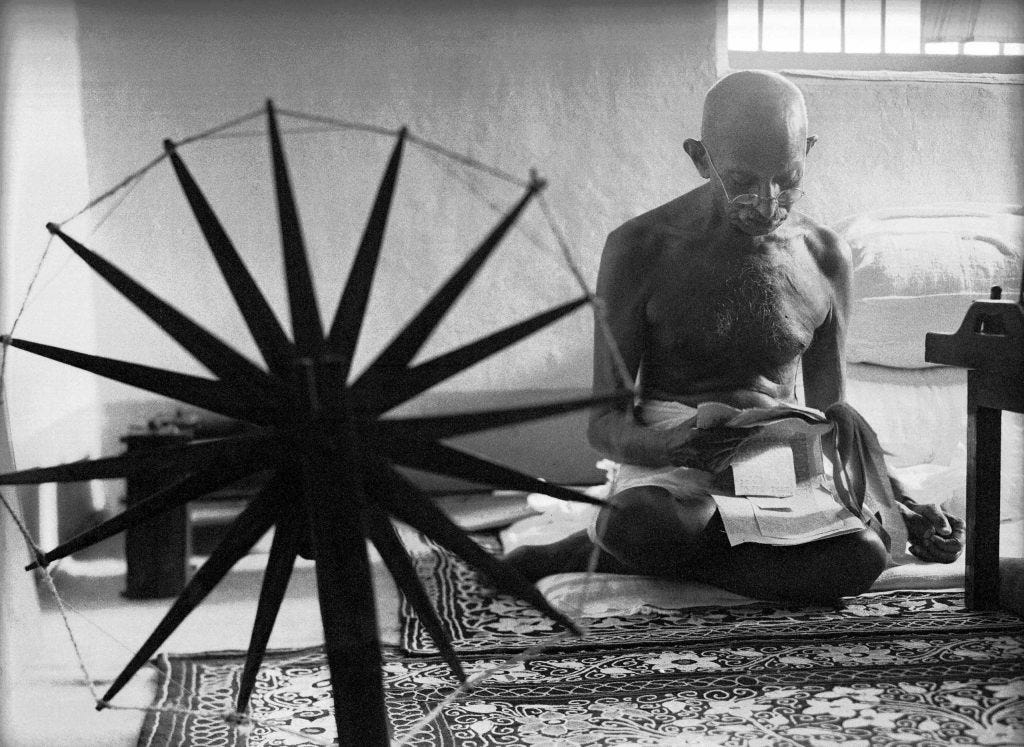
But Mokray has also taken to describing solar as “swadeshi,” which holds deep meaning for me. Swadeshi, or self-sufficiency, was the Gandhian idea that India could make its own goods, and that in doing so it reclaimed not just economic power but a kind of moral agency from its British rulers. Gandhi famously spun on his charkha, or small spinning wheel, each day for an hour, usually beginning at 4 a.m. It was, among other things, a stark visual contrast to the massive British cloth mills that had put so many Indians out of work. Just as with making salt, making khadi, or homespun cloth, was an act of dissent and insubordination; the spinning wheel was the center of the first Indian independence flag, and in stylized form still is. In an age when our brutish ruler gasses on and and about “energy dominance,” it is an important act of defiance to make your own power. You don’t need to make all your own power—the grid could be a beautiful symbol of human sharing, and it offers huge possibilities for things like “virtual power plants”—but you should make some of your power if you can. Think of it like a vegetable garden—a hedge against trouble, and a reminder of your connection to the natural world. And think of it as a gentle fist, raised against the tyrants of our time, from Trump to Exxon.
So, the question is how to make it easier for all to partake in this revolution. In the wake of Sun Day, there are now bills in more than a dozen state legislatures to fully legalize plug-in solar. (Scott Wiener, powerhouse California state senator, introduced one of the latest). I spent the noon hour today participating in a press conference for the bill introduced by New York state assemblywoman Emily Gallagher and State Senator Liz Krueger, which we think has a real chance of passing fast. Here’s a good article about the bill in Maine, with a fitting quote from State sen. Nicole Grohoski: “It’s about giving a person on a third floor apartment the same power to lower their electricity bill as a homeowner who has a south-facing roof.” In Vermont, the only hold-up seems to be some debate on whether a “qualified electrician” should handle the installation—having done this yesterday, I can assure everyone there’s literally nothing for a “qualified electrician” to do. (It would be like requiring a mechanic to fill up your gas tank).
If you want to help these bills pass, and if you want to join in the larger task of making rooftop solar less bureaucratic and expensive, you can join the Simplify Solar campaign we’re running at Third Act. Across the country we have enthusiastic volunteers in touch with state houses and city halls to find out the existing regs and to share model legislation, using economic arguments as often as ecological ones (New study: solar and storage could save Massachusetts ratepayers $313 million a year). a\And remember, Utah is so far the only place to okay plug-in solar, so it’s as much a red-state project as a blue-state one. (“It can open hearts and minds,” says Mayer. “The people being told that the environmentalists want to take your truck away, we can show them no, the solar panel is very benign. And anyway, why should the government have a say in my backyard?”) Here, for instance, is how Third Act Oregon is approaching it, and some great radio with Third Act activists in Connecticut, and here, as a template, is the testimony offered by Third Act Maine in an effort to get the bill through the legislature in Augusta
The state of Utah was the first to legalize up to 1,200 watts of plug-in solar, and the legislation passed with strong bipartisan support. Similar bills are being considered in Vermont, New Hampshire, New York and Pennsylvania. Market research predicts if five states pass plug-in solar bills, within five years the price of a 1,200-watt system will drop as low as $600. The cost today is under $3,000 compared to a rooftop system which costs between $25,000 to $40,000.
The opportunity to take some control over power generation and to save significant money on electric bills will appeal to many Mainers, as will the DIY aspect of plug in solar. It’s as simple as placing a few panels in a sunny location — like a patio or shed roof — and plugging it into an outdoor outlet. Add battery storage and Mainers can power critical appliances when the power goes out during a storm.
Other good people are hard at work on the same thing. Solar United Neighbors, for instance, offers a big virtual event about plug-in solar next Thursday. The pioneers at CleanTechnica have a GoFundMe up and running to support their educational efforts (including an Electric Home Show in Hawaii this spring).
None of this in any way reduces the need for political change and engagement. The Trump administration is trying to make all this work harder. As Nicolas Rivero writes in the Washington Post, total battery installations are expected to drop ten percent this year thanks to tariffs and restrictions. And if we had a different kind of government, all it would get much easier—in Australia, where there is government support for installing batteries alongside your solar panels, demand is pretty much literally through the roof. As Energy Source and Distribution magazine writes:
Nationwide, the Cheaper Home Batteries Program has helped more than 190,000 households and small businesses cut their power bills, with around three-quarters of installations in the suburbs and regions.
Last month, the government announced changes to ensure that more Australian households can benefit from the program, with a funding boost to $7.2 billion over four years.
These changes are expected to see more than 2 million Australians install a battery by 2030, delivering around 40GWh of capacity, doubling initial estimates of 1 million batteries and increasing the expected capacity by almost four times.
There’s absolutely no reason that couldn’t be the U.S., or any other nation. Right now it’s China that’s doing most of the work. Check out Michael Lydick’s fascinating reporting from this year’s Consumer Electronics Show in Las Vegas, where he looks at the same kind of home systems I’ve been describing, almost all of them coming from the East.
I came away from CES with the impression of two countries with very different priorities. On our side, it’s “drill, baby, drill.” China, meanwhile, has nearly 650 gigawatts of installed solar capacity and adds more solar energy each year than the rest of the world combined.
I don’t think China is eating our lunch, per se. I think they made their own lunch. The nation invested in the kitchen, hired better chefs, refined its recipe year after year, and turned its offerings into something people like me genuinely crave. It really pains me to see the US fall so far behind.
So we’ll fight at the ballot box to reboot our nation. But we can also start to make it happen on the ground, one or two panels at a time.
If you know how to put a plug in a socket, you can be part of this revolution. People look at Gandhi and he seems—and was—a small man. But with the millions of people he inspired, he led what is now the largest country on earth to victory over tyranny. If he was here today, I have no doubt his ashram would be roofed with solar panels, and that he’d be showing everyone how to set up their own systems. On a dark dark day like today, solar is one form of liberation.
In other energy and climate news:
+Here’s one of the most harrowing sequences I’ve come across. Last week the Aussie writer Alex Kelly evacuated with her family after huge forest fires ravaged their mountain community. They ended up in the Wye River valley, where they immediately had to evacuate in the face of record flooding. She said, in a line that could be the motto for our age:
“I’m feeling very angry. And what I’m feeling most angry about is we’re not putting an end to the fossil fuel industry.”
+First little signs of the Trump bump: his love for coal power, and for data centers, helped drive up America’s carbon emissions 2.4 percent last year, even as India and China were declinging. And more to come:
“We aren’t yet seeing the direct effects of these policy changes in US emissions,” Gaffney and his coauthor Ben King wrote. “That could change in the coming year or two, particularly if data center electricity demand continues to surge and the grid responds with more output from existing fossil generators instead of new, clean resources.”
+A new database of buildings across Europe shows lots of capacity for rooftop solar.
The results show that potential capacity could reach 2.3 TWp (1,822 GWp residential, 519 GWp non-residential), with an annual output of 2,750 TWh based on current PV technology. This corresponds to approximately 40% of electricity demand in a 100% renewable scenario for 2050
+Those radicals at the Bloomberg energy desk estimate that the heating of the country has already cost Americans a trillion dollars in what Mark Gongloff calls a “stealth heat tax.”
There’s the big-ticket stuff, of course, like the property losses and higher insurance premiums that come with supercharged natural disasters. But a deeper look shows that climate change is steadily draining wealth in ways that aren’t as obvious, like the hidden charges car dealers add to pad out the cost of a sale, except these are permanent. Call it a stealth heat tax.
Temperature changes alone cut US incomes by 12%, on average, between 2000 and 2019, according to a study published in December by Derek Lemoine, an economics professor at the University of Arizona. Lemoine has previously estimated average long-term losses during that period of 1%, but that was based only on localized impacts of hotter weather. His latest research is the first effort to account for how temperature changes in one part of the US can affect people in entirely different parts. The difference is drastic.
“You might think, ‘It’s hotter where I live, and that’s hurting me in some way.’ But that’s only a tiny share of the damages,” Lemoine told me in a phone interview. “Most of the damages are from everywhere getting hotter together all at once.”
For an example of how this might work, consider corn. Say hot weather causes a bad harvest in Iowa, which results in higher corn prices across the country, not only at grocery stores but for every industry that uses corn. And that’s a lot more stuff than you’d think, from aspirin to sheetrock. Maybe some corn farmers enjoy a boost in income, but the rest of us lose money — including those of us in places that didn’t get as hot as Iowa.
In other words, we’re all in this together. Some parts of the country might stay relatively shielded from extreme heat and climate disasters, but no one escapes untouched. Everybody pays a heat tax. Extreme heat not only disrupts harvests but affects workers’ health and productivity across a variety of industries. Many of the pathways by which local heat affects the welfare of the rest of the country are still a mystery, Lemoine noted, and need more research. For now, we can at least see the results in the data.
+Attention college students: another “boot camp” day of virtual training for young people interested in keeping campus landscapes toxin-free! A good place to cut your organizing teeth!
+We carefully measure the atmospheric temperature, and as you know 2023, 2024, and 2025 have been the three hottest years on record. But forces like the El Niño and La Niña currents in the Pacific can send those numbers a little up and down every year; a much more stable record comes from the heat content of the ocean, and it builds inexorably, year after year. The latest, from Michael Mann et al, in Advances in Atmospheric Science
Global ocean warming continued unabated in 2025 in response to increased greenhouse gas concentrations and recent reductions in sulfate aerosols, reflecting the long-term accumulation of heat within the climate system, with conditions evolving toward La Niña during the year. In 2025, global upper 2000 m ocean heat content (OHC) increased by ∼23 ± 8 ZJ relative to 2024 according to IAP/CAS estimates. CIGAR-RT, and Copernicus Marine data confirm the continued ocean heat gain. Regionally, about 33% of the global ocean area ranked among its historical (1958–2025) top three warmest conditions, while about 57% fell within the top five, including the tropical and South Atlantic Ocean, Mediterranean Sea, North Indian Ocean, and Southern Oceans, underscoring the broad ocean warming across basins.
Here’s what it looks like:
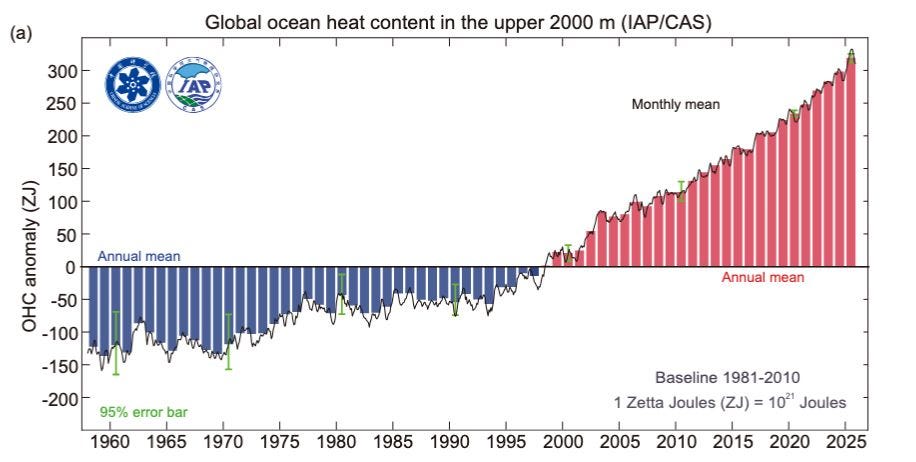
This kind of graph helps you understand the new predictions from the world’s association of financial actuaries: planetary insolvency
“Planetary Solvency is threatened, and we urgently need a recovery plan. An actuarial review of key climate change assumptions shows we may have seriously underestimated the rate of warming as well as the related economic impacts. Unless we rapidly change course, climate damages will start to impact growth and future prosperity. The parallels between the risk management failure of the Global Financial Crisis and inaction on the major systemic risk posed by climate change are clear. Both feature an over reliance on benign risk model results and a failure to understand systemic risk.”
+If you’re going to graze sheep, then for heaven’s sake do it between solar panels. Amelia Hill in the Guardian describes a growing UK trend
On a blustery Lincolnshire morning, Hannah Thorogood paused between two ranks of solar panels. Her sheep nosedived into the grass under their shelter and began to graze.
“When I first started out, 18 acres and 20 sheep was as much as I could afford,” said the first-generation farmer. “Now, because I can graze this land for free, I have 250 acres and over 200 sheep. Solar grazing has given me a massive leg-up.”
Across the UK, a growing number of farmers are discovering that the free grazing opportunities offered by some solar panel sites are a toe-hold in an industry where land is often unaffordable or unobtainable.
Dr Liz Genever, a farmer in south-east Lincolnshire, has been able to triple her sheep numbers thanks to free solar grazing.
“If I could increase my flock to the full potential offered by the local solar site, I could potentially increase my income from sheep from £20,000 to £60,000,” she said. “There’s been a massive acceleration in the last five years in solar grazing. “It’s a really important opportunity for sheep farmers.”
I hope prices continue to fall at pace. The issue -- just like buying an EV -- has always been that it's affordable for those with spare money to invest up front and not those without -- e.g. who are paying off massive mortgages. So the rich get richer so to speak. I know this is a negative way to look at it, but it's the reality of the situation in many parts of the world. The cheapest most polluting cars are owned by the folks who can't afford to buy an EV. There needs to be better schemes to make solar a must-do financially. These 'balcony solar' initiatives are certainly a massive step in the right direction.
What a brilliant essay! I just realized (I'm really slow, I admit it), that unless you've endured government violence (think Berkeley, 1969), you really can't comment in an intelligent way on what we're going through now. But I was a teenager in the Sixties, and I came out of it living what I now realize has been a revolutionary lifestyle. A lot of it had to do with my "waste not, want not" background, but my diet changed somewhat, I only bought from the Co-op, farmers markets and small businesses, I didn't drive until I was 34 (and I don't drive anymore), I sewed most of my clothes, thanks to my Dad, who gave me a sewing machine for Christmas when I was 15), and my husband and I put solar on our roof 10 years ago, my son has not paid for gas since 2015, and now we have an EV and a solar storage battery too. I re-landscaped our yard, native plants in the front and vegetables and fruit trees in the back. It's the Bay Area, so we still have lettuce, carrots, celery, kale and peas, as well as satsumas and lemons, in the backyard. But most of the comments I see on Substack are from people who are just clueless. Over the last six months I've gotten my news from Substack, and I just can't stand it anymore. I think what you espouse is the way to go, and that's what people need to realize. We need to pull away from this national "government".