
Take Five
The Crucial Years at the halfway point

This newsletter turns five years old this month, which means that more than 300 times I’ve tried to assemble the latest news from the world of climate and energy and figure out what it means. I started it in 2021, intending to run through the decade, because I thought then, and think still, that this is the crucial stretch in humanity’s attempt to navigate the climate crisis.
So we’re more or less at the halfway point of this project, and I thought it might be a useful time to sum up how I’m thinking about our predicament. But instead of just writing a short essay, I figured I might do it by also giving you some sense of how data transmutes into argument and hopefully insight in my mind in any given week.
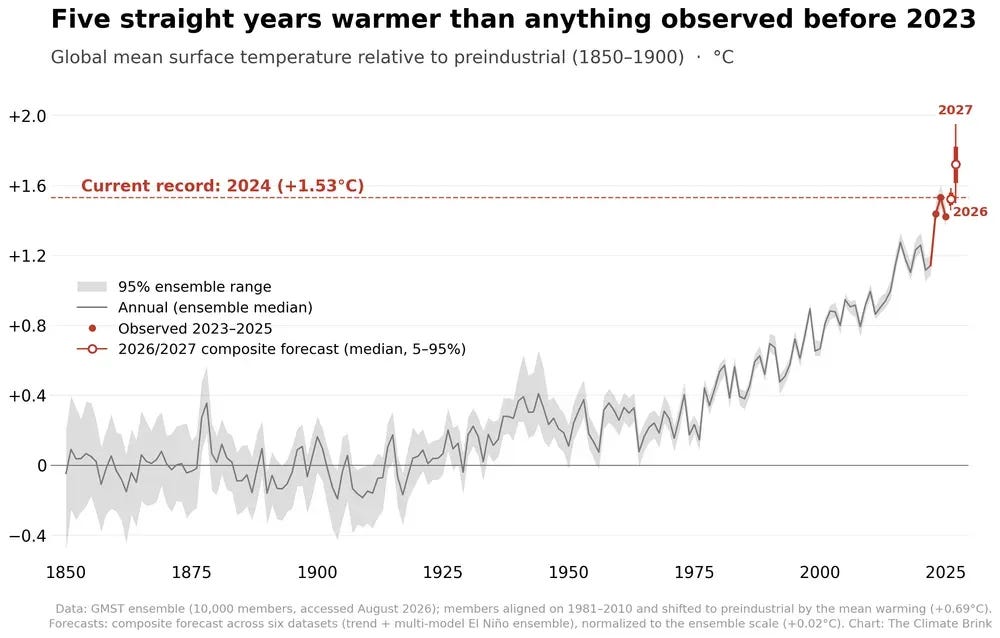
The most important bottom line, of course, is the temperature; that it’s rising, ever faster, is the basic text of our moment on earth, and I do my best to keep track of the underlying science and its unfolding implications. The chart below shows the latest data, from Zeke Hausfather, one of the most understandable climate researchers at work anywhere (though, loyal to my roots, I thin Jim Hansen continues to hold the crown.) What the chart shows is how sharply the mercury has climbed in the last few years, and how much more it’s going to jump in the next 18 months, based on consensus forecasts from a variety of models. 2024 is the current record holder; we may well break that record this year, and we certainly will in 2027. (Hausfather, by the way, has an excellent newsletter, where this week he finds that employing “agentic AI” instead of just asking ChatGPT idle questions uses about six hundred times more electricity. This is new and important information).
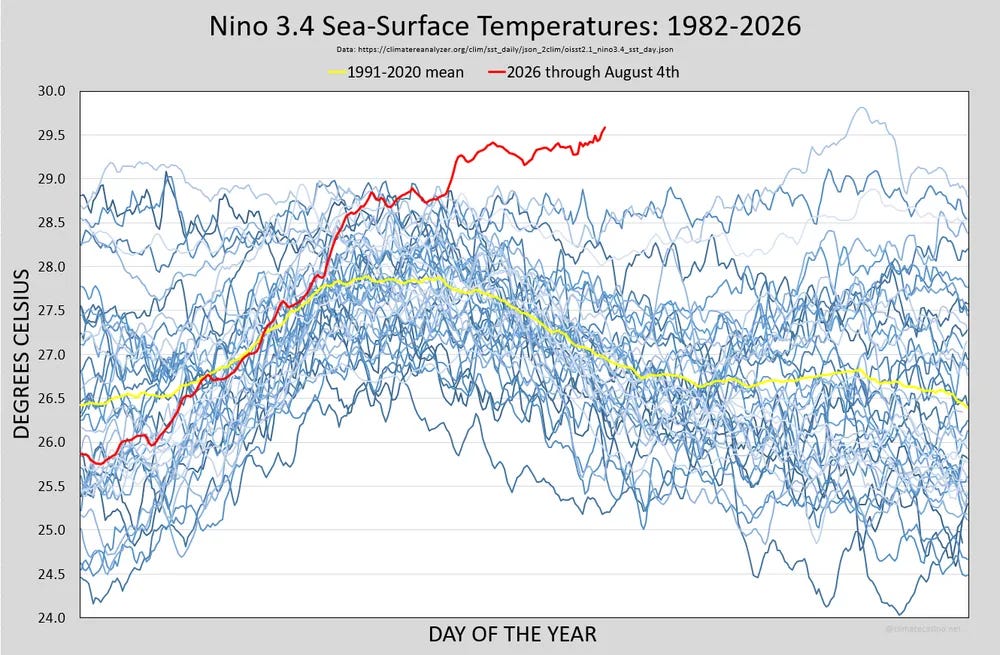
How do we know what 2027 will bring? Here’s another graph this week, of sea surface temperatures from the key region of the Pacific where El Niño is now taking shape. As you can see, we’re racing ahead of the pace even of other warming years. It doesn’t take much imagination to see why everyone is now clear we’re staring at an historic year, with a truly massive release of heat from the oceans into the air.
It’s painful for me to look at charts like this, every time. I’m constantly reminded that I knew this was coming, and that I failed in my efforts—journalistic and activist—to prevent this rise in temperature.
Though I’d like to shut my eyes, I try to force myself to be absolutely aware of its consequences, large and small—check out this report, for instance, that he record drought in France has dried up 43 percent of the nation’s streams, an ecological catastrophe. And check out this new assessment from the UN that the El Niño is likely to push 50 million more of our brothers and sisters into “acute hunger.” I know just enough ecological science, and just enough political science, to be able to intuit how bad this unraveling is: we learned this week, for instance, that the globe is setting new records for forest loss thanks to wildfire. As Hirokio Tabuchi and Harry Stevens reported:
Loss of pristine rainforests alone reached 6.7 million hectares in 2024, nearly twice as much as in 2023, researchers at the University of Maryland and the World Resources Institute said in an annual update of the state of the world’s forests.
The world lost the equivalent of 18 soccer fields of forested land every minute, the researchers estimated.
What that means is that the warming is feeding on itself, producing conditions for fires that in turn pour more carbon into the air. That same warming means the air holds more water vapor, and hence we simultaneously get more deluge and flood, and that too carries an unbearable price. As Jonathan Watts and Natasha May reported last week, for instance,
As wildfires rage across Europe and North America, the unprecedented rains continue elsewhere. While South Korea swings between heatwave and downpour, in Japan and Vietnam torrential rain has led to landslides. China, meanwhile, has seen bouts of extreme rainfall since the flood season began in April, according to the water resources ministry in mid-July, marking the start of a month-long peak flood control window. More than 600 rivers have since risen above warning levels – a 35% jump from the average for the same period over the past five years…
The extreme weather across the region can clearly be linked to climate change. Climate scientists have long predicted that large areas of Asia will disproportionately suffer from more intense heat, humidity and drought as a result of climate disruption caused by the burning of gas, oil and coal.
The hardest part, by far, of producing this newsletter is dealing with the sadness that such stories inevitably produce, and I worry sometimes that I’ve grown emotional callouses to make it possible to keep providing a record. But I’ve always been haunted by the idea that humans would step over this precipice without really understanding they were doing it; bearing witness seems a necessary minimum. You have to stare at the world, however much I’d sometimes prefer not to, and you have to look unflinchingly. As my dear friend and colleague Rebecca Solnit wrote this week:
Once, across much of the the world’s temperate zones, we looked forward to summer as a time of delights, from summer’s bounty of fruits, long days, warmth, school holidays, activities like camping and swimming, travel and adventure. Now many of us dread it.
The degree to which that dread is reaching the most normie of observers is probably a useful thing. Here’s a report from Ceylan Yeğinsu, who usually covers the cruise industry, about her heat-and-smoke plagued “vacation” in the midwest:
When we reached my mother-in-law’s cottage on Lake Michigan, a murky haze blocked the view. We hurried the children inside. Instead of the beach day I’d promised my daughter, air quality forecasts warned of “hazardous” conditions, forcing us to stay indoors.
It’s not just the midwest, of course—yesterday Portland Oregon had the worst air in the world, beating out Kinshasa. I mean, they’ve been taking rainfall records at Kew Gardens in London since 1871 and July was the first month without.any.rain.at.all.
And so—first bottom line from these five years—we can and must say that that global warming is proceeding even faster than feared, having accelerated across this period and moved to a level where it is causing daily disruption across the planet. This is the most basic news that the world needs to know, the most important thing happening on our earth. The degree to which we are now dancing along the precipice can’t be overstated—here, for instance, is Adam McKay’s perfectly fair account of just how close to civilizational bankruptcy we’ve come, driven by the lie that “global warming is real but not urgent… Keep doing what you’re doing.”
But the rise in temperature is not the only thing happening on earth. In the years I’ve been writing The Crucial Years I also published two books, and the most recent—Here Comes the Sun, out in paperback next week—was very much the result of this newsletter. It allowed me to see, a little earlier than most, that we’d quite suddenly hit the steep part of the S curve for renewable energy, and that solar, wind, and batteries had almost magically transformed themselves from “alternative energy” into the obvious way forward.
That very much continues. Indeed, last week we passed—almost unremarked—a serious milestone in human affairs. As a team from Bloomberg reported
After crossing the 100-gigawatt mark in 2012, it took the world 10 years to deploy 1 terawatt of solar power. An additional 1 terawatt, enough to meet all of US power demand at its peak, took less than three years to build. Not even two years later in 2026 — the precise timing is subject to debate among analysts — the 3-terawatt threshold was reached.
This achievement comes from many places (China above all), and I can’t stress enough how quickly it has arrived. In 2012 California generated about one percent of its electricity from solar power. Last week we learned from the think tank Ember that in May it became the first large economy to generate more than half its power directly from the sun for an entire month. As Nicolas Fulghum wrote, “battery storage is the big difference maker, enabling California to push the share of solar generation to this level.” And the bottom line, as the Utility Dive newsletter pointed out a few weeks ago, is remarkable: From January through May, solar generation in CAISO increased 21% compared with the same period in 2024, while natural gas generation decreased 60%, EIA found.
This is among the most significant statistics the climate fight has yet produced. In the fourth largest economy on earth, an extensive buildout of renewable energy has immediately and radically undercut the use of fossil fuels. No other intervention in the last forty years has come even remotely close to this scale of decarbonization.
And that good news comes, as environmentalist and politician Tom Steyer observed this week, despite recent efforts by the California government to slow down progress, as Gavin Newsom and others play footsie with the fossil fuel industry.
After decades of undisputed climate leadership, California regulators and politicians are bending the knee to Big Oil — buying the manufactured panic of petro-criminals and selling our future as collateral. The clean energy revolution was born in California — and if Big Oil has its way, it’ll die in California, too.
The point is, even California could be doing more. We’re completely capable of upping the pace everywhere on earth: China’s factories in a decade could produce enough solar panels to power the whole world. Suddenly, beautifully, there’s huge possibility, and it’s our job to spread the news.
Spreading the news is the chief point of this newsletter. (If you know someone who likes listening rather than reading, here’s my recently released TED talk, which makes the case as best I can, though with some unfortunate jabbing by my left hand, which apparently is not connected very closely to my brain.) Anyway, it all adds up to the fact that:
The next bottom line is, a truly rapid World War II scale conversion to renewable energy is utterly essential.
That conversion will not stop global warming—it’s much too late for that. But it will allow us to do two things: shave tenths of a degree off how hot the planet gets, on a planet where every tenth of a degree moves a hundred million people into the danger zone, and also rebuild our civilization on more localized lines instead of the current model with its ruinous (and murderous) reliance on a few concentrated deposits of fossil fuel. It is the most important single task humans have ever faced, and it will succeed or fail depending on how fast we do it—we do not have any spare decades left at hand. Every month we slide deeper into the inferno, something this El Niño will be demonstrating in real time.
And so the question that really underlies this newsletter, and my work in general, is: how do we speed up this transition even a little?
Part of the answer, of course, is individual action—and here let me say thanks to all who are a part of this community, because readers of The Crucial Years played a serious role first in getting a quarter-billion dollars for heat pumps in the wake of the Ukraine invasion, and second in pushing ten state legislatures this spring to allow balcony solar. But we know that individual decisions in our homes need to be backed with strong policy if they’re going to move at anything like the speed we need.
That’s not impossible: over the years of this newsletter, we’ve chronicled the rise and passage of the Green New Deal Build Back Better Inflation Reduction Act, and then of course its demise in the early months of the Trump administration. But as the irreplaceable analyst and activist Leah Stokes reminds us in an important essay this week, key parts of the IRA remain intact, and continue to underwrite factory expansions across the country; that’s one reason that, despite all the efforts of the White House, solar and wind projects continue to come on line in this country. (Trump got two more blows in yesterday, putting huge tariffs on the key components of solar panels, and sending off another billion dollars of taxpayer money to buy back another set of coastal wind rights from another foreign company).
Given the indefatigable opposition in the White House, good policy is hard to come by in this country right now. But with the prospect of a Democratic Congress improving (please, everyone, do what you can heading to November; GrayPac is a good place to start if you’re looking) there’s some movement towards “permitting reform,” to make it easier to build everything from transmission lines (needed) to gas pipelines (disastrous). For a while now there’s been a fragile consensus among energy nerds that such reform is on balance a good idea—with renewables cheap, it would spur their progress, which is why you see stalwart climate warriors like Rhode Island senator Sheldon Whitehouse working on them. But a new analysis put out earlier this week by the extremely well-sourced researcher Jeremy Symons calls that into doubt.
As a result of the 2024 elections and the surge in AI-driven demand for new gas-fired electric power, the script has flipped and natural gas is now poised to be the biggest winner of permitting reform…
Among all the provisions being considered for permitting reform, the most consequential would benefit gas by giving the president unconstrained powers to categorically exclude major power projects and pipelines from NEPA without court review. Not coincidentally, the gas lobby is a leading proponent of getting permitting reform across the finish line in 2026.
Remember, I’m trying to give you a peek inside my mind as I write this installment, so I’ll say I highlighted Symons’ analysis in part because I knew Senator Whitehouse and his staff read this newsletter some of the time. Trying to communicate to “elites” is important; they have huge power, and they need all the facts to figure out how best to structure legislation.
But trying to build big public movements is even more important, because ultimately that’s what sets the ground on which politicians must operate. If they feel the pressure of public opinion they will move, and if they don’t they won’t. One big story of the past five years has been the dwindling of the public climate movement, for any number of reasons: success (the IRA) reduces pressure, and so does the unavoidable distraction that comes with, say, global pandemic, the resurgence of fascism, and globe-spanning war.
We need to spin up that activism again. I helped launch Third Act right about the same time I kicked off this newsletter; it’s done immensely successful work even against the political tide, and I couldn’t be prouder of its staff and leaders across the country. And readers of The Crucial Years have been a part of that: for instance, you helped make Sun Day a success in America last September, which in turn set in motion the lobbying that led to those plug-in solar victories this spring.
There’s not going to be a Sun Day in 2026; we don’t dare distract from the organizing to win the midterms. But there will be—and this might as well serve as a kind of announcement—a big powerful global version coming in June 2027, right around the summer solstice. It should be happening at the moment that El Niño will be delivering the highest temperatures that any member of our species has yet seen, and as the lines are being drawn for the 2028 election, and as we set huge new records in the rest of the world for solar deployment. It will be a chance to change the politics so that far more rapid progress is possible.
The other side never wavers in the fight. Emily Atkin (proud pioneer of the climate newsletter space!) has an important new entry this week on the rise of the anti-solar online influencer; it’s a dismaying but important read. So we need to make sure that our side is more creative, more connected, and more real.
This newsletter will resume its normal operation in a few days time. But for now, let me just say what a fierce joy it is to be fighting this fight alongside you. There are days when I’m despairing and there are nights when I can’t sleep, but there’s never a moment when I’m tempted to walk away. I’m glad to be here with you.

In the interests of "speeding up the transition even a little," and offering a real, meaningful, achievable goal, I propose state and local laws requiring that data centers be powered ONLY with renewable energy.
I have to say that you are a brilliant communicator, blending the personal, scientific, and political streams of information. Please keep up the excellent work!