
The Biggish Picture
Trying to imagine a working world

One of the (many) curses of the Trump era is that he keeps us fixated, hour by hour, on his latest stupidity or fraud, a constant swirling game of three-card monte that ends only when he robs some more of our attention and money. So I will try valiantly for a moment to escape his asteroid belt of provocation (it’s not easy—did you know that America decided this week to sink a few billion into promoting…coal) and try to think a little more broadly.
This step back is occasioned by Thomas Piketty and his team at the World Inequality Lab in Paris, who last week released the Global Justice Report, subtitled “A Plan for Equality & Prosperity Within Planetary Boundaries.” Piketty, you will recall, is the London-born economist who in 2013 released his book Capital, in many ways launching the ongoing critique of global inequality and the generalized scorn for the billionaire class. (At one point, remember, America and the world generally admired these people).
Now he and his team has enlarged their analysis to include the 21st century’s novel dilemma—that we are steadily and rapidly overheating the planet—and the result is this report, which I read in certain ways as the data-rich companion to Naomi Klein’s 2014 classic This Changes Everything, an investigation of whether it is possible to imagine prosperity without ruinous growth. Much has changed in the years since those volumes—most importantly, the plummeting price of solar and wind energy and of batteries to store that power has opened up a much larger escape hatch. And it’s from that premise that Piketty’s new work really proceeds.
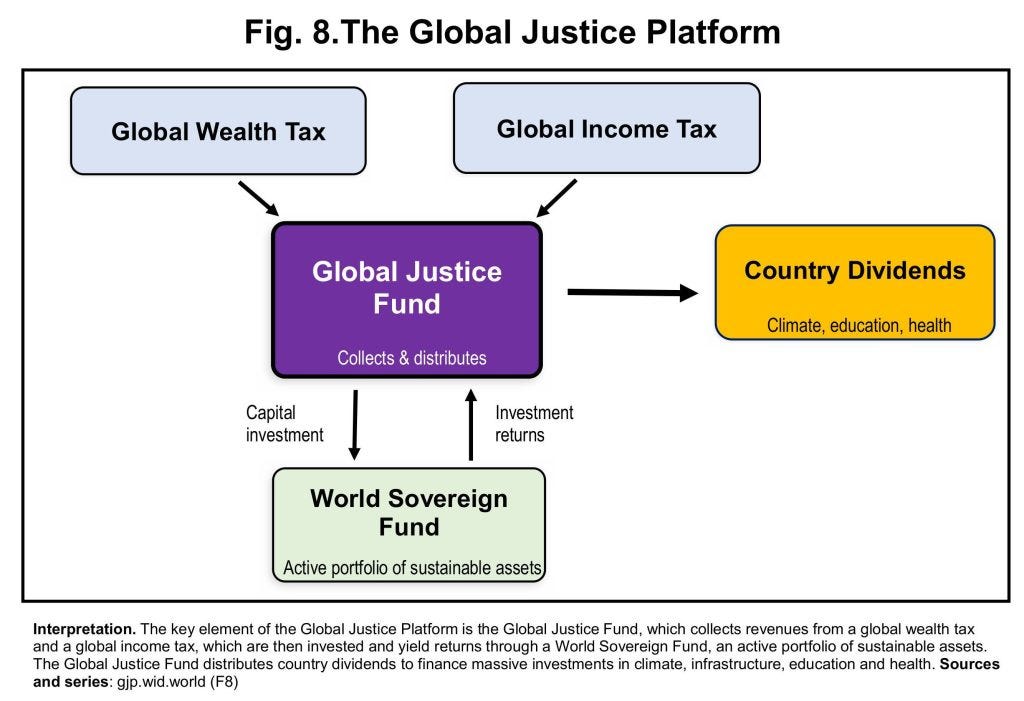
The Global Justice Project says that rapid decarbonization is a must, and that it needs to be paid for by the rich, and that that payment should come in the form of a global wealth tax and a global income tax, which funnel fairly large sums of money from the north to the south. They aim for a “sufficiency” world, in which all have enough and where the share of wealth owned by the richest one percent drops dramatically—a kind of globalized Sweden, I’d say, in which people work half the hours we do at present, and consume more education and health care and less stuff. They view it as an alternative to “degrowth” scenarios, and also to our current unrestrained growth model, and say that it leaves the world with lower temperatures than either of those schemes.
To avoid climate catastrophes, we show that sufficiency is required: a structural transformation of the economy involving shorter working hours, a lower material footprint, a shift from material-intensive sectors toward relatively immaterial sectors such as education and health, and major changes in food systems and land use. Rapid decarbonization of energy systems is also necessary, as is the sharp compression of income and wealth inequality. This compression is both a social justice objective and a condition for financing necessary climate investment and human capital expenditure and for sustaining political support from bottom- and middle-income classes in both the North and the South.
Here’s a little diagram they provide of the basic outline
I have a certain sympathy for the argument—expressed most pithily by David Roberts on Bluesky—that this kind of sky-castle architecture doesn’t amount to much; I too am more fascinated by the daily drumbeat of technological innovation. And I think that the accumulation of that innovation may undermine part of Piketty’s argument; I have a feeling that the investment required for decarbonization is going to be easier to come by, as the price for good stuff just keeps falling, and the economic logic of paying for fossil fuel becomes ever smaller.
But I also think that the climate crisis is not the only ecological threat we face, nor indeed the only threat period. I think it’s pretty clear that democracy can’t survive inequality; there’s an ever-better case for taxing the hell out of billionaires even if all you do is bury the resulting money in a hole in the ground. One possibility is that the mega-rich will succeed in their current project of deliberalizing the planet, and we’ll all get to live in our own nasty little sovereignties; another is that the Bernie Sanderses resident in most parts of the world will figure out how to combine their efforts and that over time we’ll get something that looks a bit like what Piketty (or for that matter Kim Stanley Robinson in Ministry for the Future) imagines. One tell for me that this team is not entirely politically detached came in this paragraph about what would happen if America (or China) predictably refused to join in such a scheme:
If necessary, the Global Justice Platform can be implemented with an incomplete coalition of countries, including the absence of the US and/or China. According to our projections, the climate damages imposed by the US on other countries would be about 3% of world GDP per year, on average, over the 2026-2100 period if the US does not participate in the GJP. Under simplifying assumptions, other countries should impose a corrective tax of approximately 80% on all US exports to collect tax revenues approximately equivalent to the damage. Given the projected decline of the US share in world GDP – from 30% in 1945 to 15% in 2025 and 5-10% by 2100 – it is likely that such tariffs would induce the US to join the GJP. The same conclusion applies to the case of China, but with a higher tariff (180% or more).
The report concludes that
“A habitable, equal 21st century is materially possible. What stands in the way is not technical impossibility but political choice and the hard but crucial work of building a coalition behind it.”
I think that’s a worthy goal to keep in the back of our minds as we proceed with the daily work of building the infrastructure for this new world; every election is a chance to get us a little closer, by electing the kind of people who understand the need for this kind of compression of wealth.
But the infrastructure is the part we can do something about right now, and on that score there’s some equal mix of encouraging maddening news, all of it again on a large scale.
On the one hand, our farcical war in the Gulf continues to serve as the recruiting sergeant for the renewable revolution. As a Bloomberg team reports in a long and important essay, the Gulf War has been “Asia’s Ukraine.”
About two hours from Manila there’s a solar power plant capable of powering 60,000 homes. Surrounded by fields growing okra and eggplant, it had been sitting idle since August, waiting for a connection to the grid — stuck in a queue just like many other renewable energy facilities around the world as power networks struggle to catch up with rising electricity demand.
Then the Iran war cut off the Philippines’ supply of imported liquefied natural gas. Immediately, the government cut fuel taxes and offered free bus rides to the public. Then a few weeks later, as the Strait of Hormuz remained blocked, officials began deploying policies toward a deeper, more structural plan to reduce the country’s dependence on fossil fuels.
One strategy was to fast track more than 30 renewable plants by the end of April. One of those was that 125-megawatt solar plant, built by Citicore Renewable Energy Corp, which is now supplying clean energy to the grid. It is “good timing,” said Joselito Ernst Cañete, operations manager at Citicore, just as electricity demand increases to power air conditioners during the peak summer months.
What happened in the Philppines isn’t an isolated example. With their energy supplies threatened, countries across Asia and Europe have chosen to speed up deployment of renewables and electrification.
Meanwhile, the cheerful solar guru Danny Kennedy chimed in from a conference in Singapore where he found the western politicians and analysts way behind the Asian curve. I will quote from his account at some length because it’s important
Philippines. After declaring a national energy emergency in March, the government activated a whole-of-government mandate for energy security. Regulatory bottlenecks for renewables are being dismantled. Rooftop solar inquiries are up 500% since the crisis began. This is not a green ambition. This is a survival response.³
Vietnam. The country has revised its power development plan, targeting a minimum of 47% renewable electricity generation by 2030. Vietnam is already the region’s largest EV market, and its government has expanded EV tax incentives in direct response to the Iran War’s impact on fuel prices.³ HSBC recently extended $4 billion in clean-tech financing to Chinese firms, much of it flowing into EV and solar exports to Vietnam and ASEAN.⁴
Indonesia. Beyond the factory I visited in Batam, the government is engineering a broad fiscal shift — expanding EV incentives with a target of 2 million electric cars and 12 million electric two-wheelers on the road by 2030. With the world’s largest nickel reserves, Indonesia is positioning itself to replace diesel imports with a domestic battery ecosystem. The logic is national sovereignty as much as climate policy.³ We’ve also talked about their 100GW solar archipelago plans.
Thailand. Advanced its net zero target by 15 full years, to 2050. Solar generation surged 72% in 2025. The country is adding 50 GW of renewables and 14 GW of energy storage by 2037. A major 1 GW module supply deal between China’s GCL-SI and Thailand’s Getz Energy was just signed to support that buildout.⁵ ⁶
Singapore itself. Already scaled solar to 1.7 GW and is executing multi-gigawatt cross-border subsea clean electricity cables from Indonesia, Cambodia, and Vietnam — with a requirement that developers bundle storage at origin for 24/7 firm power delivery. Singapore, to its credit, is acting. The conference, perhaps, just needed a bigger window.³
We already know China and India — the two largest energy consumers in Asia — reached a historic tipping point together in 2025. For the first time, fossil fuel generation fell in both countries simultaneously: China down 0.9%, India down 3.3%.³ These are not small numbers. These are inflection points.
And yet even as this good news is happening, the Chinese are also beginning to shutter many of the solar panel factories that are at the heart of this revolution, because they’re not making enough money. This is, on the hand, understandable, and on the other entirely maddening—these factories are the single most important industrial asset on earth—they are factories for lowering the temperature of the earth. As readers are doubtless painfully aware, I’ve been beating this drum for a good long while, but I’m glad to see others joining in. Adam Tooze, the interesting bricoleur in charge of the Chartbook newsletter, wrote in the FT this week, it would be understandable if we were talking about some mundane commodity like cement.
But solar panels? Since when were solar panels just another commodity? They are a technological miracle. They make us into farmers of the sun. For the past half century, research labs around the world, starting in the 1970s with Nasa spin-offs and the big US energy research push under Jimmy Carter, have been straining to reach this point. Together with batteries, which are also rapidly approaching the point of excess supply, they are the key to a sustainable future.
As Tooze points out, it cost China very little in subsidies ($18 billion) to build this behemoth (though one should probably add in the subsidies that, say, Germany provided to its citizens to buy the early models, underwriting the startup of China’s engineering miracle).
I’ve long argued that on a rational world, trying everything it could to head off the worst of global warming, we would “globalize” these factories, running them 24/7 and then piling up the panels on every railroad siding and wharf on the planet so that people could come take them away. This would be, I think, a backdoor way of achieving a fair amount of what Piketty has in mind, far messier than his global scheme but somewhat more plausible. By some calculations, ten years production from those plants would produce enough panels to provide all the power the world currently uses.
If my sense that the coming El Niño will revive the world’s focus on the climate crisis—well, this is the easiest possible route forward. And it comes not just with more power, but with different power. Elon Musk may be rushing his IPO for data centers in space or whatever the heck he’s currently selling, but some of us will hole up here on earth, quite sufficient with the solar panels in our yards.
In other energy and climate news:
+Along somewhat these lines, very worth reading the Volts interview with James McGinniss, an entrepreneur pushing small battery systems to tenants and small holders—in the case of his company, mostly business like laundromats and small groceries. He argues that cumulatively they’re going to be…very important
What we’ve found is — this is another mind-blown moment for me — when you look at the National Electric Code and UL certification and how, outside of whatever jurisdiction that you’re in, just what is safe physically to do, you can do hundreds of kilowatt-hours in buildings because there’ll be multiple 200- to 400-amp panels. Each of those — there’s the 120 rule — and you can push a lot more power into them than you think, not just these little batteries. We’re keeping things small because of the current environment that we live in.
The physical, safe way to do it — I see paths to having, imagine in every panel on a commercial building you have a stack of these batteries like a server rack, and they are all plug-in based. You are not just doing one giant system on the roof, which has totally different safety and weight considerations and needs permits, etc. When you think about these metropolitan areas, you could imagine solar on every balcony, solar on the roof, storage on every panel, and they are all plugged in.
You’re talking about megawatt-scale deployments.
+I’ve spent what seems like months of my life trying to dispel the notion lodged in American minds that China is undercutting the climate by endlessly building coal plants; as it happens, China is decreasing its coal use. But not the U.S. (see above); indeed, new data shows that America is now investing more in fossil fuel than the vastly larger People’s Republic. From Josh Gabbatiss:
High demand for electricity to power these data centres has led to companies rushing to build new gas-fired power plants across the country.
This trend, combined with “soaring” gas-turbine prices, drove a threefold increase in US gas‑power investment in 2025 – and the IEA expects this to continue throughout 2026.
As the chart below shows, Chinese investment in coal- and gas-fired power is expected to drop this year, amid domestic policy changes and the Iran war sending gas prices spiralling.
Together, these trends mean the IEA expects US investment in fossil-fuelled power plants to overtake China’s in 2026.
Happily, as Haley Zaremba points out, the solar boom in the U.S. is also continuing despite Trump’s best efforts
Newly released data from the Federal Energy Regulatory Commission (FERC) shows that at the close of last year, solar energy additions were the single largest form of new energy capacity installations for the 28th straight month, starting in September of 2023. In fact, in spite of a broad rollback of Biden-era clean energy incentives since Trump resumed office in January of last year, renewables represented a whopping 88 percent of energy additions in 2025, with utility-scale solar alone counting for 72.6 percent of U.S. electricity additions.
This massive growth trend has caused solar power’s share of the United States energy mix to surpass that of wind power, nuclear power, and hydropower. And while many if not most of these renewable projects were greenlit and funded before Trump took office and rolled back tax cuts and subsidies for solar and wind projects, experts say not to expect a major cooldown any time soon.
In fact, FERC projections show that solar energy installations will continue to grow by 86 gigawatts over the next three years, at which point the sector will surpass coal as well, Trump’s $700 million plan to revive coal production notwithstanding.
Meanwhile, out in Trump’s favorite parts of the world, solar spending in Africa is also outpacing fossil fuels. As Allan Olingo chronicles
Of the 322 energy projects announced across Africa in 2025, 173 were solar projects, followed by hydropower at 46, wind at 34, gas at 22 and hybrid energy projects at 14, according to the energy research firm Electron Intelligence.
“Africa is not on the periphery of the global energy transition, it is sitting at its center,” said Mugwe Manga, climate finance lead at FSD Kenya. “The continent holds the world’s best renewable resources, and the economics have now decisively turned in favor of clean energy.”
According to Olamide Niyi-Afuye, CEO of the Africa Minigrid Developers Association (AMDA), the continent is undergoing a broader strategic shift in how energy infrastructure is being developed, with an emphasis on systems that can be deployed faster and expanded gradually with flexible financing.
+Thanks in no small part to James Talarico (and that Leo fellow), it’s a good season for rethinking the basics of Christian theology. Talarico has reminded us that kindness is somewhat more Scriptural than cruelty; now a California pastor, Jeff Spencer, has written a nifty sermon arguing that the creation story in Genesis was really the first incarnation. And he quotes that California mystic (who knew, thanks to his fundamentalist father, every word of the Bible by heart), John Muir.
“The earth, he said, is a divine ‘incarnation.’ Here, Muir uses a word that most of Western Christianity has reserved exclusively for Jesus. Muir applies it not just to Jesus, not even just to humanity and the creatures, but to the matter of earth itself. Even earth’s geological formations, he says are ‘heaven incarnate’; the rocks can be called ‘instonations’ of God. Everything is in essence spirit, incarnated in flesh, in leaves, in rocks. All these varied forms of matter ‘are simply portions of God,’ wrote Muir. They are all of ‘the God essence.’”
I can’t help but wonder if this long thread of Christian thought, typically suppressed and condemned by the gatekeepers in the church, influenced Father Richard Rohr when he wrote much more recently, “When Christians hear the word ‘incarnation,’ most of us think about the birth of Jesus, who personally demonstrated God’s radical unity with humanity. But I want to suggest that the first Incarnation was the moment described in Genesis 1, when God joined in unity with the physical universe and became the light inside of everything.”
+Annals of divestment: Quebec’s pension fund reports that getting out of fossil energy and into the clean stuff made it a lot of the green stuff.
La Caisse — the Quebec pension fund managing the retirement savings of six million Quebecers — confirmed this month that its exit from oil has paid off financially.
Since launching its climate strategy, its energy investments returned 10 per cent annually, compared to 8 per cent from a global oil index — a gap that amounts to almost $4 billion above what investing in oil companies would have generated.
+You’ve heard about urban legends, but one rural legend—fanned by the same fossil fuel disinfo experts that have been hard at work for decades—is that farmers should reject solar panels because they might shed glass that would somehow end up in future crops. As Austyn Gaffney reports:
In January, Michigan Republican state Rep. Cam Cavitt posted a 51-second clip to Facebook labeled “Solar Farm SECRET.” In the segment, he claimed that farmers in his district couldn’t grow potatoes on land where solar developments were sited.
“Frito [Frito-Lay] did the same with the potato growers up by us,” fellow Michigan Republican Rep. Dave Prestin told Cavitt in the clip. “Any field that had solar panels installed on it will never be allowed to grow potatoes for human consumption due to the leaching.”
Shockingly, this isn’t true.
PepsiCo, which owns Frito-Lay, told Canary Media that the company “has not issued blanket guidance to growers that fields with solar installations will not be accepted.”
Nor is there any published evidence that solar farms have a negative impact on potato farming, according to experts consulted for this story. On the contrary, there is agrivoltaics research showing that potatoes—and many other crops—can benefit from growing alongside shade-making solar panels.
+Denmark is out with its new climate policy, and where others (New York!) are in cowardly retreat, they have decided that they will go to 110% emissions reductions by 2050 (funding work elsewhere to make up for past emissions). I predict that this will end up making them richer, not poorer. They’re also introducing a tax on private jets and cruise ships. Creeping Pikettyism!
Meanwhile in Scandinavia, the Finns are putting huge storage batteries outside a new Microsoft data center that will allow them to capture the excess heat from the facility and use it to warm almost half the house in a large district. As Patrick Jowett writes,
Peter Strannegård, Fortum’s Executive Vice President, Renewables and Decarbonisation, said that once fully implemented, data centre waste heat is expected to cover approximately 40% of the total 2 TWh annual district heating demand of the 250,000 heat users in the area.
The recovery of waste heat from Microsoft’s data centre sites is scheduled to begin step by step next year, Fortum’s update adds, in line with Microsoft’s construction and commissioning schedule.
“As new phases of the data centres are completed, increasing volumes of waste heat will be available for the district heating customers,” the company said. “Waste heat recovery increases local heat production capacity, reduces exposure to fuel price volatility and helps maintain predictable district heating prices.”
Fortum also explained that the set-up of the plants allows heat production to respond flexibly to varying demand, strengthening reliability and price competitiveness of heat production for district heating customers in the area. “For the wider energy system, flexible heat production helps balance electricity demand, particularly during fluctuating renewable generation,” it said.
Meanwhile, as I noted above, the U.S. energy secretary has decided to invest in…coal
+New Zealand’s conservative government has not been particularly planet-friendly, but they are investing in putting solar panels on hundreds of schools
“Early modelling by Energy Efficiency and Conservation Authority (EECA) shows that solar panels are estimated to pay for themselves within five to seven years and a 30kW system - the standard size for a school - could save a school up to $8000 a year in electricity bills,” Energy Minister Simeon Brown said.
“Schools will also have options to sell energy back to the grid, generating an estimated $6.7m in revenue over 10 years.”
+Chelsea Harvey reports that municipal heat preparedness campaigns across the country are suffering from federal funding cuts
The federal government doesn’t define heat waves as a disaster, even as events with fewer victims, like hurricanes and floods, qualify for Federal Emergency Management Agency assistance. So money is short, no matter who’s president. But they said it’s gotten worse under the Trump administration, which has canceled grants ranging from long-term resilience funding from FEMA to tree-planting support from the Forest Service.
Those challenges roared to life at a disaster planning conference in Boston earlier this month. Heat officers from around the country were asked to respond to a fictional scenario in Phoenix, where an imaginary blackout silenced the thrum of air conditioners citywide as temperatures soared to 111 degrees.
Funding lapses were an urgent undercurrent, even as participants dreamed of expanding heat emergency plans and urban cooling projects.
“You can identify those big budget items, and you can advocate for them, but you’re not necessarily going to get them,” Jane Gilbert, a veteran official who has overseen heat programs in Miami, said at the two-day workshop attended by nearly two dozen officials from across the country.
But, did I note, we’ve got plenty of money to subsidize new coal power?
+Very good to see blue states suing the federal government over its dispersal of billions to buy back offshore wind rights. As Ella Nilsen writes,
New York Attorney General Letitia James called the March announcement an “illegal agreement.”
“After repeatedly losing in court, this administration cooked up a sham deal to pay a foreign energy company hundreds of millions of taxpayer dollars to abandon offshore wind and invest in oil and gas instead,” James said.
The lawsuit was filed in the US District Court for the District of Columbia. State attorneys general from New York, New Jersey, Connecticut, Maine, Vermont, Massachusetts and Rhode Island argued on Tuesday the administration had violated the law when executing the March deal — failing to hold a hearing required by law to determine that keeping the offshore wind leases “would likely cause serious harm to life, property, national security, or the environment.”
+Finally some good news. The Trump administration is desperately trying to sell off the Arctic National Wildlife Refuge for oil drilling, but it’s almost impossible to find buyers. Only two companies put in bids on small corners of the acreage. Partly this is because campaigners—mostly native Alaskans—have made it toxic: not even Exxon wants to go dig up a wildlife refuge. And partly its because—can you imagine, in the 21st century, making money by digging up oil in the farthest corners of the earth, refining it, shipping it, and then selling it to…who exactly? As Dan McCarthy reported the other day, EVs are taking over the world
Nearly 60% of cars sold in China this year will be electrified.
EV sales are growing rapidly across the rest of Asia, too. This year, sales are expected to leap by over 50% across Asian countries other than China, IEA found, driven in large part by the availability of super affordable Chinese EV models.
In Europe, which has strong emissions standards that push consumers toward EVs, sales are growing especially fast. This year, EVs will make up one-third of new cars sold in the region, powered not only by EV-adoption poster child Norway but also by rapid uptake in Germany, the U.K., and Turkey.
The Arctic refuge story is the one that stays with me — not because of the policy outcome, but because of what it reveals. Native Alaskans made it toxic. Campaigners made it impossible. That's not data winning. That's people with a relationship to a place refusing to let it go. I wrote my novel Empty Earth about a wilderness guide named Harry who understood that the only thing that ever actually stopped extraction was love for a specific piece of land. Looks like he was right.
Technology may be moving faster than politics. The real challenge is whether our institutions can evolve quickly enough to match the possibilities created by the energy transition.