
Thinking about lying
Climate denial taught our leaders shamelessness

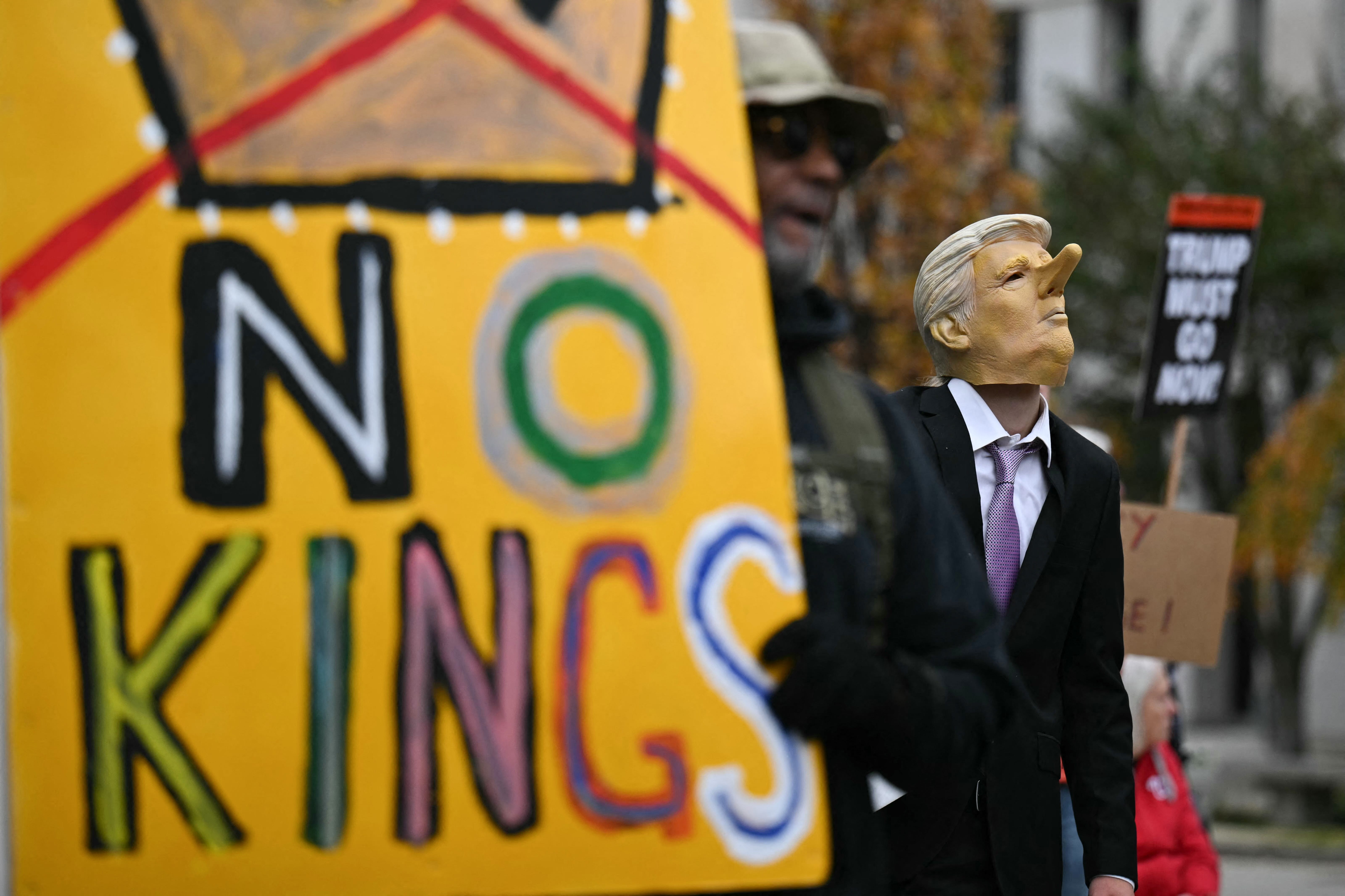
The past stretch of days—say, since the murder of Renee Good—has been marked by brutality, but also by a dishonesty so deep and stupid that it’s begun to finally turn on the liars. Following the execution of Alex Pretti, for instance, various White House officials were quick to start just plain lying: he was an “assassin” and a “domestic terrorist” who "wanted to do maximum damage and massacre law enforcement."
As many videos emerged in the course of the day, those lies were shown for what they were. Pretti was, at worst, trying to help a woman who was being unnecessarily gassed; for his pains he was executed once he’d been disarmed; the only “weapon” he’d “brandished” was a cellphone. Oh, and instead of being a domestic terrorist he was a VA nurse who treated former soldiers with compassion and dignity.
Politicians, it goes without saying, have sometimes engaged in dishonesty, often with hideous consequences. The Gulf of Tonkin “attacks” that gave America an excuse for war in Vietnam were at least in part fabrications; the “weapons of mass destruction” weren’t in Iraq and there was no compelling reason to think they were. Hell, we had a president—Richard Nixon—known as Tricky Dick for the smears and fibs that marked his whole career, from his first congressional race to the last days of Watergate. But the presidents who told those lies generally attempted to manufacture cover stories or cloud them in enough shadows that they might pass for mistakes. By now, however, we’ve reached a point where the president and his party just recite up-is-down lies constantly. Consider this reckoning of his first term:
When The Washington Post Fact Checker team first started cataloguing President Donald Trump’s false or misleading claims, we recorded 492 suspect claims in the first 100 days of his presidency. On Nov. 2 alone, the day before the 2020 vote, Trump made 503 false or misleading claims as he barnstormed across the country in a desperate effort to win reelection. This astonishing jump in falsehoods is the story of Trump’s tumultuous reign.
By the end of his term, Trump had accumulated 30,573 untruths during his presidency — averaging about 21 erroneous claims a day. What is especially striking is how the tsunami of untruths kept rising the longer he served as president and became increasingly unmoored from the truth. Trump averaged about six claims a day in his first year as president, 16 claims day in his second year, 22 claims day in this third year — and 39 claims a day in his final year.
Put another way, it took him 27 months to reach 10,000 claims and an additional 14 months to reach 20,000. He then exceeded the 30,000 mark less than five months later.
The second term, obviously, is far worse than the first. At this point, it would be far easier for the Post to assign a reporter to list the true things the president says—a list as short as his…temper. (And of course the second-term Post wouldn’t do this, since its owner has castrated one of America’s great papers in an effort to curry favor with the fibber-in-chief). Every lie he tells is then repeated by his satraps in the administration and Congress—the closest they come to shame is when they lie and say that they haven’t heard his latest lies so they don’t have to publicly swallow them. Here at home we’ve gotten so used to this that the lies often barely register—but when Trump went to Davos and gave a speech literally filled with whoppers, European leaders were astonished. He was telling them things that they knew to be absurd—that China has no wind farms, say—and expecting them to go along.
Where the GOP learned to lie as a matter of course is an interesting question, and I’m afraid I’ve had a front row seat. I think it’s the climate fight, more than anything else, that taught them to regard reality as optional. And I think this because I remember the start of it all. When Jim Hansen first testified before the Senate that global warming was real, it caused a society-wide stir; running for the White House, the sitting vice-president George Herbert Walker Bush said he would combat the greenhouse effect with “the White House effect.” He made no attempt to deny it, or pretend it wasn’t a problem; it was reality, he wanted to lead the world, he had to at least pretend to deal with it.
And of course he could have—he could have resurrected Jimmy Carter’s plans (only eight years old) for a rapid solar research and development program, for instance. He seemed like he might; during the campaign he promised to convene a "global conference on the environment at the White House" during his first year in office. That didn’t happen, and it’s fairly easy to figure out why.
At about this same time—1989-1990—the fossil fuel industry was making a fateful decision. They were well aware that global warming was real; as a series of archival documents and whistleblowers have now laid out in excruciating detail, the big oil companies had conducted their own research programs, and reached conclusions just like Hansen’s. (Indeed, Exxon’s internal estimates of how hot the world would be by 2020 turned out to be even more accurate than NASA’s). We know that the executives of these companies believed their scientists—Exxon, for instance, began building drilling rigs higher to compensate for the rise in sea level they knew was coming, and plotting which corners of the Arctic to lease for drilling once it had inevitably melted.
But they decided, across the industry, that the price of telling the truth would be too high. Inevitably it would mean having to leave at least some of their reserves of coal, gas, and oil in the ground, and those reserves were valued in the tens of trillions of dollars. And so they started forming the coalitions and councils, hiring the veterans of the fights over tobacco and asbestos and even DDT—they started lying.
Their lies were, at first, made concessions to some notion of plausibility. The science was “uncertain.” It was mostly China’s fault. Climate always fluctuates. Computer models are “unreliable.” And so on—these were never good-faith objections, they were always the arguments from selfishness. And as time went on they became more and more outlandish. Before the 1990s were over, the CEO of Exxon was telling a key crowd of Chinese leaders that the earth was cooling and that it would make no difference if we waited a quarter century to start phasing out fossil fuels. Again, his scientists had assured him that this was nonsense years before.
It took a while for this to filter down through the entire GOP ecosystem. George W. Bush actually ran for president in 2000 promising to officially establish that carbon dioxide was a pollutant and to regulate its emissions. Shortly after taking office, however, his vice-president—oil-patch CEO Dick Cheney—held a series of private meetings with his industry brethren, and before long W announced that he had made a mistake and that co2 was not in fact a problem.
That was the signal for the rest of the Republican party—save for a few iconoclasts like John McCain—to fall in line, and by the time he ran for president even McCain had pretty much given up talking about global warming. The biggest donors by far to GOP campaign funds were the Koch brothers and the vast network they had assembled of rightwing billionaires—and the Koch brothers were the biggest oil and gas barons in America, owners of an unrivaled fleet of pipelines and refineries. The efforts of this group of oil-adjacent cronies became ever more extreme—eventually they were funding groups to put up billboards equating climate scientists with Charles Manson.
And eventually, inevitably, it produced a president who felt no compunction about just saying that climate change wasn’t real, and using all the power he could muster to kill off both the scientific effort that had alerted us to the crisis, and the policy effort to do something about it. His crew assisted in this cover-up in all the usual ways—we learned this week, for instance, that a federal judge had ruled that the Department of Energy’s effort to produce a report pooh-poohing climate danger had violated all manner of federal law.
Judge William Young of the U.S. District Court for the District of Massachusetts said the Energy Department did not deny that it had failed to hold open meetings or assemble a balance of viewpoints, as the law requires, when it created the panel, known as the Climate Working Group.
“These violations are now established as a matter of law,” wrote Judge Young, who was nominated to the bench by Ronald Reagan. He said the Climate Working Group was, in fact, a federal advisory committee designed to inform policy, and not, as the Energy Department claimed, merely “assembled to exchange facts or information.”
What makes this campaign of deception all the more remarkable is that it’s happened even as the actual facts of global warming have become painfully clear. Back in 1988 it was still pretty much theory; now it’s flood and fire, storm and sea level rise. We live on a planet losing the ice at its poles, and the vast coral reefs in between, where tens of millions of humans are already on the move because their homes can no longer support them. It’s also remarkable because in 1988 the solutions were hard—solar power was still the most expensive energy on earth. Now it’s the cheapest. Most of the world has recognized these truths, coming together if fitfully to try and least talk about it. But whenever America is in the hands of Republicans it just walks away.
Perhaps, given this long history, I can offer a few hard-earned ideas about how to try and deal with Trump’s many assaults on the truth. They won’t do all that we might hope, but they’re nonetheless important.
Don’t give up.
Telling the the truth repeatedly actually can work. Because more than 80 percent of Americans saw the video of Alex Pretti’s execution, the lies backfired. And at least in part because 95 percent of Americans live in counties that have had a federally declared disaster since 2011, it’s hard to convince most people that there’s not something afoot. Indeed, polling demonstrates that public concern and understanding of climate change has held relatively stable for the last thirty years, with about two-thirds of Americans acknowledging that we’ve got trouble. And since it’s clear that about one-third of America is beyond the reach of fact or feeling, that’s not bad.
More than ever we need to support independent media.
Throughout Trump’s second term, it’s been as much Substackers, Youtubers, and others of this breed who’ve been keeping things straight as it has the ‘legacy media.’ (As one small example, check out this epic—in both content and length—rant about renewable energy’s benefits that appeared on YouTube over the weekend). That legacy media is increasingly craven and corrupted (see, for instance, CBS News), or just simply out of business—we now have big cities in America without daily newspapers. The administration clearly recognizes this trend—that’s why they’re trying to prosecute Don Lemon, Georgia Fort, and others covering the Minnesota debacle. Many of these independent journalists have a point of view—I certainly do. And I can tell you that, though I continue to work for and love brave institutions like the New Yorker, I’m also very grateful for things like Substack that are increasingly taking up the slack. (Tips on how to support Lemon and Fort here)
Even on days when one despairs (and that’s an awful lot of days) it’s good to remind oneself that the truth has real value in and of itself. I’ve written more words than anyone else on the climate crisis—one motivation was to try and spur action, but another was simply to record and spread this news. It always has seemed to me that the worst fate would be to walk over this cliff without knowing it was there. Dignity demands understanding.
I have no idea if I’ll live to see the day when the truth regains a strong footing in our culture, but I do have a certain amount of faith it will happen eventually, if only because reality reality ultimately trumps (not Trumps) political reality. Physics and chemistry are functional truth, despite their liberal bias. I remember the week after Hurricane Sandy hit New York shutting down the financial district, and the cover of Business Week magazine was simply a big block of text: “It’s Global Warming Stupid.” Eventually that message will get through; our job is to see if we can make that happen before the damage is any worse than it has to be.
Oh, and word on the street is that ICE is going after Springfield Ohio this week—home of the biggest lie of the last election campaign. Haitians are not eating cats and dogs. ICE is killing good people. The last three years are the hottest on record. Pass it on.
In other climate and energy news:
+Somewhat remarkably, New York’s new congestion pricing law is speeding up travel not just in downtown Manhattan where the law applies, but throughout the metropolitan area, right down to the side streets of Jersey suburbs. As the aptly named David Zipper reports
As they expected, the researchers determined that the $9 charge has sped up vehicle journeys into Manhattan, nudging some people who would otherwise drive at peak times to instead ride transit, drive earlier or later, or forgo the trip entirely. Because traffic thinned, those still opting to enter Manhattan by car saved roughly 83,000 hours per week, averaging around three minutes per journey, according to the NBER paper.
But drivers who never ventured into the toll zone also saved time: As a group, this cohort, including those traveling within Bergen County or from the Bronx to Brooklyn, racked up savings exceeding 461,000 hours per week. An average journey became just eight seconds faster, but because there were over 100 times more of them than Manhattan-bound trips, their aggregated savings were more than five times greater.
+Canada’s Mark Carney, emerging as an intellectual leader of the free world, followed his deal with China to allow EVs into Canada with plans for trade talks with India, which the veteran energy reporter Mitchell Beer described as “the other electrostate.”
Now India is “electrifying faster and using fewer fossil fuels per capita than China did when it was at similar levels of economic development,” Bloomberg says, citing analysis by the UK’s Ember energy think tank. “It’s a sign that clean electricity could be the most direct way to boost growth for other developing economies, too.”
Canada’s decision to encourage EVs, even Chinese ones, has of course drawn Trump’s fury, but there were more signs last week that our president’s attempt to stall the electric vehicle revolution is only working in the US. Sales are up sharply across not only Europe, but also Turkey, Brazil, Mexico. Arit Naranjan reports that
For decades, climate progress has largely come from cleaning up the power sector. Burn gas instead of coal, or replace power plants with wind turbines or solar panels, and you can slash the amount of planet-heating gas spewed into the atmosphere for little cost.
Now, early signs suggest transportation may be on the brink of delivering similar wins. EVs have quickly gained ground in markets outside Europe and North America, avoiding a rise in fuel-burning vehicles and “leapfrogging” the development path that richer countries have taken in transport.
“Five years ago you might have thought [transportation] is really going to be a bottleneck [for climate progress],” says William Lamb, a scientist at the Potsdam Institute for Climate Impact Research. “But now with the widescale adoption of EVs, it’s looking a little bit easier.”
Even in the U.S. the wall looks a little less impregnable all the time. Here’s a review of a Chinese EV in that radical rag the Wall Street Journal, from a writer who managed to borrow one for a few weeks and drive it in suburban Jersey (where the roads are clearer thanks to congestion pricing, see above). As the author Joanna Stern says,
My dearest Xiaomi SU7 Max,
It’s been about a month since we were last together. Now, every time I climb back into my Ford Mustang Mach-E, I can’t stop thinking about you—your long range, your modular interior, your absurdly large infotainment screen.
At night, I miss your adjustable color lighting. On weekends, the kids talk about your wireless karaoke mics, walkie-talkies and yes, that back-seat minifridge.
Please come back to America…for me.
She raves on for many paragraphs, and quotes Ford’s CEO Jim Farley as saying “There’s no real competition from Tesla, GM or Ford with what we’ve seen from China.” Ford is trying to build a cheap EV of its own, retooling a production line to produce an electric pickup for about $30,000. But Stern predicts this technology will reach America when Xiomi or BYD or Geely build a plant here, something that even Trump has said he will welcome. Here’s how she ends her piece
“You absolutely will get a car like the Xiaomi SU7 here—no question,” Michael Dunne, chief executive of auto-consulting firm Dunne Insights, told me.
“Chinese manufacturers are prepared and poised to pounce as soon as the door opens—and that door opens not through imports, but through manufacturing here,” he said, adding that it could happen in the next two years. Geely has even said as much, though Xiaomi said it has no current U.S. plans.
I will wait for you, Xiaomi. We shall be together again one day.
I don’t think this kind of demand can be suppressed forever. As one straw in the wind, super-centrist economics pundit Noah Smith wrote a long column over the weekend saying the time had come to let the cars into the U.S.
First of all, if the U.S. keeps driving combustion cars while the rest of the world switches to EVs, American automotive technology will be orphaned from the rest of the world. Currently, GM and Ford both make almost a fifth of their revenue from overseas sales; if they only make gasoline cars that the world has no interest in buying, those export markets will be cut off, and the U.S. companies will be confined to their home market. This is known as “Galapagos syndrome”, because it’s as if the U.S. car industry lived on an isolated island.
Second of all, the U.S.’ turn away from EVs will make it a lot harder for the country to develop an indigenous Electric Tech Stack. Batteries and electric motors are the key to lots of future technologies, including all-important military hardware like drones. Currently, the U.S. can’t build many batteries or motors; if this situation continues, American military power will wither.
On top of that, lots of physical technologies — transportation, electronics, robots, and others — are converging on a standardized package of components that includes batteries and electric motors. A country that has no electric supply chain will lose an increasing number of manufacturing industries as more and more devices switch to the Electric Tech Stack. By providing the single biggest source of demand for batteries and electric motors, EVs allow producers of those components to attain large scale, thus driving down costs for a bunch of other manufacturing industries.
Joe Biden did his best to protect American automakers—and more importantly union jobs—by providing the money for our own rapid transition to EVs. But the business community really wanted more tax cuts instead, and the auto industry chieftains were happy to stand in the Oval Office as Trump officially rolled back automobile mileage standards. For their pains they also got to listen to him describe how Somali immigrants have “destroyed our country.” And they just stood there smiling, a phalanx of stupid greed.
+Funny little piece from Zach Fox Loehle about renewable energy’s biggest drawback: no explosions
Among the many flaws of renewable energy (such as the way solar panels look from my mountain house and wind turbines from my beach house), there is one that doesn’t get enough attention: its utter lack of major explosions. Those explosions are the thing that makes energy important and dangerous and mildly erotic. Simply put, renewables don’t go boom.
+Important report from Jessye Waxman and Ben Cushing at the Sierra Club on how public pension funds should respond to the climate emergency.
Only eight of the 30 funds evaluated earned a “strong” or “developing” score for their climate-solutions investing strategy, and even the more advanced systems often lack measurable targets or comprehensive definitions. Most funds still rely on portfolio-emissions metrics rather than approaches that drive real-economy decarbonization, and transparency into climate-solutions holdings remains limited. These findings highlight the gap between growing recognition of climate risks and the decisive investment strategies needed to address them.
+Longtime readers know that the author of this newsletter has a fatal weakness for blimps. Here’s a piece about a Canadian entrepreneur combining airships and solar power—SolarShips he calls his company—to ferry freight to remote parts of Africa. Andrew Seale writes
Solar Ship’s aircraft are currently in test mode. To date, the company has completed test flights of 14 different airships, narrowing them down to two core designs that are now being scaled up. All of them are designed to unlock access to the world’s most extreme environments – from delivering cargo and aid to transporting critical minerals from remote, politically volatile environments.
The next step, Mr. Godsall says, is regulatory approval and a series of demonstration missions intended to prove that solar airships can operate reliably at scale.
The first is an ambitious round-the-world flight planned for 2027, using the Tsorocopter – a solar-powered airship designed to carry up to 12 tonnes at low speed with a high degree of control. If successful, Solar Ship plans to begin operating the aircraft in Africa later that year.
“Africa’s our first target,” he says. “Everything we do there, we can put into a virtual aerospace environment and switch it to Amazon, the Arctic, Rockies, Australia, Indonesia – we’re building up a capability to operate in multiple places.”
I’m afraid that if you keep reading The Crucial Years, you will be subjected to reports on how these test flights go.
+In the Proceedings of the National Academy of Sciences, Mariana Walter et al write that collaboration with local social movements makes conservation work far more effective—even in the face of the violent repression such efforts often confront.
Our analysis shows that by contesting environmentally harmful activities in their territories—many of which are highly biodiverse—socio-environmental mobilizations make substantial contributions to biodiversity conservation. Yet, socio-environmental mobilizations are often portrayed by states and corporations as subversive or obstructive actors
+The reason that the fight against fossil fuel is so intense, so difficult—and so winnable—is that so few players are involved. As Liam Gilliver reports
An increasingly concentrated group of fossil fuel giants is dominating global emissions and “actively sabotaging” climate action to weaken government ambition.
New analysis from Carbon Majors’ dataset found that just 32 companies were responsible for 50 per cent of the world’s CO2 emissions in 2024, down from 36 a year earlier.
Carbon Majors found that 17 of the top 20 emitters in 2024 were firms controlled by nations that went on to block this roadmap. This includes Saudi Arabia, Russia, China, India, Iraq, Iran, and Qatar.
“Each year, global emissions become increasingly concentrated among a shrinking group of high-emitting producers, while overall production continues to grow,” says Emmet Connaire, a senior analyst at Influence Map, which hosts the Carbon Majors platform.
“Simultaneously, these heavy emitters continue to use lobbying to obstruct a transition that the scientific community has known for decades is essential.”
+Good news from southeastern Montana, where the Cheyenne tribe is using a combination of buffalo restoration and solar panels to reclaim important forms of sovereignty on their land. Illana Newman has a firsthand account:
Brandon Small’s pickup squeezes down a narrow dirt road lined with trees and bushes as we drive down the hillside towards the buffalo. We’re on the Northern Cheyenne Reservation in southeastern Montana, a landscape full of yellow grasses and hillsides lined with small pine trees. Small runs the buffalo restoration program here on the Northern Cheyenne Reservation.
Here on the reservation, where food and energy sovereignty are inextricably linked, a new solar installation is helping the tribe become more self-sufficient.
The buffalo pasture we’re traversing is huge—15,244 acres, to be exact—and Small said they’re working on expanding even further. Small drove us out here from nearby Lame Deer, Montana, to check on the water infrastructure and give us a tour of the buffalo habitat and the brand new solar installation that will allow them to grow their buffalo operation.
The buffalo enclosure has no transmission lines crossing it, meaning there’s no way to get electricity out to the land unless the electricity is completely off the grid.
Last year, in partnership with Indigenized Energy, a native led nonprofit focused on energy sovereignty, the Northern Cheyenne buffalo program received a solar array that will allow Small to expand the herd and processing capacity of the facility. The 36kW solar array and 57.6kW battery was funded by the Honnold Foundation and Empowered By Light and constructed by Freedom Forever and Jinko Solar in collaboration with Indigenized Energy.
Cody Two Bears, the founder of Indigenized Energy, sees energy sovereignty as inextricable from food sovereignty. “ We need energy sovereignty to flourish because that’s what’s gonna support all the other initiatives that are so important to tribal people moving forward,” Two Bears said in a Daily Yonder interview.
Note just in passing the Honnold Foundation as one of the players here. If you wonder why Alex was climbing a 101-story skyscraper in Taipei not long ago, there’s part of your answer.
+If you’re not yet reading Julian Brave Noisecat you should be. A canny veteran of the climate fight, he’s also a superb reporter and writer, as this essay about a Chilcotin River canyon makes clear.
I know Farwell Canyon is the best fishing spot, because the first time I fished there it was just the third time I stuck a dipnet in a river in my entire life. Running my net along slimy rocks, through whirlpools, and off the calm ends of back eddies where salmon choose to swim because they need breaks and prefer the path of least resistance, I caught dozens. Alongside my friend Chief Willie Sellars of the Williams Lake First Nation, his dad Darrel, and Darrel’s buddy who lives in the cabin behind Darrel’s house on the SugarCane Indian Reserve, we must have hauled at least 100 sockeye and half a dozen chinooks out of Farwell Canyon that day. Maybe even more.
The hardest part? Getting those slimy swimmers into trash-bag-lined burlap sacks and hauling them up a canyon trail cut through sagebrush in sprints of 20 fish per trip, a weight of about 100 pounds. Then into the big ice chest in the back of the truck. The view from the top of the trail is breathtaking. Dune-drifted badlands punctuated by pinnacles that tower over our pale blue river like a great natural cathedral. With one of my burlap sacks emptied of fish but still full of slime, I pause to take in the beauty of Farwell Canyon, of our way of life, of Creation.
That afternoon, Willie, Darrel, Darrel’s buddy, and I rolled through the Williams Lake First Nation handing out fish. A dozen salmon into this smoke house, a dozen into the next, another dozen for drying, a dozen for a freezer here, another dozen over there. Fillets, fish eggs, fish heads, red fish, oily fish, fish appreciated. I don’t know how many people we fed. But it must have been hundreds. One fish makes at least half a dozen generous portions. Many more, if it’s one of those chinooks real fishermen call “hogs,” because king salmon are known to rival the heft of a pig. I’ve seen photographic evidence. Real fishermen love photographic evidence.
+Kate Yoder, in Grist, has the lowdown on the Interior Department’s new mascot, an animated lump of coal known as…Coalie. Here he is in action with Interior Chief Doug Burgum, who introduced him with the powerful slogan “Mine, Baby, Mine!”
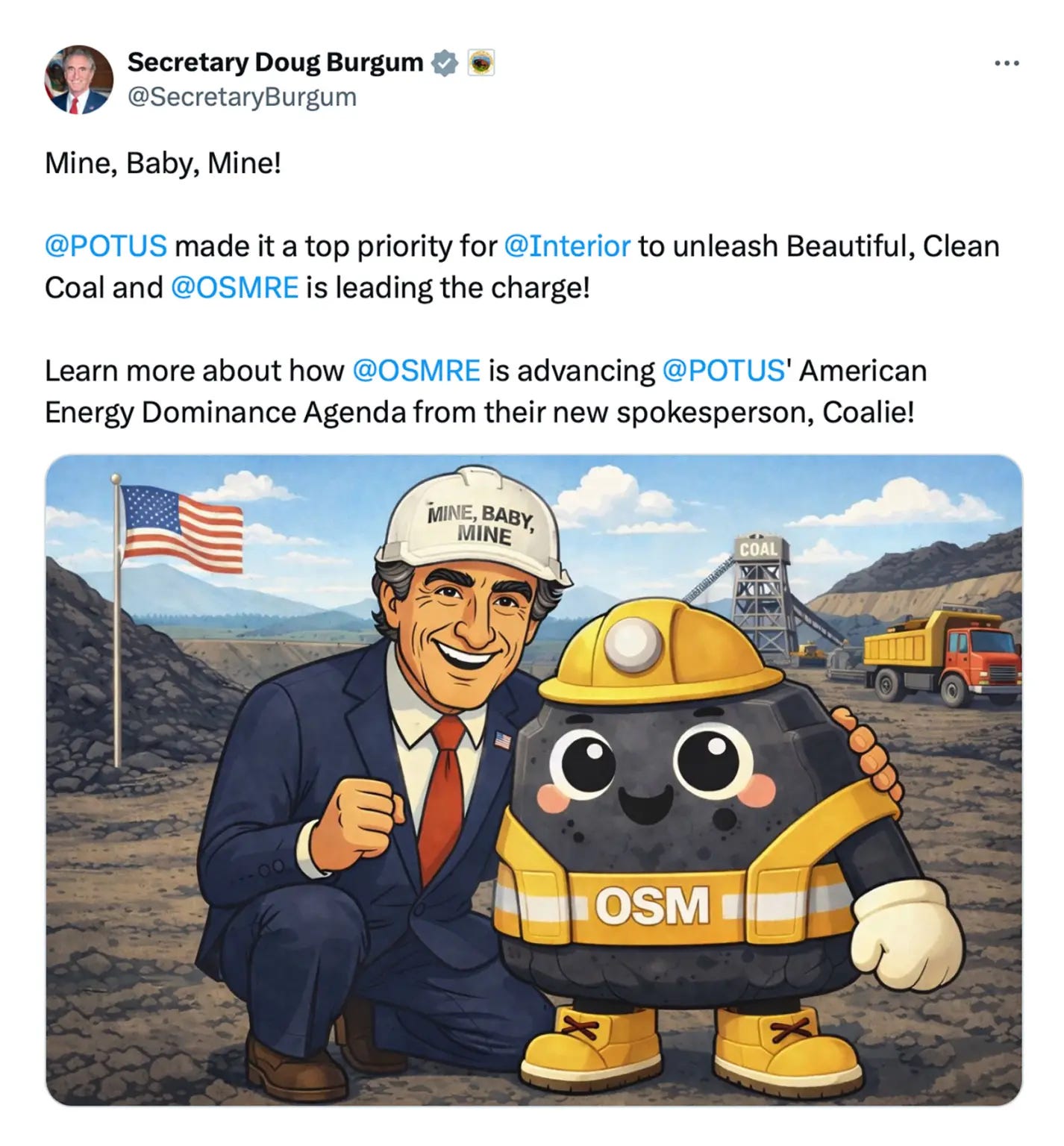
Someday we will look back on all of this and laugh? Or cry? Or both?
+According to Brian Roewe, it looks like New York’s new Catholic archbishop is a climate hawk!
Ronald Hicks led the Joliet, Illinois, suburban diocese outside Chicago for the last five years. There he oversaw a number of efforts to embed ecological concern deeper into Catholic life, including joining the Vatican’s premier initiative to live out Francis’ call to care for God’s creation.
That background has New York Catholics who are involved in Laudato Si’ ministries hopeful their new archbishop will not only support their work but help to root it even deeper into one of the country’s largest dioceses that counts 2.5 million Catholics and nearly 300 parishes.
“We’re excited that he’s coming,” said Nancy Lorence, founding member of the Metro New York Catholic Climate Movement, a chapter of the global Laudato Si’ Movement. “We’re hopeful that we’ll be able to do more and that there will be more of a promotion of Laudato Si’ in the parishes.”
+Francesca Paris reports on the ways that some cold-weather states are lowering the price of heat pumps.
This winter Massachusetts and Minnesota are requiring most of the major utilities in those states to offer discounted rates to people heating with electricity; Colorado is on the way to doing the same. These are states where lawmakers, mostly Democrats, have set targets to reduce planet-warming emissions, and the new rates are supposed to help them do that — especially at a time when rising electricity rates are in conflict with the goal of moving away from fossil fuels. But they’re also an attempt to fairly distribute the costs of keeping up the grid.
The discounts range from roughly 4 to 7 cents per kilowatt-hour and apply to all electricity used in the winter. (The typical household uses just shy of 1,000 kilowatt-hours per month, though heating uses more. So a 7 cent discount could amount to hundreds of dollars over the winter.)
A discount can make a heat pump go from a bad investment to a good idea.
Under the existing gas and electric rates set by National Grid, one of Massachusetts’ largest utilities, only around 40 percent of all households would save money by switching to a heat pump. Some people could lose hundreds of dollars each month, because their electric bill would go up more than their gas bill would fall.
But with National Grid’s new discounted rate, which applies from November through April, the share who would save would shoot up to nearly two-thirds.
+Your regular update on the state of balcony or plug-in solar: in the wake of everyone’s advocacy post Sun Day, we’re now at almost two dozen states with legislation pending to legalize this simplest form of solar power. As Todd Woody explains, a breakthrough in just one or two big states would be enough to firmly establish a market and quickly bring the price down.
“The impact of California passing legislation would be huge and will get manufacturers to come into the market,” said Kevin Chou, cofounder and executive director of Bright Saver, a Bay Area nonprofit that sells do-it-yourself plug-in solar systems and has pushed to legalize the technology.
+In Science, Joshua Lappen and Emily Grubert describe one of the (welcome!) problems that the energy transition may entail: it seems likely that as fossil fuel goes out of style we’ll start encountering systems that struggle to maintain the remnants of the old system
The fossil-fueled systems that currently supply about 80% of global energy consumption are complex, high-hazard networks of networks. These systems have developed through decades-long processes of accretion and adjustment, gradually producing complex interdependencies that often developed opportunistically and with limited coordination or documentation. The resultant networks of networks rely on their near-universal coverage and the foundational expectation of long-term demand growth to support economies of scale. As demand for fossil fuels stagnates or declines, these economies of scale will invert, leaving shrinking user bases to carry growing liabilities, and infrastructure designed for expansion to instead weather contraction.
If America’s Department of Energy wasn’t officially committed to the idea that “there is no energy transition” we could begin, you know, planning.
+Whistleblower ad executives are warning that the industry is now fueling both hatred and high temperatures. TJ Jordan writes
A group of senior advertising executives has released an anonymous memo warning that “a vacuum of responsible leadership” means the ad industry is morally failing itself and society.
“We know our industry is funding hate, legitimising environmental destructive companies, and working at the frontline of a US-led rollback on diversity, equity and inclusion” (known as DEI), they said in the memo, while “paying little more than lip service to solving critical issues” that include “spreading hateful content” and “helping polluting industries such as oil and gas rebuff public scrutiny.”
Many of the advertising and public relations industry’s headquarters and biggest clients are located in the United States.
The insiders called for an “honest conversation with industry’s power holders” such as agency leaders, the industry press, and advertising trade bodies, which they say are “failing to make a material stand on any of the issues that would give our industry a moral justification for existing alongside a commercial one.”
Harriet Kingaby, co-chair of the industry group Conscious Advertising Network, said that the memo is “a warning shot to both the C-Suite and investors in the advertising industry as well as the brands that use them.
+Movement thoughts. As the people of Minneapolis chart new paths in nonviolent resistance, Paul Cohen and former Weatherman leader Mark Rudd note that the award-winning film One Battle After Another runs some risk of glamorizing political violence
When the film played in theaters, audiences cheered for those fighting the forces trampling human dignity. But emulating the movie’s violent resisters would be a trap, confirming the justifications President Trump and his enablers give for brutalizing ordinary Americans and shredding the law.
In the movie, Leonardo DiCaprio’s lead character is part The Dude (complete with ratty bathrobe), and part follower of the 1960’s-era radical group, the Weathermen. But one of us, Mark, cofounded the Weathermen after helping lead successful student protests at Columbia—and now sees the group’s embrace of violence as a destructive trap.
+Some good news to end on. In Puerto Rico, where the grid fails each time a storm comes, often with life-altering consequences, solar and batteries are combining to produce an ever-growing virtual power plant. As Victoria Foote describes:
Today, solar panels are installed on the rooftops of some 175,000 households; of those, approximately 160,000 also have storage. The pilot program has since become a pillar of the island’s energy system and is the first operational virtual power plant (VPP) in Latin America and the Caribbean, helping to deliver electricity to three million residents.
And here’s a nifty story from Norway, where I’ve ridden the converted electric ferries that carry commuters across Oslo’s harbor. Now comes word that an electric hydrofoil has completed the longest open-sea journey, reaching Oslo from the west coast of Sweden across 160 miles of bouncy sea.
Already proven in Stockholm’s public transport system, Candela P-12 holds the record as the fastest electric passenger vessel in operation, with a service speed of 25 knots, and has exceeded 30 knots during trials, with a range of up to 40 nautical miles at cruising speed on a single charge.
The mission was to reach Oslo, where several electric high-speed ferries are already in service. The contrast between these conventional electric vessels and Candela P-12 is striking. Oslo’s fastest electric passenger ferry, m/s Baronen, operates a fixed 10-nautical-mile route and relies on swapping a deck-mounted battery container with several megawatt-hours of capacity at the end of each trip. The automated battery-swapping system alone has cost hundreds of millions of Norwegian kroner. While several swap stations have been completed, the system has faced delays and cost overruns, and deployment of additional stations has been delayed—limiting route flexibility.
By contrast, Candela P-12’s efficiency allows it to charge from standard, easily deployable automotive DC fast chargers. During the journey to Oslo, the vessel charged using a portable 360 kW Skagerak Energi Move DC charger connected to a mobile battery system, towed behind a Ford F-150 Lightning electric pickup.
You really should watch the video!
Great stuff Bill! I weep for what the USA and the world might have been by now had any true visionaries ever been in charge, and not greedy corporate-owned scumbags.
Great thoughts as always. I would add that yes, we need to support independent media, but that support should be focused on publications with editors. Substack and YouTube are filling in the gaps for now, but reporters need editors (and other colleagues) to check their stories for bias, missing context, a lack of clarity, and so on. Just as the U.S. government still needs a system of checks and balances, so does journalism.