
Tour de Planet
Are bikes DEI, or are they a miracle? (Or both?)

The most useful thing I did this week was appear on Ezra Klein’s New York Times podcast to talk about the rise of clean energy. He framed the story well, and asked generous and sharp questions, and my only regret is that I was too jacked up going in (this is one of the very few remaining real forums in American journalism) and so I think I interrupted him at several points when I just should have been listening. But I know it was a real conversation because at several points I found myself thinking new things, and one that I blurted out was: "Even better than the E.V. is the e-bike, which I think may turn out to be the transformative invention of our time on Earth."
Even as I said it I wondered if it was an overstatement, so this edition of the newsletter is an effort to interrogate that claim, not to mention an homage to the great Tadej Pogacar, who grabbed control of the Tour de France on Thursday with a truly remarkable climb up a couple of Pyrenean peaks, blithely adapting to the 100-degree heat. If he can do it, why not the rest of us?
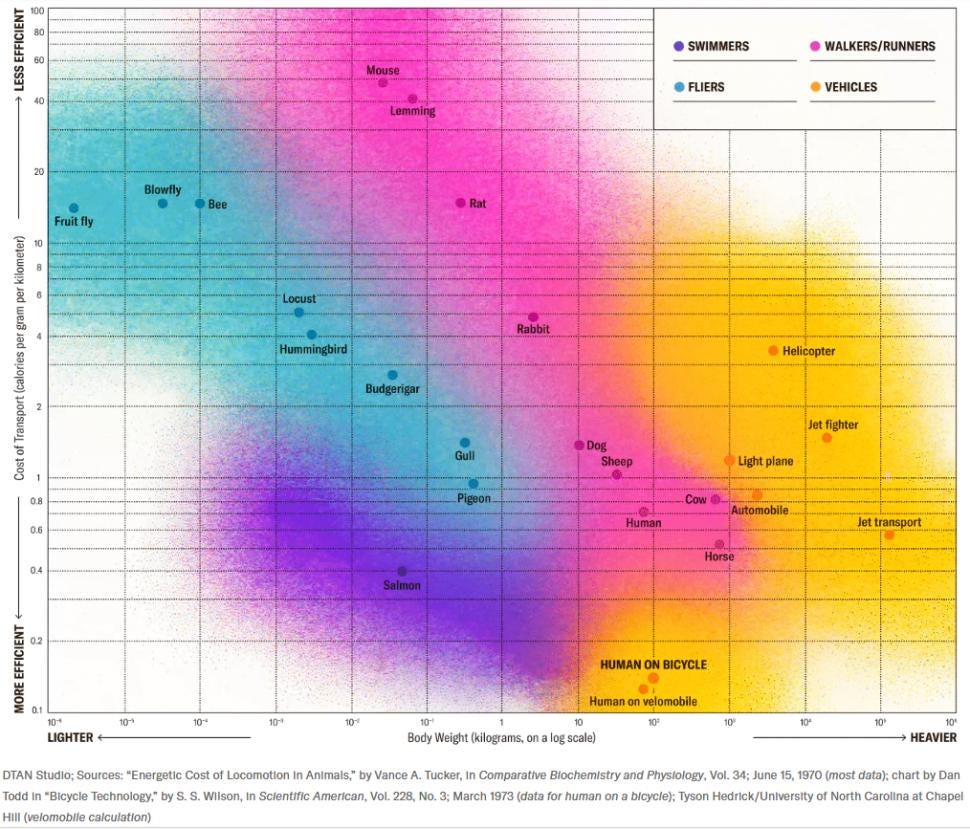
The Economist updated an October article this week that began in much the same tone: “Forget EVs,” the headline read. “Cycling is revolutionizing transport.” And really, they began in the right place: even before we get to e-bikes, bikes themselves are a magical technology, according to one recent reckoning from Anthony Blazevitch four times more efficient than walking. (Here’s the chart from Scientific American that more or less proves it).
As the Economist account pointed out,
Though robotaxis have notched up impressive growth, they look ploddingly pedestrian compared with far zippier pedal-powered rivals. Waymo, Alphabet’s self-driving taxi firm, proudly proclaims that its cars do around 250,000 trips a week. Yet in New York alone that number of trips is made every three days using the city’s bike-share scheme.
In London cyclists now outnumber cars in the City, the financial district, by two to one. Paris, where they now outnumber motorists across the whole city, is catching up with Europe’s traditional bike capitals, Amsterdam and Copenhagen, though cycling is still growing in those cities, too. In Copenhagen, the Danish capital, bikes account for almost half of commuter journeys to work and school.
Even in Beijing, just 30 years after most cyclists were pushed off the city’s roads to make way for cars, the number of cyclists is rising again. Only these days they are more likely to be riding a fancy Brompton bike than a black Flying Pigeon, the ubiquitous pedal-powered ride in the years after the communist revolution.
Covid helped spark the bike boom—American bike trips increased 19% between the summers of 2019 and 2020—but the other factor has been the rapid development of e-bikes.
By giving cyclists a pedal assist, these open up riding to people who cannot comfortably squeeze themselves into slim-fit Lycra. Workers can turn up at a meeting without breaking a sweat or needing to change. They are especially useful for transporting children and groceries, which is hard going if done by pedal power alone. E-bikes have also massively accelerated the use of local bike-share schemes, and made them profitable. With Chicago’s “Divvy” bike scheme for example, e-bikes are now ridden 70% more than “classic” bikes, despite being a lot pricier.
It’s very hard to find up-to-date numbers, but as early as 2023 the estimates were already that e-bikes were cutting oil demand by a million barrels a day, probably more than EVs. There are now 400 million of them on the road in China. I can remember Beijing in the days when the bike was dominant, and “driver” was an occupation—a chauffeur for party higher-ups. Those days may be coming back, as people grow tired of traffic jams, and as Chinese cities make bike infrastructure ever-better. As Daizong Liu, Xianyuan Zhu and Alphonse Tam described a couple of years ago
Beijing put forth a comprehensive plan to make the city more cycling-oriented by 2035. Beijing began this work in 2019 by developing 6-metre-wide, elevated, bike-only lanes to help ease congestion between dense residential areas and busy office districts. The projects are already yielding results: according to ITDP’s analysis, e-bike riders in Beijing now represent approximately 23% of commuters who have shifted from driving and ride-hailing services as their primary transport mode. This shift has contributed to an annual reduction in fuel consumption of nearly 59.86 million litres and an estimated decrease in CO2 emissions of 240,000 tons.
If you broaden your scope a bit to include anything on two wheels, you can see even more progress. Delhi, which has replaced Beijing as the poster child for bad air, has just put up $2.5 billion to electrify more of its transport—two-thirds of the vehicles in the city are on two wheels, and plenty more are the three-wheeled rickshaws that once ran on pedal power but now belch smoke from inefficient engines.
There’s endless room for improvement everywhere. Writing in Streetsblog, Pete Tomao offers new calcuations for the borough of Queens.
Queens Community Board 1 — which encompasses a broad swath of Western Queens — contains roughly 44,749 cars. That’s about 0.49 cars for every household. If Western Queens matched Manhattan’s car ownership rates, there would be 21,000 fewer vehicles on local streets, enough to fill more than 80 football fields of parking space.
Here’s what that might look like. Curbside parking becomes rain gardens, and sidewalks are expanded. Some streets become permanent pedestrian plazas. Instead of hearing cars as you walk on busy streets, you hear your neighbors’ voices.
Medians turn into community gardens, and every intersection has finished crosswalks. All of this is possible. Other cities and countries have already done it.
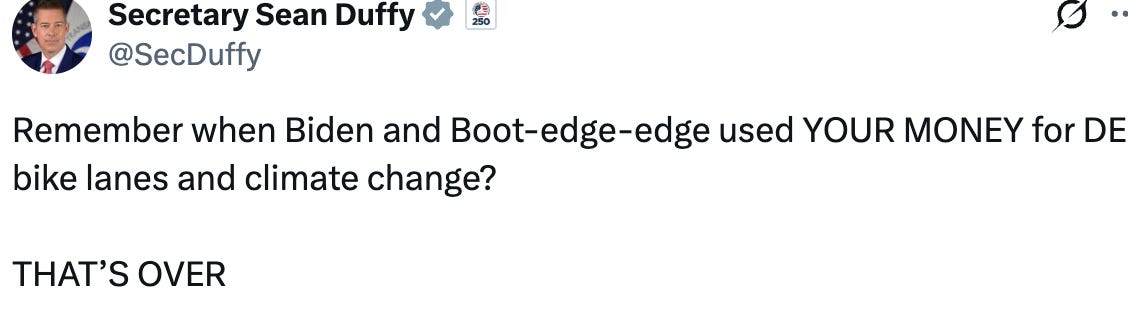
Most people would look at that and say: Nice. But most people don’t take big contributions for the fossil fuel industry. Probably the easiest way to track the growing importance of bikes is by seeing the backlash they’re creating; around the world, the very worst politicians are making anti-bike crusades key parts of their propaganda. Nigel Farage (now locked in a tight electoral contest with a trash can) has called bike lanes evidence of “anti-car fanaticism,” and Ontario premier Doug Ford’s effort to rip up Toronto’s main bike lanes is currently under court review. But leave it to the Trump administration to escalate things one step further. Last week Transportation Secretary Sean Duffy, (whose qualification for office was appearing on the RV-based “reality” show “Road Rules,” and who has just completed a similar gas-guzzling trip with his family sponsored by Toyota and Shell) declared that he was ending federal funding for bike paths because they were “DEI.” As Edith Olmsted reported, federal grants under Biden in 2021 2021 grants funding bike lanes noted that they would serve to “improve infrastructure, strengthen supply chains, make us safer, advance equity, and combat climate change.”
Upon hearing “equity,” President Donald Trump’s goons can’t help but get triggered into attacking any federal spending that won’t benefit them directly. In reality, those Biden-era grants directed funds to build a new transit center in North Carolina, replace bridges in New Mexico, extend streets in New Hampshire, install traffic lights and crosswalks in Missouri, and install bike lanes in Seattle, among other projects. Now the financial status of these projects is unclear.
If “goons” seems strong to you, note that the classy Duffy decided to mock his predecessor’s name in his announcement of the new policy
The thing that makes a bike lane “equitable” is that most people can afford a bike even if they can’t afford a car. If the Secretary of Transportation was actually interested in, say, transportation, then he could usefully occupy himself drawing up some new rules of the road. There are, for instance, “e-bikes” that work just by turning a throttle. These “e-motos” are far more like motorcycles than bicycles, they can go way too fast, and they should be regulated—a license, a helmet, kept to the road and not the bike path. Actual e-bikes—which help you pedal—might well be restricted to pushing you no faster than 20 mph, which would still move you far more quickly around most cities than you can travel in a car.
But that’s not, of course, what motivates the Trump administration. They don’t mind crashes—that’s why they keep making life easier for the bloated SUVs that make American roads ever more dangerous. They hate bikes and e-bikes because they don’t use oil, and all federal policy in this area is devoted to making us burn more, at all times.
It’s not going to work, I don’t think. Bikes are fun, bikes are cheap, e-bikes are super easy to recharge. They’re good for you. As Micah Toll points out, they’re especially good for teenagers, who can cruise the streets in something other than a car.
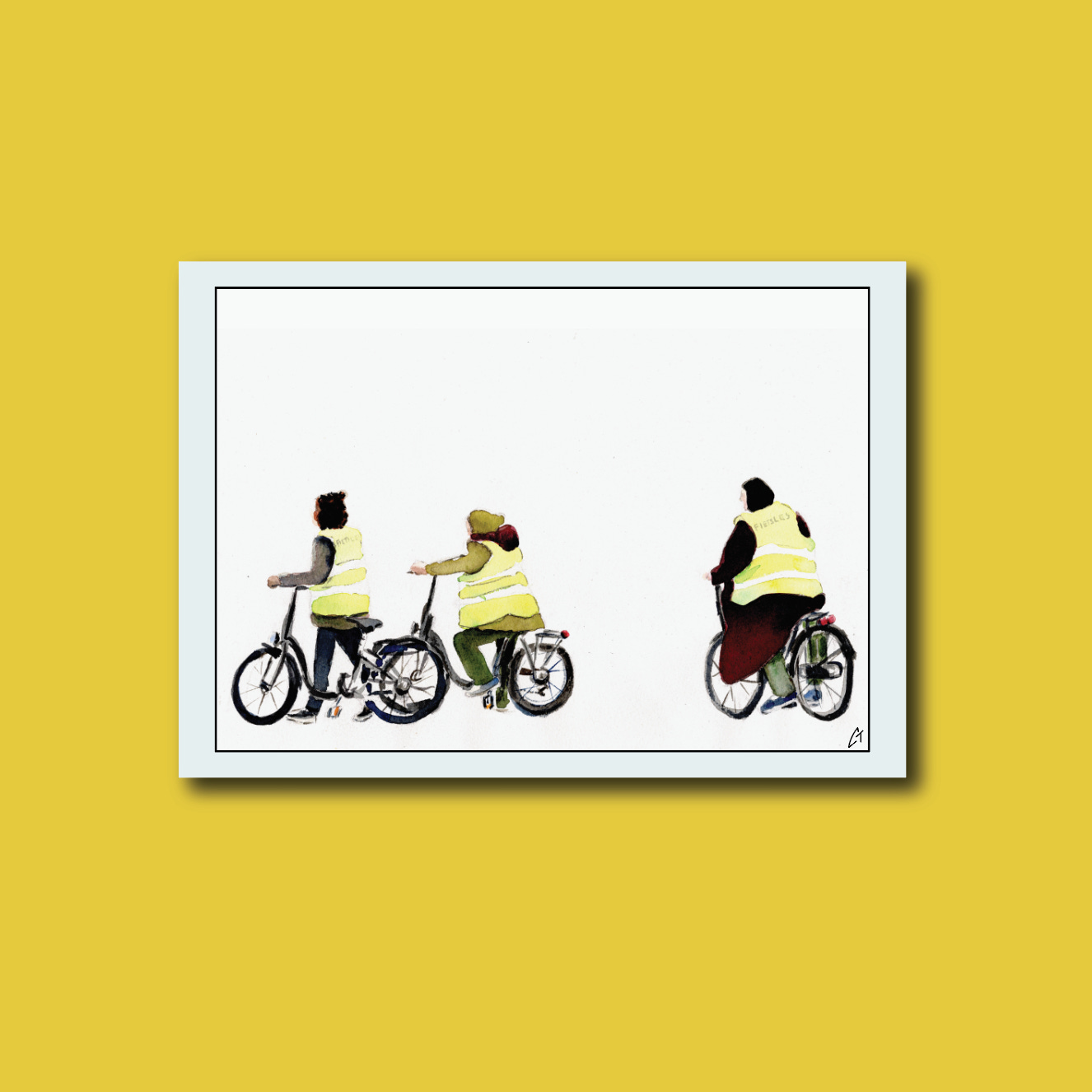
This type of group riding brings back real-world socialization, which is especially crucial right now. According to the U.S. Surgeon General, American teens are experiencing a “loneliness epidemic,” and much of that isolation has been linked to digital life. E-bikes can help counter that by encouraging face-to-face interaction, literally side-by-side, rolling down the street, talking and laughing the whole way.
People sometimes moan about the fact that we haven’t yet developed flying cars (and God help us if we ever do). But it turns out the transportation we needed was there all along, just waiting to get better. A bike is magic, and an e-bike is a bike without hills and showers. That’s enough miracle for now.
In other energy and climate news:
+If you want to see what turns on folks like Sean Duffy, here’s perhaps the dumbest truck ad in the history of car ads, starring Trump pal Dana White who brought cage-fighting to the White House. It’s argument, in its entirety, is that the thing that’s good about RAM pickups is that they are very loud, and that if they weren’t loud they wouldn’t be American and hence…not good. It builds to a climax where he literally replaces God with Noise:
Something to ride? Ride it straight into the history books, because quiet won't get you anywhere. In this country, in loud we trust.
Meanwhile, if EVs were feeling a little slighted by my bike advocacy above, good news on that front: Mack Hogan, one of the country’s big-time car reviewers, says they’re progressing much much faster than their noisy counterparts:
When I left Road & Track to join InsideEVs, my car enthusiast friends were surprised. I was trading in the glamorous world of six-figure supercars and earth-shaking monster trucks for the practical business of charging infrastructure and battery chemistry. Why would I bother, they asked, when even the mightiest EV was less exciting and heavier than a run-of-the-mill sports car?
The answer was hard to explain in the present tense. I was tired of living in a world where the past was celebrated as somehow pure, and the future tinged with anxiety about emissions and regulation. I wanted to get excited about the future again, and as I saw gas cars stagnate, I knew that I had to turn the page.
So I did. In the two and a half years since, I can say with certainty that I’ve seen more exciting progress in the EV sector than I have in the last ten years of internal-combustion development. And the party’s just getting started.
It’ll only get better from here. As the North American battery supply chain gears up, prices are falling quickly, and automakers are iterating constantly. Battery breakthroughs like high-silicon anodes, lithium-manganese rich chemistry, and solid-state technology promise to further drive down costs while improving range and longevity. Meanwhile, EVs are getting simpler due to the proliferation of software-defined vehicle architectures, which make them cheaper to build, easier to service, and simple to update.
There are no equivalent gasoline breakthroughs on the horizon. After 150-odd years of iteration, we have already taken the easy money off the table. You’re not going to double MPG without adding a battery, and you’re not going to drive down costs far below today’s figures without major sacrifices. The technology is nearing the end of the line.
Meanwhile, the Chinese (of course) are figuring out cool electric cargo ships
Electric cargo ships are entering real-world operation at a rapidly growing pace (Figure 1). In 2022, there were only four electric cargo ships in China; by 2025, this figure had increased by 950%, to 42.
Ship types have diversified, from bulk carriers and container ships to multi-purpose cargo ships. At the same time, vessel sizes have grown significantly, with the maximum deadweight tonnage (DWT) rising from around 3,000 tonnes in 2022 to approximately 14,000 tonnes in 2025.
This indicates that China is testing the feasibility of electrification for increasingly larger ships. Although battery capacity constraints continue to limit sailing range per charge—which typically hovered between 150 km and 400 km from 2022 to 2025—trends show steady improvement; by 2025, electric cargo ships with a range of up to 500 km were already in operation in China.
+Accounts of the great European heatwave (still ongoing in many places) continue to trickle in, with the Guardian doing the best job of both chronicling the disaster and linking it to its causes. Here’s their account of what schools are like
Teachers say they have been desperately trying to keep children safe, with some covering younger pupils in wet paper towels as they lie on the floor, while older students have been given trays of water under their desks to put their feet in.
Staff say learning on the hottest days is almost impossible, with pupil behaviour and attention deteriorating rapidly.
Some teachers and pupils have fainted, while others say they have had to buy fans and window shades out of their own pockets to try to keep themselves and their pupils safe.
And just in case you’re wondering what a record heatwave feels like on London’s Tube, Rosie Peters-McDonald has the answer:
A quick glance at the thermometer I’m carrying on this unscientific investigation shows that the station is about 30C. On the platform and tube it crawls up to 32C, and then at the Victoria line platform at Finsbury Park it hits 34C. In the UK, it is illegal to transport cattle above 30C; transporting people at 34C, though, might be becoming the norm.
Asher Minns, executive director of the Tyndall Centre for Climate Change Research, a partnership across several UK universities, says that tube tunnels are “basically radiators”, taking on the heat of the clay and concrete around them. The carriages, platforms and surrounding tunnels are also warmed by the hundreds of kilowatts of heat the trains produce while breaking. And the warmer it is outside, the worse it gets underground.
But Minns adds that the infrastructure is difficult to adapt because of its age and the surrounding clay. It will likely be years before the network is better suited to dealing with the heat, so for now he says the focus needs to be reducing risks to passengers.
+Portland, Oregon’s climate fund is working so well that…politicians want to raid it for other purposes. Jamie Parfitt has the story:
In November 2018, Portland voters overwhelmingly approved a tax on large retailers to fund clean energy and job training projects. It was the work of longtime climate activists and leaders in communities of color.
Measure 26-201 instituted a 1% Clean Energy Surcharge on gross revenue from retail sales in the city for companies with total annual revenue above $1 billion and in-city revenue over $500,000. Proceeds would go toward the new Portland Clean Energy Community Benefits Fund, or PCEF, to support those climate-related projects.
Eight years later, the PCEF has amassed at least $1.7 billion — all of it already allocated, either through community grants or long-term strategic initiatives. But in a cash-strapped city facing pressing needs beyond climate change alone, that growing war chest has increasingly invited proposals for other uses.
To Mayor Keith Wilson, it’s a way to bankroll renovations to the Moda Center and keep the Trail Blazers in Portland. To some city councilors, it’s one way to undo job cuts in the budget they just reluctantly adopted. To the city’s police union, it’s a way to boost the Portland Police Bureau’s budget and hire several hundred more officers.
+Writing at the National Catholic Reporter, Sabrina Danielson and Ellie Simmons have the scoop on why nuns are so much more environmentally engaged than priests, bishops, etc. (something I have seen in many places)
Research shows that the top U.S. Catholic leaders, U.S. bishops, have largely approached climate change with ambivalence and denialism, and have largely avoided engaging in significant climate action, despite their power to do so within their local dioceses. This is likely due to their ties to Republican individuals and organizations.
In contrast, Catholic sisters, who have little formal power within the U.S. Catholic Church, are leading on environmental issues at many levels of society and within the Catholic Church.
Our research finds that 1) key qualities of sisters' avowed religious life facilitate their environmental leadership and 2) bishops and diocesan priests' environmental leadership may be inhibited by their power and money interests, as well as their isolation from community…
Many sisters perceived U.S. bishops and diocesan priests as being resistant to environmental activism because they were more focused on maintaining their institutional power. For example, one sister described bishops as “hesitant to move on any area that is controversial.”
Here, some sisters discussed bishops and diocesan priests as not wanting to anger conservative financial donors or parishioners. This aligns with findings that political conservatives are more skeptical of climate change. The sisters noted that “money does talk” and some “have outsized influence in some of their dioceses because of the amount of money that the family has.” Diocesan priests were described as “trying to please the people and not rile them, and they don’t want their money to go down.”
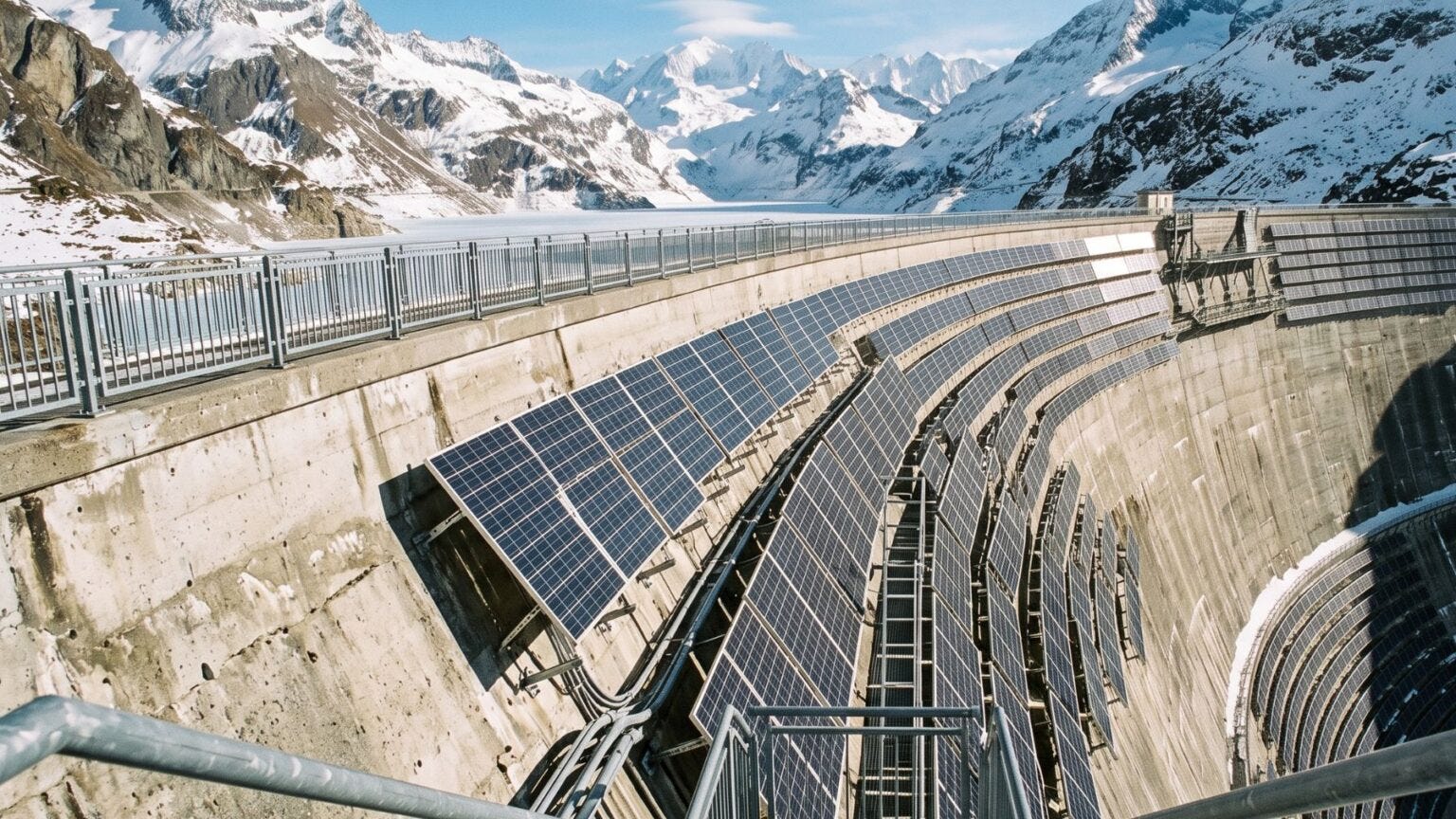
+Here’s an interesting two-fer: the face of a big Swiss dam now studded with solar panels. Apparently they work best in winter, because these alpine dams are often. up above the cloud layer.
Yes!!!!! I use my pedal assist e-bike to commute to the school where I teach (5 miles each way) most days and it's cheaper, cleaner, and often FASTER than taking a car. It's also fun and ensures that I'm outside every day. I've biked in rain and even light snow. As long as you have the correct gear, it's fine. My husband and I even sold one of our cars and have managed a one car life in the suburbs with two kids for over a year thanks to our e-bikes. I have almost 6500 miles on my e-bike and that's all errands and commuting around.
I'm 73. I've been using an e-bike for 4 years now. At first, it scared me a little (cars passing me). But soon I grew very comfortable with it. Now I adore it. Every possible car task that I can use the bike for instead, or my legs, I do. That's pretty much every day, winter, spring, summer, or fall. I don't use the e-bike for pleasure, but using it for tasks IS immensely pleasurable. And I come away from every trip amazed at the quality of my little e-machine, it's brilliant design. It cost me $999 and it's one of the very best things I've ever purchased. I used it today to get a bunch of library books and buy groceries for my household, and loved every minute.