
World on fire
And the global climate talks, too

I have been to a great many of the annual global climate talks—in Poland, in Mexico, in Denmark, in France, in Scotland, in Egypt, in…so many places. They’re all kind of the same: once you’re inside the vast convention hall, there’s a constant babble of speeches, seminars, symposiums. Various countries and trade groups and environmental organizations hold endlessly overlapping sessions, each focused on their particular pet series of topics; meanwhile, the “work” of the conference proceeds largely behind closed doors, as delegates from the powerful countries hash out the text of the proposals, quibbling over a “must” versus a “shall.”It’s hard to remember, amidst the banality, that it’s all about the most real thing ever: the ongoing alteration of the planet’s atmosphere, and with it the planet’s temperature, and with it the future of everything we know and love.
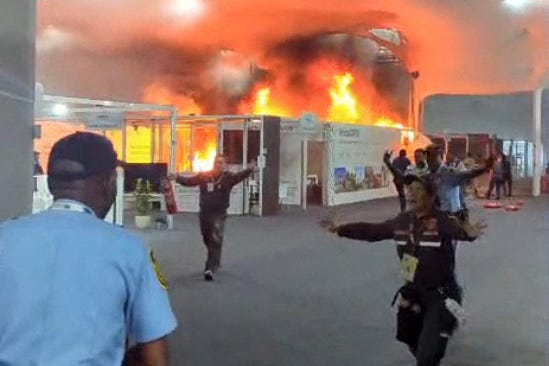
But occasionally reality breaks through, this afternoon in Belem, Brazil in the form of a very literal fire that apparently began in the Africa pavilion. The video was truly terrifying—this could have been truly awful.
Luckily, everyone reacted the way people should in an emergency. People warned each other, and evacuated. Firefighters arrived and used their tools to put out the blaze. Apparently eleven people are being treated for smoke inhalation, but all are expected to survive.
In other words, everyone behaved in precisely the opposite way they’ve reacted to the fire that’s begun to consume the earth.
I’m not going to belabor this analogy—it’s painfully obvious. But sometimes the obvious is worth pointing out, because it doesn’t seem to have sunk in.
When I say the planet is on fire, I mean in many cases literally. We’ve already managed to mostly memory-hole the fact that large sections of America’s second-largest city burned to the ground earlier this year (though it has inspired forensic anthropologists to come up with new ways of identifying people burned to death; a special training with ten donated cadavers is happening this week). Across the world blazes rage—somehow NASA’s new minders haven’t gotten around to taking down this page which points out the science in admirably straightforward terms
Many different factors influence wildfire behavior, such as forest health, weather, topography, and forest management practices. A warming climate is increasing some types of fire activity, leading to larger and more destructive fires, more intensive firefighting efforts, and widespread smoke
But of course it’s more than just fires. A heating planet has thousands of ways to do damage, from rain and flood to drought and storm. A new study, detailed here by Pro Publica, counts the excess deaths simply from Trump’s about face on climate policy at 1.3 million souls
Our calculations use modeled estimates of the additional emissions that will be released as a result of Trump’s policies as well as a peer-reviewed metric for what is known as the mortality cost of carbon. That metric, which builds on Nobel Prize-winning science that has informed federal policy for more than a decade, predicts the number of temperature-related deaths from additional emissions. The estimate reflects deaths from heat-related causes, such as heat stroke and the exacerbation of existing illnesses, minus lives saved by reduced exposure to cold. It does not include the massive number of deaths expected from the broader effects of climate change, such as droughts, floods, wars, vector-borne diseases, hurricanes, wildfires and reduced crop yields.
The numbers, while large, are just a fraction of the estimated 83 million temperature-related deaths that could result from all human-caused emissions over the same period if climate-warming pollution is not curtailed. But they speak to the human cost of prioritizing U.S. corporate interests over the lives of people around the globe.
“The sheer numbers are horrifying,” said Ife Kilimanjaro, executive director of the nonprofit U.S. Climate Action Network, which works with groups around the world to combat climate change.
“But for us they’re more than numbers,” she added. “These are people with lives, with families, with hopes and dreams. They are people like us, even if they happen to live in a different part of the world.”
Indeed, another new study now allows one to calculate how many deaths any new fossil fuel project can be expected to produce. As Patrick Canning writes
In 2021 R. Daniel Bressler published a paper called “The Mortality cost of carbon,” proposing a method to estimate the number of deaths caused by the emissions of one additional metric ton of CO2. This opened the door to assessing the number of deaths per project, or per nation, industry, etc. But no one did it right away, it took some time to percolate.
After that I started advising my clients to insist of regulators that this calculation be made.
Then in July of this year a team based at University New South Wales, Sydney, Australia, did it. For the first time, they calculated the number of deaths which are likely to be caused by a particular project – Woodside’s Scarborough gas project.
The number for that one western Australian gas project? 484 people dead, and 16 million corals along the Great Barrier Reef.
Meanwhile, great reporting from Anupreeta Das highlights the toll from unrelenting heat on women in particular, making the point that it’s daily higher temperatures as much as extreme heatwaves that do the damage.
Every summer morning, Kantaben Kishen Parmar, a 45-year-old vegetable seller in the Indian city of Ahmedabad, settles onto a patch of ground the size of a large rug, sandwiched between the warming asphalt and a simmering sky, to sell peppers and tomatoes. She doesn’t get back home until 10 p.m.
Over the decades, summers have gotten longer and hotter — average temperatures can hover around 105 degrees Fahrenheit, or 40 Celsius, between March and June — but Ms. Parmar’s hours have remained the same. The toll on her health is growing.
Three years ago, she collapsed during an especially scorching April day and was rushed to a hospital, where she was treated for severe dehydration. Ms. Parmar, who is diabetic, has suffered from urinary tract infections, dizzy spells and heavy bleeding during her period, conditions that medical experts often attribute to heat stress.
“It’s hot from above, it’s hot from the pavement,” said Ms. Parmar as she deftly tossed green peppers onto a weighing scale with her right hand, which bears the tattoo of a heart pierced by an arrow encasing the letters “KK.” The other “K” stands for Kishen, her husband and partner in the business.
If dead people and dead coral and sick women don’t motivate leaders, perhaps money might? A fascinating new study found that the risk of fire and storms is driving up insurance costs, and hence driving down the value of homes, and by truly eye-watering amounts. As Claire Brown and Mira Rojanasakul explain
The study, which analyzed tens of millions of housing payments through 2024 to understand where insurance costs have risen most, offers first-of-its-kind insight into the way rising insurance rates are affecting home values.
Since 2018, a financial shock in the home insurance market has meant that homes in the ZIP codes most exposed to hurricanes and wildfires would sell for an average of $43,900 less than they would otherwise, the research found. They include coastal towns in Louisiana and low-lying areas in Florida.
Changes in an under-the-radar part of the insurance market, known as reinsurance, have helped to drive this trend. Insurance companies purchase reinsurance to help limit their exposure when a catastrophe hits. Over the past several years, global reinsurance companies have had what the researchers call a “climate epiphany” and have roughly doubled the rates they charge home insurance providers.
In the end, all this derives from the fundamental damage being done to the earth’s fundamental systems. One of the scarier reports I’ve read in a long time passed almost unnoticed earlier this month in the journal Nature. It documented exactly how fast the world’s forests and oceans are losing their ability to sequester carbon. As Zeke Hausfather and Pierre Friedlingstein explain
Climate change has caused a long-term decline in land and ocean carbon sinks, with sinks being about 15% weaker over the past decade than they would have been without climate impacts.
The study, published in Nature, finds that the decline of carbon sinks has contributed about 8% to the rise in atmospheric CO2 concentration since 1960…
The combined effects of climate change and deforestation have turned tropical forests in south-east Asia and in large parts of South America from CO2 sinks to sources.
And these sinks will likely continue to weaken as long as atmospheric CO2 concentrations continue to rise and the world continues to warm. There are a wide range of estimates of carbon cycle feedbacks among climate models, but a large carbon cycle feedback could result in a few tenths of a degree of future warming.
There are a few people responding to the emergency in the fashion one might hope: Last week, for instance, the European Center for Human and Constitutional Rights filed a criminal complaint against TotalEnergies for its complicity in war crimes and torture associated with African gas projects. They are the equivalent of neighbors seeing a fire and getting on the phone to the authorities.
And there are some people reacting the way you’d expect arsonists to respond. With America absent from the Belem talks, Saudi Arabia has taken over the function of blocking action. As Damian Carrington points out in the Guardian, the kingdom gets $170,000 in oil revenues a minute, so no wonder they fight any effort to do anything.
More than a dozen obstruction tactics have been deployed, from disputing the agendas to claiming that strands of the talks have no mandate to discuss issues it dislikes – such as phasing out fossil fuels – to insisting action to help vulnerable countries adapt to global heating is linked to compensating oil-rich nations for lost sales. Delay is a key aim and, for example, Saudi Arabia strongly opposed any virtual negotiations when Covid shut down the world in 2020. “They are really good at it, absolutely masterful,” says Dr Joanna Depledge at the University of Cambridge.
Mostly, though, the world just kind of stands by and watches. As the Belem talks staggered towards their end, Brazilian president Lula returned to help spur negotiators on, but he sounded oddly equivocal
“We haven’t found another place to live,” Lula, flanked by Brazilian negotiators and his wife, said.
Lula and several other leaders are pushing to create a road map toward transition to renewable energies. But in his remarks Wednesday, he was careful to say there’s no intention to “impose anything on anybody,” that countries could transition at their own pace and count on financial help to do so.
Indeed, Bloomberg reports that the latest draft of the proposed text omits language about phasing out fossil fuels. Which—well, that’s the whole damned point.
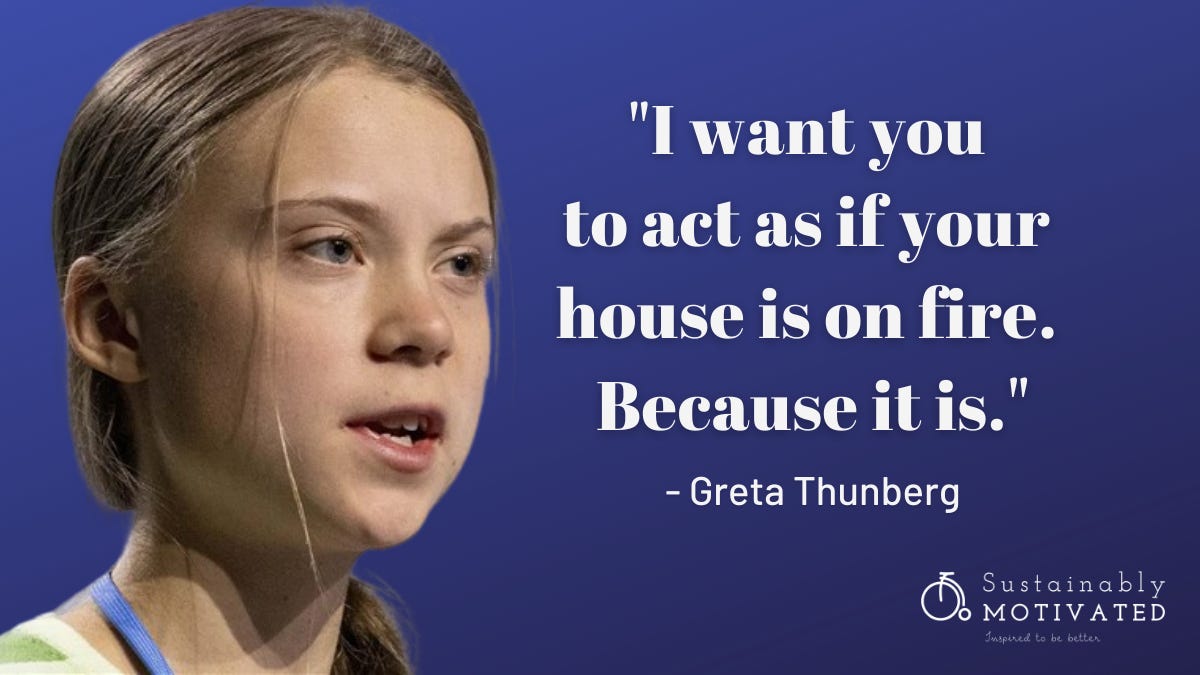
And so, perhaps, we should leave the last word to Greta Thunberg, who near the beginning of her remarkable campaign said something that should resonate with the delegates currently standing outside the convention hall watching firefighters mop up
In other energy and climate news:
+Not to be missed: new fake meditation app from Oli Frost. It lampoons Edelman, the giant pr firm, that works hard for the oil industry. “Now breathe in profit. And breathe out responsibilty.”
It’s part of the ongoing Clean Creatives campaign to hold the public relations industry to account for their climate damage. Here’s a letter that many of us signed to Edelman before this climate conference
During the upcoming negotiations, Edelman staff will be writing talking points for the climate talks that we are expected to use and amplify, while simultaneously advocating for the oil and gas industry. In fact, one key Edelman leader in Brazil is personally overseeing communications for both COP30 and Shell at the same time.
Our planet is at a tipping point, not just in terms of our climate, but in our culture. Fossil fuel companies aided by PR agencies are contributing to a misinformation crisis that could halt climate progress. Companies like Shell’s commitment to expanding oil and gas production at the cost of clean energy demonstrates clearly where they stand in this crucial moment.
+ In American politics, much division about whether to talk about climate change or not. The conventional wisdom in recent months has been: all affordability all the time, as Democrats try to regain momentum ahead of the midterms. Some pols are using this as a way to downplay climate action. In New York state, for instance, governor Kathy Hochul is under increasing fire from enviros. She has approved a new gas pipeline (and a new crypto mining complex with a gas-fired power plant at its core). Some are attributing this to her husband’s work at a law firm that represented both interests. A particularly dumb decision: delaying the state’s All-Electric Buildings act. (For a counterpoint on Hochul’s climate record, see here). Meanwhile, in Pennsylvania, Gov. Josh Shapiro is reportedly taking the state out of the Regional Greenhouse Gas Initiative (RGGI), a truly baffling decision.
But others are calculating differently. California governor Gavin Newsom was in Belem to insist he was standing up to Trump on climate (though there’s significant pushback in California, as Sammy Roth reports, on his plan to roll back EV mandates.) And in Massachusetts, swift pushback from citizens across the Bay State has at least temporarily stopped plans to roll back climate targets. (More on Newsom’s cliamte efforts here)
My guess: political fads come and go fairly quickly. I don’t think support for climate action has actually vanished, and talented politicians will figure out fairly quickly how to connect it to the sharply rising cost of electricity. Further prediction—some of this will focus around data centers, where opposition is starting to emerge, and where the demand that they be powered by renewable energy will start to grow.
America can’t cordon itself off forever from the renewable energy wave washing across the world, though Trump is surely trying. Encouraging signs are emerging—Wisconsin lawmakers are working hard to permit more community solar projects. And new technology keeps getting cooler, even in New York—where the city’s Housing Authority is getting ready to install many thousands of induction cooktops in public housing. The best news—these ones come with built-in batteries, so residents can keep cooking even if the power goes out. A deep dive from Doug Doyle at WBGO (which is also one of the nation’s best jazz stations).
Advocates will keep pressing, politicians will begin to respond, the tide will turn—and electric prices will be an issue that helps environmental progress in the next elections. I hope.
+From UCIrvine, the nation’s first all-electric acute care hospital
The healthcare sector is responsible for 8.5% of all carbon emissions. UCI Health is committed to minimizing its impact on the environment across all of its facilities, says UCI Health emergency medicine physician Dr. Ryan Gibney, the medical director of the emergency department at the new hospital.
“We have solar on the roof, we’re using recycled water. We’re really being intentional about our impact to this area being as little as possible so we can deliver the highest level of healthcare with minimal impact to the place around us.”
+Sixty two new faith institutions have divested from fossil fuels.
Today’s list of divesting institutions includes five Catholic dioceses (four in Italy and one in Canada), Catholic religious orders in France, Belgium, Germany, Austria, Switzerland, the Netherlands, the UK and the US; Catholic and Protestant banks in Germany; and 42 members of the Arbeitskreis Kirchlicher Investoren (AKI), a network of institutional investors in the German Protestant Church.
For the first time, a Catholic diocese in Canada has announced its divestment from fossil fuel companies. Its decision is especially significant as Canada - with the US, Australia and Norway - is among those most responsible for fossil fuel expansion since the Paris Agreement. Together, these four countries increased fossil fuel production by nearly 40% between 2015 and 2024, while production in the rest of the world combined fell by 2% during the same period.
In Italy, which has been hit by extreme heat, wildfires and floods in recent months, the calls for divestment from numerous Catholic bishops and the Community of the Diaconate are especially significant. They provide clear evidence of the strong support for fossil fuel phase out within the Catholic Church in Italy.
+More good news from the world of agrivoltaics, otherwise known as ‘growing stuff in between solar panels.’ A new study finds increases in water retention and crop yields—and reductions in opposition to new solar farms
Landowners gain a new, steady revenue stream in an incredibly volatile industry, all while maintaining their land’s agricultural productivity; solar project developers get access to viable sites with fewer permitting battles; and communities retain agricultural land in production while enjoying local investment and tax revenue. In short, agrivoltaics is a winning solution.
+Elphaba comes out big for environmental progress!
+Also not to be missed—this new video from suburban Boston, with neighbors explaining newfangled heat pumps to their neighbors. As Bedford 2030 explains,
Inspired by the genius of works like Six Feet Under and Schitt’s Creek, our film follows one zany family’s journey as they say goodbye to their dearly departed boiler (who they realize wasn’t that great after all). Thanks to the help of a patient and sourdough-loving Reverend, they find something unexpectedly wonderful: heat pumps. The Blackwoods discover that saying goodbye to fossil-fueled heating can be good for the planet and their wallets.
+Cooperatives are playing an increasing role in Spain’s huge solar revolution. As Stephen Burgen explains
Environmentalists have long advocated the spread of energy communities, in which solar panels on the rooftops of government buildings, warehouses and sports facilities supply electricity to nearby homes and business. Until recently, this was limited to a 500 metres radius, but that limit has now been extended to 2,000 metres – and it is taking off across the country, thanks to government support channeled through the IDAE.
The institute’s policy aims to bring cheap electricity to households suffering from pobreza energética (fuel poverty) who cannot afford the upfront cost of installing solar panels – typically €5,000-6,000 for each household.
The institute defines fuel poverty as low-income, energy-inefficient households where a high proportion of income is spent on energy supply.
As well as fostering the development of energy communities, the IDAE encourages the communities to talk to each other, to form a patchwork of autonomous but integrated groups. Taradell has now teamed up with two nearby energy communities in Balenyà and La Tonenca.
“We’ve developed a formula to help people who are struggling to get by through incorporating them into a network that helps them to improve their situation,” he says. “We’ve taken advantage of the EU Sun4All scheme to develop a system to assess who are the vulnerable families, and not just in terms of fuel poverty.” The Sun4All project, which finished last year, was an EU project supporting solar power projects that helped low income families.
+How much solar have Pakistanis built? Enough that the country is paying Qatar to divert 24 giant ships full of liquefied natural gas that it had earlier contacted to receive.
The agreement comes amid what officials describe as “demand destruction” in the gas sector, as power producers consume less RLNG due to lower electricity generation.
As a result, Sui Northern Gas Pipelines Limited (SNGPL) has been facing surplus LNG volumes in the system. Last year, Pakistan worked with Eni to sell 11 cargoes in the open market and deferred five Qatar shipments to ease the pipeline pressure.
Sam Butler-Sloss and Kingsmill Bond argue that the same story is repeating across the world as solar outpaces LNG everywhere
There are two main reasons why the US’ LNG bet looks more vulnerable than China’s electrotech bet.
First, solar outshines LNG as a source of electricity generation. It is cheaper, faster to deploy, and local. Solar-plus-battery projects across Asia and Europe now cost less than the running costs of gas plants burning imported LNG.
For energy-hungry emerging markets, LNG has to compete on speed, as well as on cost. LNG projects take five to 10 years to realize. Solar can be up and running in less than a year. The result: Solar demand is fundamentally more elastic, responding faster to falling prices.
Having worked on climate and environmental issues for the past 30 + years and teaching Environmental Studies in Higher Ed for 17 years I really wonder what will stop this, if anything. All of our opportunities that were lost, Gore, 2000, Kerry 2004, Obama failing to utilize those 8 years in a significant way and supporting fracking, and on it goes into the horrors of Trumpism. In Ohio we had an excellent energy bill 2008 that implemented benchmarks and was passed unanimously. That was gobbled up and replaced with oil and gas land, adding to the methane assault, we even allow fracking in our state parks. Fought that beginning 2011 and finally swept through 2023. Our state legislature is so slimy you slip on the marble stairs.
Now we must pay our attention to the Quiet Piggy president, one shock after the next. We haven't time to address the expansive environmental catastrophy any longer. Stupidity, ignorance and corruption reigns. The genocide in Gaza and West Bank a horror daily. Daily. How is it possible that the west allows this killing,killing with US tax money and weapons. The GHG emissions from this war exceeds 100 countries outputs. https://www.middleeasteye.net/news/carbon-footprint-israels-war-gaza-exceeds-100-countries. Will someone care?
As a 70 yo grandmother it is heartbreaking. We will continue to oppose and fight, to litigate, to collaborate, to stand for the forests. But we have just missed so many opportunities. We must continue to challenge and work, be strong. Testify against expanding fossil fuels. We see the reality now, the complicity, the corruptness, the value of dollars over life. There are no questions. We must continue to strategize and work in collaboration with the earth and fellow colleagues. And what of COP 30. Civil society is engaged, a roadmap for the end of fossil fuels discussed. It is good v evil.
I don't quite get it. All these terrible things happening due to the climate crisis and yet no one mentions individual actions anymore such as not flying, stopping meat consumption, living more simply. Why is that? Most people I know aren't willing to make any lifestyle changes at all. There never seems to be any answers in these articles about what we can do, aside from blame the governments and corporations.