
A Question of Margin
And there's so very little.

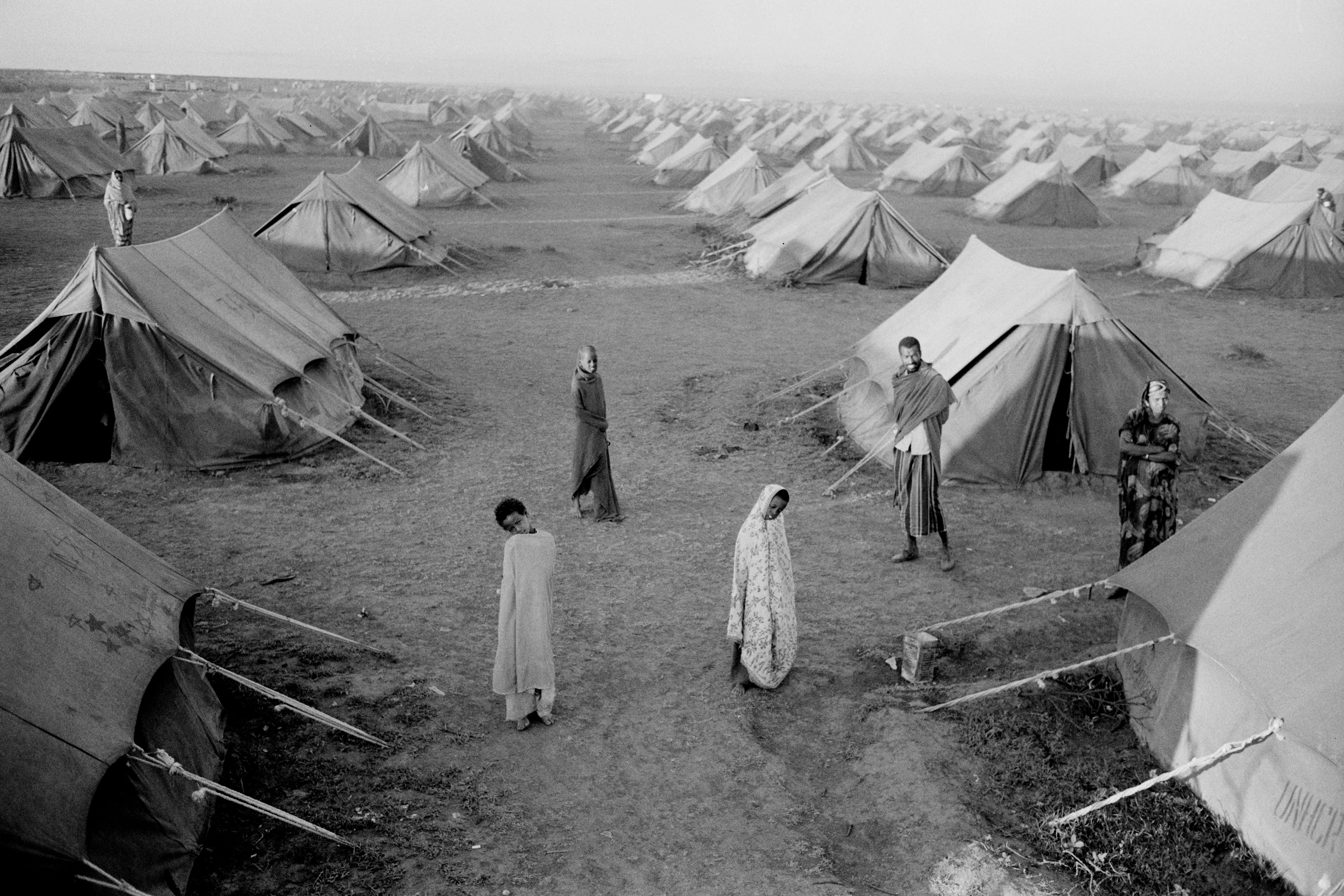
One way to think about the climate crisis is that we are systematically reducing the margin on which we live on this planet. There were always places where humans couldn’t live: the Antarctic, the centers of the great deserts, the high mountains. But now we’re systematically adding to that list, as places become dangerously combustible, or overrun by rising seas, or just plain too hot. We’re shrinking the board on which we play the sublime game of being human. I was thinking of this today because I read a truly remarkable piece in the New York Times, the kind of reporting that justifies a subscription despite all the endless disappointments. It was written by Peter Goodman, with powerful photographs from Finbarr O’Reilly.
The two of them traveled widely in recent weeks across Somalia, and what they found—well, you need to read the whole thing. But climate change and war are making life there almost impossible, and now that the U.S. has shut down the U.S. Agency for International Development the “almost” is disappearing.
For nine days, they trudged across the parched soil of southern Somalia, taking turns carrying their 3-year-old daughter on their shoulders. Abdullahi Abdi Abdirahman, his wife and their seven children sought escape from a landscape drained of life.
Another drought had killed their goats and sheep, turning their life savings to dust. So they pressed on for 140 miles toward Dollow, a dusty outpost on the Ethiopian border. They were drawn by the same things that had already attracted more than 100,000 other people: International relief organizations were clustered there, offering food, water and health care.
Yet when they arrived in late January at a camp on the fringes of town, they were horrified to learn that aid groups had abandoned the area. President Trump had dismantled the U.S. Agency for International Development, or U.S.A.I.D., eliminating Somalia’s primary source of assistance. From London to Berlin, governments had reduced funding for humanitarian aid. Relief organizations had been forced to choose where to focus their remaining money.
Let me get my anger out of the way first. Elon Musk, in particular, shut down US AID—boasted about “feeding it to the woodchipper” in the first weekend of his DOGE assault on the federal government. That is to say, the richest man in the world did this, under the auspices of our government. His cruelty and his self-regard—and his abject racism—know no bounds.
And then the most piggish and self-involved man in the world, Donald Trump, started a war in Iran, and now the price of fertilizer is through the roof, making life much harder for the people who grow food in Africa (and those who eat it). And an El Niño is now bearing down on the planet, riding on the highest temperatures in human history, which were caused mostly by us in the western world. All of it taken together is too much
Drought ravaged the most recent harvest. Some 6.5 million people — roughly one third of the population — were suffering hunger at levels deemed an emergency, the U.N. Food and Agriculture Organization warned in February. That included more than 1.8 million children under 5 facing acute malnutrition.
Those numbers have almost certainly increased given the war. Yet the World Food Program, the largest source of aid in Somalia, has only enough funding to support 300,000 people a month through July, a fraction of the nearly 2 million people a month it was reaching in early 2025.
Humanitarian relief organizations now contemplate a surreal hierarchy of suffering.
“There are different categories of starvation,” said Hameed Nuru, the World Food Program’s Somalia director. “We are only able to reach those who are really on the verge of, if you don’t give them something now, they will not be there tomorrow.”
In some areas, children are still getting food, but not pregnant mothers. “Literally, it’s who dies first,” he said, “and who dies next.”
Somalia is, of course, a particularly apt place to do this reporting. Trump has referred to its citizens as “garbage people,” and he and Stephen Miller dispatched ICE to Minneapolis to hunt Somalis. As it happens, it’s on the fairly short list of places I’ve never been, but one of my closest colleagues is Somali, and she is as fine a human being as I know, so I thought of her as I read and re-read this piece. But as Goodman points out in his reporting, Somalia is by no means unique.
Indeed, the news this week of a new Ebola outbreak elsewhere in Africa reminds us of another way we keep shrinking the world: there are places it’s too dangerous to go because we’ve unleashed diabolical illnesses. As Kat Lay reports:
The Global Preparedness Monitoring Board (GPMB) said in a report published on Monday that “as infectious disease outbreaks become more frequent they are also becoming more damaging”, warning that pandemic risk is outpacing investments in preparedness and “the world is not yet meaningfully safer”.
Disease outbreaks are becoming more likely due to the climate crisis and armed conflict, while collective action is being undermined by geopolitical fragmentation and commercial self-interest, the report said.
In fact, it’s more or less Musk again—he made a joke at a presidential cabinet meeting about “accidentally” cutting Ebola funding, but insisted it had been restored, something that—and this will shock you—seems not to be entirely true.
In Geneva, Prof Matthew Kavanagh, director of the Georgetown University Center for Global Health Policy & Politics, said aid cuts may have played a role in leaving the world “playing catch-up against a very dangerous pathogen”.
He said: “Because early tests looked for the wrong strain of Ebola, we got false negatives and lost weeks of response time. By the time the alarm was raised, the virus had already moved along major transport routes and crossed borders.
“This crisis didn’t happen in a vacuum. When you pull billions out of the WHO and dismantle frontline USAID programmes, you gut the exact surveillance system meant to catch these viruses early. We are seeing the direct, deadly consequences of treating global health security as an optional expense.”
That margin is thinner all the time. Consider this report from Laura Paddison about the heatwave that shook India last week: there was a day when all the fifty hottest cities on our planet were in that country.
On April 27, average peak temperatures across all 50 Indian cities on the list hit 112.5 degrees Fahrenheit.
Top of AQI’s list was the city of Banda in the northern Indian state of Uttar Pradesh, which has a harsh, sub-tropical climate which often delivers brutal summers.
Even before what are typically hottest summer months, the heat has ratcheted up. On April 27, temperatures in Banda reached 115.16 degrees, according to AQI, the highest temperature recorded anywhere on the planet that day. The coolest Banda got, in the early hours of that morning, was 94.5 degrees…
Experts have warned heat in India is becoming so extreme, it may “cross the survivability limit” for healthy humans by 2050.
Across the border in Pakistan, as Asad Mumtaz Rid reports, it’s at least as bad.
In southern Pakistan throughout April and May, temperatures have risen far above seasonal norms. In Sindh, daytime temperatures have frequently crossed 44C to 46C, forcing residents indoors during peak afternoon hours and severely affecting outdoor labourers, transport workers and farming communities.
The impact has been particularly severe in Karachi’s coastal settlements, where prolonged electricity outages and water shortages have compounded the effects of extreme heat. In Ibrahim Hyderi, one of the city’s largest fishing communities, residents say survival is becoming increasingly difficult.
Abdul Sattar, a fisherman with more than three decades of experience, recalled how one of his colleagues collapsed from heat exhaustion during the recent heatwave. “We gave him lemon water and rushed him to a doctor,” he said. “He regained consciousness after receiving intravenous fluids.”
There are things we can and must do to make a short-term difference. One is to provide cooling—air-conditioning—to much of the planet. As a study last week from the Rocky Mountain Institute described,
Between now and 2030, the increase in electricity demand for air conditioning systems alone will exceed that for data centers, one of the fastest-growing energy uses globally. By 2050, cooling electricity demand is expected to match the combined annual electricity consumption of the United States, China, India, Germany, and Japan today.
That’s not optional—at this point, it’s medicine. In those kinds of heatwaves cool air is as important to the human body as water, or food. But, obviously it will drive up demand for energy, which is why, as the RMI experts point out, we need to
Reduce energy use and emissions through super-efficient technologies, improved system design, and better refrigerant management, while scaling next-gen, innovative solutions that lower life-cycle costs and emissions.
All of this is possible—new heat pumps are far far more efficient at cooling air than old AC units, and we can paint roofs, plant trees, and do lots more.
But at the most basic level we have no more important task than converting absolutely everything we can, right away, to sun and wind and batteries, so that we stop pouring carbon into the air and making the problem ever worse. And the horrible part is that we can do this, which makes the fact that we’re not doing it as fast as we can deeply and profoundly immoral. Hell, no one is even asking Americans to do with less, because that is clearly impossible. We’re just asking them to do with slightly different, and save money in the process. Here, for instance, is the latest update from Biden’s key energy deployment expert, Jigar Shah, talking about a new method for coaxing more juice through existing transmission lines, which experts call
reconductoring with advanced conductors. Reconductoring replaces the wire on an existing line with advanced conductor technology that carries 50 to 110 percent more current through the same towers, on the same right-of-way, in 18 to 36 months. No new permitting. No land acquisition. Montana-Dakota Utilities reconductored a 15-mile 230 kV line, increased ampacity by 77 percent, finished a full year ahead of schedule, and came in 40 percent under cost estimate. The Berkeley and GridLab 2035 study found a national reconductoring program could quadruple the rate of transmission capacity expansion at only 20 percent higher total system cost — saving $85 billion by 2035 and $180 billion by 2050.
But we have to do it. We have to force our leaders, state by state at the moment since DC is such a disaster area, to actually make these relatively small changes.
A way to look at the work we’re doing together is that we’re trying to build some margin back in. Every gas car that becomes an EV buys us back an inch or two, every furnace that becomes a heat pump, every solar panel and wind turbine that sprouts takes the tiniest bit of pressure off the system.
We were born onto a world with lots of margin, especially those of us who are older. The size of the game board was expanding back then, as we learned new ways to grow and store food and the like. But through short-sightedness and greed we began to shrink that buffer, and now greed and short-sightedness have become the cornerstones of government policy, along with pure and undiluted racism. It’s not like anyone is fooled. Goodman again:
As he sat beneath the shade of a mango tree, its branches sloping toward the river dividing Somalia from Ethiopia, Adan Bare Ali, deputy mayor of Dollow, said his community was suffering from troubles that had been concocted far away. The drought was worsened by climate change — primarily the result of industrial polluters in larger, more powerful nations. The war was the handiwork of foreign actors.
“The situation has become unbearable,” he said. “The American regime is led by a person who really doesn’t care about anything happening outside his gates. The Americans are not honoring their commitment to the world.”
He is right, and we are very very wrong.
In other energy and climate news:
+Two of the country’s really great environmentalists, Vanessa Fajans-Turner and Ayana Johnson, teamed up for a crackerjack essay about the ways that NY Governor Hochul is undercutting the state’s climate law.
The proposed changes would extend the deadline for greenhouse gas regulations from 2024 to 2028. It would also replace the binding 2030 emissions target with a softer 2040 commitment and adopt a methane accounting method that makes fossil-fuel emissions look smaller without actually reducing them. The 2050 target remains, but the deal weakens the pressure to act now, allowing dangerous greenhouse gas pollution to amass in the intervening quarter-century.New York is one of 10 states with binding, economy-wide climate targets, alongside California, Colorado, Maryland, Massachusetts, and Rhode Island. All face similar affordability pressures, strained grids, and federal headwinds. None has walked back its targets. If lawmakers, who are deliberating now, agree to water down the law with the imminent budget vote, New York would be first.
+Corbin Hiar reports that a small company that wants to inject sun-reflecting particles into the atmosphere has revealed a bit more of what they have in mind
Stardust Solutions has raised $75 million since 2023 from investors who are betting that global warming could get so out of control that governments might decide to pay the Israeli-U.S. startup to spray millions of tons of sunlight-reflecting aerosols into the stratosphere. Its plans were so guarded that it required scientists to sign nondisclosure agreements before they could study its potentially planet-altering technologies.
On Thursday, the company revealed the makeup of its proprietary particles. They are made of what’s known as amorphous silica and are 0.5 microns in size — only visible with a microscope. The startup also shared information about the systems it could use to disperse the spherical silica particles some 11 miles above the ground and monitor them as they fall back to the Earth…
“This announcement is a clear example of why self governance led by for-profit entities does not work,” said Shuchi Talati, the executive director of the Alliance for Just Deliberation on Solar Geoengineering, a nonprofit that seeks to include marginalized countries and communities in debates over sunlight-reflecting technologies.
Stardust, she said, “cannot create their own principles and then applaud themselves for following them. They cannot define safety according to their own standards and then self-certify that they meet them. The field requires coordinated, legitimate, and independent research governance.”
+Perhaps you’re in the mood for listening to some guys talking about the El Niño that appears poised to come crashing out of the Pacific in the months ahead. Here’s the estimable David Wallace-Wells and, um, me, on KQED’s Forum the other day. David, anyway, was great—and I got in a pitch for California gubernatorial candidate Tom Steyer; the primary is two weeks out now.
Meanwhile, the crucially important meteorologist Jeff Masters has a new account of the rapid heating of the water in the Gulf of Mexico and why that matters.
In 2012, the temperature of the Gulf of Mexico began rising along a shocking upward trajectory.
Climate change is causing oceans worldwide to warm. But that year, summertime sea surface temperatures in the Gulf of Mexico began heating up at about twice the rate seen in the global oceans. The trend has continued into the 2020s, with sea surface temperatures hitting record highs in both 2024 and 2025. The shift has huge implications for the hurricanes that form in the Gulf – and the people who live along its shores and on the islands that dot its waters.
Hurricanes are heat engines that take heat energy out of the ocean and convert it to the kinetic energy of wind. The maximum intensity that a hurricane can reach increases by about 5-7% per degree Celsius of sea surface temperature increase. So the rise of about half a degree per decade in Gulf sea surface temperatures per decade since 2012 may be causing a 3% per decade increase in the winds of the strongest hurricanes. Because stronger winds cause more destruction, this equates to about a 30% increase in hurricane damage per decade for these strongest storms.
+Some good news. A big new study found that Americans are littering less, with a 34 percent reduction in trash along roadsides. Now if we could just stop tossing carbon into the air…
+New Mexico Attorney General Raùl Torrez, in the Santa Fe newspaper, calls on the state’s Oil Conservation Commission to hold drillers responsible for cleaning up their messes.
Across New Mexico, there are already hundreds of abandoned wells, with thousands more at risk. Some leak methane or contaminate groundwater, threatening public health and the land our communities depend on. When companies fail to clean them up, the cost does not disappear. It falls on the public.
That is not fair to New Mexico families.
The rules under consideration would move New Mexico closer to a simple standard: Companies should set aside funds that reflect the real cost of cleanup so they can plan ahead and follow through on their responsibilities.
In other words, if you drill it, you clean it.
It’s amazing that this even has to be said, but I’m glad someone is saying it.
+Finally, I’d like you to meet Burrito, who according to Warren van der Sandt, has become the crucial employee at a big solar farm in Tennessee. Apparently the 9.5 megawatt facility owned by Volkswagen brought in 65 sheep to keep the vegetation trimmed between the panels, and they were doing a good job, but they became the object of carnivorous affection for local coyotes. Enter Burrito, who when he came on board quickly began to patrol the perimeter of the site (which powers the production of VW’s EVs)
If unfamiliar animals approached, he reacted immediately. Donkeys naturally protect herd animals from threats. It’s in their nature, despite their “dozy” reputation.
Burrito acts as a scout, clearing “paddocks” for safety before the sheep enter to feed. Workers said the donkey even inspected areas before the sheep moved through them.
Once a stray without a home, he is now the most essential “worker” on the property.
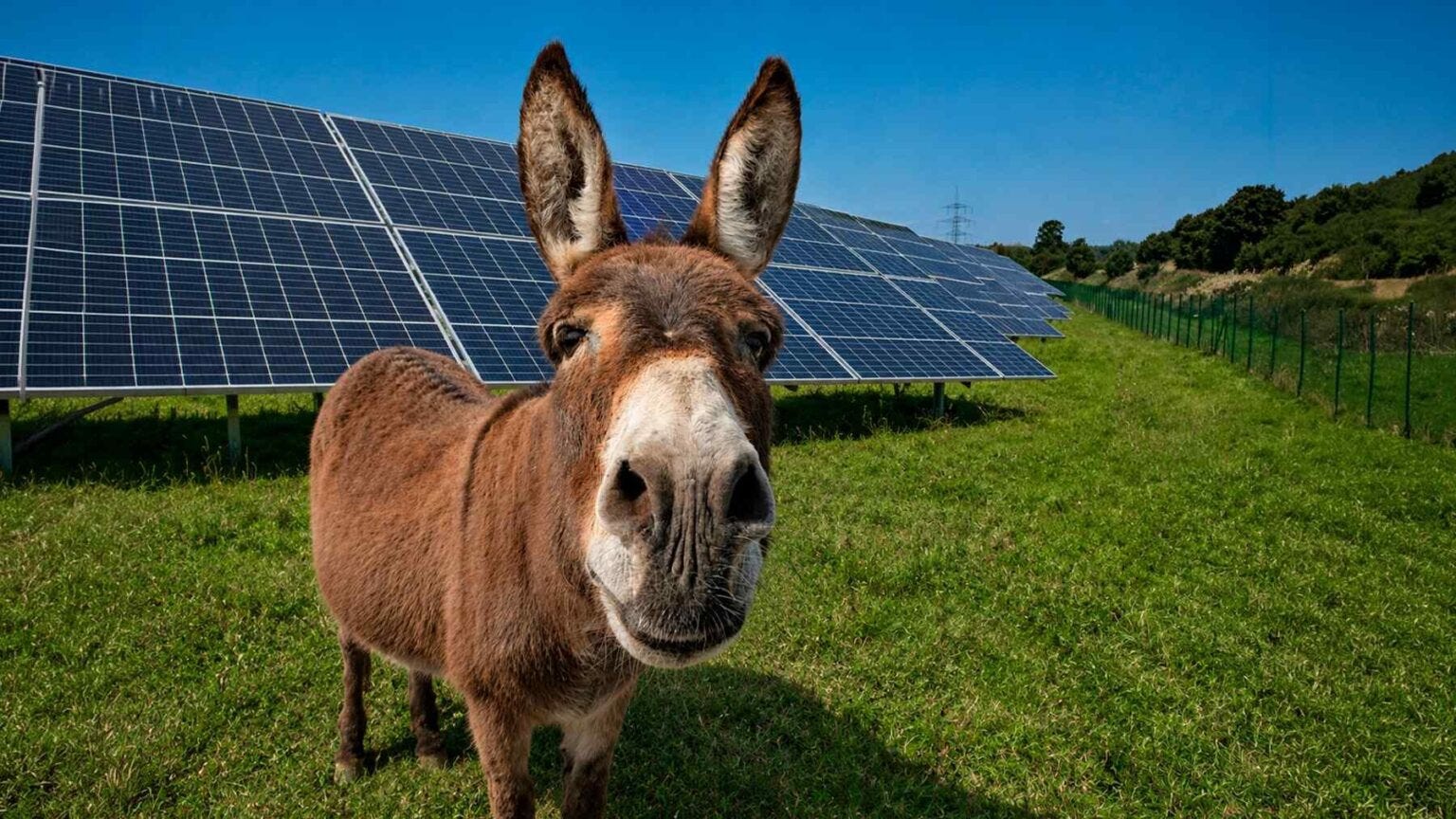
Burrito for President!
Thank you, Bill McKibben, for keeping US informed. Please continue. Sending this on to people I hope will “do something.”